JSTOR Global Plants Home
  • Home
  • Browse
  • About
  • Access
  • Account
    • Saved Items
    • Profile
  • Log in

Global Plants

Skip to Main Content
  • JSTOR Global Plants Home
  • Global Plants

    • Browse
    • About
    • Access
    • Account
      • Saved Items
      • Profile
Log in
  • Browse
  • About
  • Access
  • Account
    • Saved Items
    • Profile
Advanced Search

Compilation
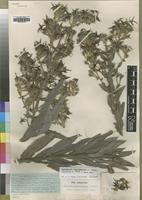
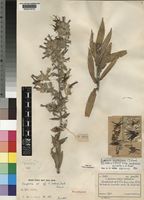
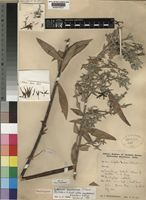
Cystostemon hispidissimus

3 Images see all

Type of Vaupelia hispidissima S.Moore [family BORAGINACEAE]
Cystostemon hispidissimus (S.Moore) A.G.Mill. & Riedl [family BORAGINACEAE]
Previous
Next

Name

Identification
Vaupelia hispidissima S.Moore [family BORAGINACEAE ] Cystostemon hispidissimus (S.Moore) A.G.Mill.&Riedl [family BORAGINACEAE ] (stored under name); Verified by Miller,A.G.,
Related name
  • Vaupelia medusa
  • Vaupelia hispidissima
  • Vaupelia unrecorded
  • Cystostemon hispidissimus

Flora

Entry for Cystostemon hispidissimus S. Moore Miller & Riedl [family BORAGINACEAE]
Herbarium
Royal Botanic Gardens, Kew (K)
Collection
Flora Zambesiaca
Resource Type
Reference Sources
Entry From
FZ, Vol 7, Part 4, page 59, (1990) Author: E. S. Martins (Trichodesma by R. K. Brummit)
Names
Cystostemon hispidissimus S. Moore Miller & Riedl [family BORAGINACEAE], in Notes Roy. Bot. Gard. Edin. 40: 19, t. 6 fig. e, f (1982). Type from Angola.
Vaupelia hispidissima S. Moore [family BORAGINACEAE], in Journ. of Bot. 58: 49 (1920). Type as above.
Information
An erect, perennial, several-stemmed herb up to 2.5 m. high; stems usually unbranched, more or less ribbed, scabrous to shortly hispid and with scattered spreading bristles 2–3 mm. long. Leaves sessile or subsessile, 6–12 x 1.0–1.8 cm., the superior ones progressively smaller, dense, narrowly lanceolate, hispid above and below or shaggy below, acute at apex, rounded to subcordate at base, almost leathery, with the secondary nerves not or hardly perceptible. Inflorescence a more or less dense terminal panicle with indumentum of short dense rigid hairs mixed with very numerous spreading yellowish bristles 2–3 mm. long. Bracts numerous, ovate to lanceolate, rounded to subcordate at base. Calyx densely bristly outside, sericeous inside with long ascending hairs; lobes narrowly triangular to narrowly lanceolate, 7–11 x 1.5–2.0 mm. when flower newly expanded, increasing to 15 mm. long in fruit. Corolla blue, violet or lilac; tube 6–7 mm. long, funnel-shaped, glabrous outside; lobes 12–20 x 2.5–4.0 mm., narrowly ovate-lanceolate with attenuate apices, more or less sericeous outside, mainly to the apex and with some appressed short hairs inside. Stamens inserted near the apex of the corolla tube; anthers 6–10 mm. long, minutely scabrous; terminal appendages 6–11 mm. long; filaments c. 2 mm. long with basal appendage densely hairy. Style 22–29 mm. long. Fruit usually of 1–2 well developed nutlets, the other ones abortive; nutlets c. 5 x 4 x 4 mm., ovoid, verrucose, keeled to the apex, rounded at back.

Related Materials

  • Terms and Conditions
  • Privacy Policy
  • Cookie Policy
  • Cookie Settings
  • Accessibility
  • Help
  • Contact Us
  • Facebook
  • Twitter
ITHAKA

JSTOR is part of ITHAKA, a not-for-profit organization helping the academic community use digital technologies to preserve the scholarly record and to advance research and teaching in sustainable ways.

©2000-2026 ITHAKA. All Rights Reserved. JSTOR®, the JSTOR logo, JPASS®, Aluka®, and ITHAKA® are registered trademarks of ITHAKA.

╳