JSTOR Global Plants Home
  • Home
  • Browse
  • About
  • Access
  • Account
    • Saved Items
    • Profile
  • Log in

Global Plants

Skip to Main Content
  • JSTOR Global Plants Home
  • Global Plants

    • Browse
    • About
    • Access
    • Account
      • Saved Items
      • Profile
Log in
  • Browse
  • About
  • Access
  • Account
    • Saved Items
    • Profile
Advanced Search

Compilation
Cyphia mazoensis

7 Images see all

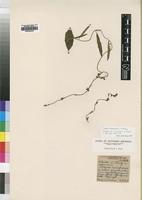
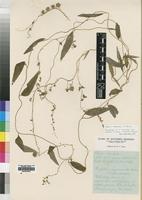
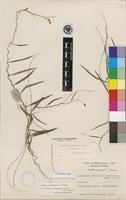
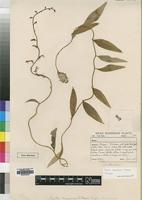
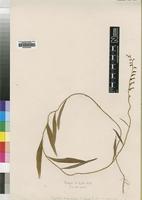
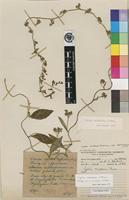
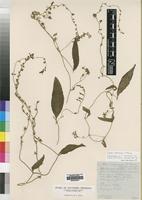
Isotype of Cyphia rivularis E.Wimm. [family LOBELIACEAE]
Isosyntype of Cyphia mazoensis E.Wimm. var. stellaris [family LOBELIACEAE]
Syntype of Cyphia mazoensis S.Moore [family LOBELIACEAE]
Holotype of Cyphia mazoensis S.Moore [family LOBELIACEAE]
Type of Cyphia mazoensis S.Moore [family LOBELIACEAE]
Isosyntype of Cyphia mazoensis E.Wimm. var. stellaris [family LOBELIACEAE]
Previous
Next

Name

Identification
Cyphia mazoensis E.Wimm. [family LOBELIACEAE ] (stored under name); Verified by Thulin,M.,
Related name
  • Cyphia rivularis
  • Cyphia mazoensis

Flora

Entry for Cyphia mazoensis S. Moore [family LOBELIACEAE]
Herbarium
Royal Botanic Gardens, Kew (K)
Collection
Flora Zambesiaca
Resource Type
Reference Sources
Entry From
FZ, Vol 7, Part 1, page 116, (1983) Author: M. Thulin
Names
Cyphia rivularis E. Wimmer [family LOBELIACEAE], in Kew Bull. 7: 145 (1952); in tom. cit.: 942, fig. 37A (1968). Type: Zimbabwe, Inyanga Distr., Inyangombi R. above Nyamziwa Falls, Chase 590 (BM; SRGH; W, holotype).
Cyphia mazoensis var. stellaris E. Wimmer [family LOBELIACEAE], in Kew Bull. 7: 144 (1952). Syntypes from Zimbabwe: Umtali Distr., Stapleford, Hopkins in GHS 12477 (SRGH; W, syntype), Cecil Heights Commonage, Chase 2139 (BM; LISC; SRGH; W, syntype) and Inyanga Distr., Pungwe Valley, Chase 894 (BM; LISC; SRGH; W, syntype).
Cyphia gamopetala Duvign. & Denaeyer [family LOBELIACEAE], in Bull. Soc. Roy. Bot. Belg. 96: 133 (1963). Type from Zaire (lost).
Cyphia rogersii subsp. rogersii [family LOBELIACEAE], sensu E. Wimmer, tom. cit.: 947, fig. 39 (1968) pro parte.
Cyphia subscandens E. Wimmer [family LOBELIACEAE], tom. cit.: 949, fig. 40B(1968), nom. invalid. Orig. coll.: Zambia, Sunzu Mt., Bullock 2184 (K; W).
Cyphia mazoensis forma angustior E. Wimmer [family LOBELIACEAE], tom. cit.: 950 (1968), nom. invalid. Orig. coils, from Zimbabwe: Umtali Distr., Banti Forest, Exell, Medonca & Wild 210 (BM; SRGH) and Melsetter Distr., lona Farm, Chase 4860 (SRGH).
Cyphia mazoensis S. Moore [family LOBELIACEAE], in Journ. Bot., Lond. 45: 46 (1907). — E. Wimmer in Engl., Pflanzenr. IV. 276 c: 949, fig. 42B (1968). — Binns, H.C.L.M.: 25 (1969) pro parte. — Thulin in Bot. Notiser 131: 461 (1978). Type: Zimbabwe, Mazoe, Eyles 231 (BM, holotype; SRGH).
Information
Twining and climbing, rarely suberect herb from 20 cm. up to 1 m. or more long, from a tuber c. 3–5 x 1·5–2 cm.; stem not or sparsely branched, ribbed, glabrous below, ± densely, very finely crisped pubescent at least in the upper part of the inflorescence region. Leaves petiolate, up to 35–140 x (2)10–30(45) mm., linear to ovate, acute to acuminate at the apex, attenuate to cuneate at the base, glabrous; margin serrate or serrate–crenate, flat or ± revolute; venation prominent beneath; petiole up to 5–15 mm. long. Raceme twining, lax, up to 50 cm. long, sometimes with ± short and few–flowered branches below, or with 2–3–flowered branches almost to the top of the inflorescence; pedicels 1·5–18 mm. long, very shortly crisped pubescent; bracts up to 5–20 mm. long; bracteoles 1–3·5 mm. long, sometimes denticulate. Hypanthium broadly obconical, 10–nerved, shortly crisped pubescent at least towards the base. Calyx–lobes narrowly triangular, erect to ± reflexed, 1·5–8 mm. long, glabrous, with 1–8 pairs of teeth at the margin, basal teeth sometimes very long and resembling the calyx–lobes. Corolla 8–18 mm. long, white, greenish yellow, pink, purple or red, tubular with 5 subequal lobes, or at least the 2 lower petals sometimes becoming ± free; all petals linear, short pubescent outside at least towards the base, pubescent inside, at least towards the base. Stamens 3·5–6 mm. long; filaments linear, free, pubescent; anthers narrowly elliptic–oblong, 1·2–2 mm. long, with a short tuft of hairs at the apex and ± sparsely pubescent with hairs 0·1–0·2 mm. long or rarely glabrous on the back of the connective. Ovary semisuperior; style 2·5–5 mm. long. Capsule subglobose, inferior part 2–5 mm. long, membranous, with 10 distinct nerves connected by weak transversal nerves; valves 4–9 mm. long. Seeds almost round in outline, flat, 2·4–3·2 x 2–2·8 mm., broadly winged, brown.
Habitat
In woodland and grassland, usually on rocky ground.
Range
Probably also in Shaba.
Distribution
Zimbabwe N vicinity of Umvukwe Mts., near Toroshanga pass, 24–27.iv.1948, Rodin 4426 (K; MO; PRE; SRGH).Zambia N Chilongowelo, Plain of Death, 1460 m., 19.v.1955, Richards 4159A (BR; K; LISC).Zimbabwe S Belingwe Distr., Sikanajena Kop, 1100 m., 4.v.1973, Biegel & Simon 4295 (K; LISC; MO; SRGH).Zimbabwe E Umtali Distr., Inyamatshira Mt., 1520 m., 2. iv.1955, Chase 5538 (BM; BR; COI; K; LISC, SRGH).Zimbabwe C Wedza Mt., 19.ii.1963, Wild 5997 (K; LISC; MO; SRGH).Zambia S Mazabuka Distr., Mabwingombe Hills, 5.ii.1960, White 6826 (K).Zambia C Lusaka, 5.ii.1965, Fanshawe 9177 (BR; K; SRGH).Mozambique MS Chimanimani Mts., near St. George’s Cave between The Saddle and Poacher’s Cave, 1520 m., 12.iv.1967, Grosvenor 394 (K; LISC; SRGH).Malawi C Kongwe Mt., near Dowa, 1525 m., 18.ii.1959, Robson 1655 (K; LISC; SRGH).
Notes
Specimens from E. Zimbabwe with branched inflorescences, where the flowers are 2–5 together in the leaf–axils have been called Cyphia rivularis or C. mazoensis var. stellaris. There are too many intermediates for this distinction to be maintained, at least at the specific level. C. mazoensis is very closely related to C, rogersii S. Moore (1918) in Transvaal, which differs mainly by being glabrous on the outside of the corolla and by always being glabrous on the back of the connectives. They might perhaps be treated as subspecies.

Related Materials

  • Terms and Conditions
  • Privacy Policy
  • Cookie Policy
  • Cookie Settings
  • Accessibility
  • Help
  • Contact Us
  • Facebook
  • Twitter
ITHAKA

JSTOR is part of ITHAKA, a not-for-profit organization helping the academic community use digital technologies to preserve the scholarly record and to advance research and teaching in sustainable ways.

©2000-2026 ITHAKA. All Rights Reserved. JSTOR®, the JSTOR logo, JPASS®, Aluka®, and ITHAKA® are registered trademarks of ITHAKA.

╳