

Compilation
Cyperus hystricinus
1 Images see all
Name
Identification
Related name
- Cyperus hystricinus
Common name
- Bristly flatsedge, Flora of North America Vol. 23
Flora
Entry for Cyperus hystricinus Fernald [family CYPERACEAE]
Herbarium
Flora of North America (FNA)
Collection
Flora of North America
Resource Type
Reference Sources
Entry From
Flora of North America, Vol 23,
Names
Cyperus hystricinus Fernald [family CYPERACEAE], Rhodora, 8: 127. 1906
Cyperus retrofractus (Linnaeus) Torrey var. hystricinus (Fernald) Kükenthal [family CYPERACEAE]
Information
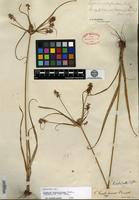
Herbs, perennial, cespitose, with well-developed rhizomes. Culms trigonous, 30–100 cm × 2–4 mm, basally cormlike, glabrous. Leaves flat to broadly V-shaped, 20–70 cm × 4–6 mm, glabrous except for marginal prickles. Inflorescences: spikes loosely to densely ovoid, oblong (2 times long as wide), 10–12 × 6–9 mm; rays 6–11, 1–16 cm, glabrous; bracts 5–10, ascending at 30–45°, flat, 6–25 cm × 3–6 mm; rachilla persistent, wings 0.5 mm wide, covering nearly entire length of achene. Spikelets (20–)40–100(–120), proximal spikelets reflexed somewhat, distal ones divaricate, ± terete, lanceoloid, 6–6.8 × 1–1.4 mm; floral scales persistent, 1–2(–3), appressed, golden brown, lanceolate, laterally 5–6-ribbed, 3.8–4.9 × 1.4–1.6 mm, apex mucronate, mucro at most 0.3 mm. Flowers: anthers 1–1.3 mm; styles 0.8–1 mm; stigmas 2–3 mm. Achenes brown, sessile, linear, 2.5–2.8 × 0.5–0.7 mm, apex obtuse, apiculate, surfaces muriculate.
Phenology Fruiting
summer
jun
fall
oct
nov
jul
aug
sep
Altitude range
0–200 m;
Distribution
USA Ala.USA Ark.USA Del.USA D.C.USA Ga.USA La.USA Md.USA Miss.USA Mo.USA N.J.USA N.C.USA Tex.USA Va.
Discussion
Cyperus hystricinus resembles C. plukenetii and C. retrofractus; it can be readily distinguished from both by its glabrous culms. Overly mature specimens of C. lancastriensis are frequently misidentified as C. hystricinus; C. hystricinus may be confirmed by its narrow, nearly glabrous leaves and bracts, golden brown spikelets, longer, narrower achenes, and elongated rhizome internodes (to 15 mm vs. 5 mm in 76. C. lancastriensis).