JSTOR Global Plants Home
  • Home
  • Browse
  • About
  • Access
  • Account
    • Saved Items
    • Profile
  • Log in

Global Plants

Skip to Main Content
  • JSTOR Global Plants Home
  • Global Plants

    • Browse
    • About
    • Access
    • Account
      • Saved Items
      • Profile
Log in
  • Browse
  • About
  • Access
  • Account
    • Saved Items
    • Profile
Advanced Search

Compilation
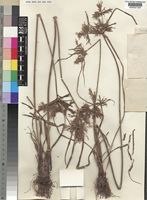
Cyperus congensis

5 Images see all

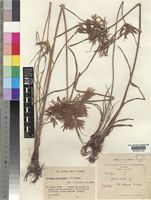
Isotype of Cyperus distans L.f. var. obliquus Cherm. [family CYPERACEAE]
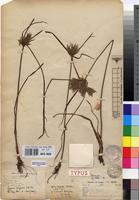
Isotype of Cyperus congensis C.B. Clarke [family CYPERACEAE]
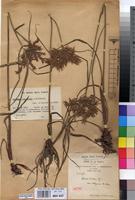
Type of Cyperus congensis C.B.Clarke [family CYPERACEAE]
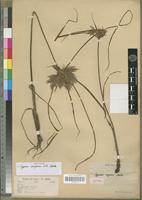
Isotype of Cyperus distans L.f. var. obliquus Cherm. [family CYPERACEAE]
Previous
Next

Name

Identification
Cyperus congensis C.B.Clarke [family CYPERACEAE ] (stored under name); Verified by Not on sheet,
Related name
  • Cyperus distans
  • Cyperus congensis
Common name
  • leia-fimbe (NWT) (SIERRA LEONE, SUSU), Burkill, H.M. 1985. The useful plants of west tropical Africa, Vol. 1

Flora

Entry for CYPERUS congensis C. B. Clarke [family CYPERACEAE]
Herbarium
Royal Botanic Gardens, Kew (K)
Collection
Flora of Tropical Africa
Resource Type
Reference Sources
Entry From
Flora of Tropical Africa, Vol 8, page 264, (1902) Author: (By C. B. Clarke.)
Names
CYPERUS congensis C. B. Clarke [family CYPERACEAE]
Information
Glabrous. Stems erect, 8–12 in. long, rather stout, at the base thickened into woody bulbs, at the top round-trigonous. Leaves often longer than the stem, 1/8– 1/6 in. broad. Umbel simple, contracted; rays 3–6, 0– 3/4 in. long; bracts 4–6, often 6–14 in. long. Spikelets densely clustered, dusky-brown, 1 by 1/16– 1/12 in., 30-flowered; rhachilla scarcely winged. Glumes loosely spreading, obtuse; margins scarious. Style hardly any; branches 3, long. Nut 2/3 the length of the glume, oblong, pyramidal at each end, trigonous, brown.
Distribution
Congo South Central Bussindi, 1000 ft., Hens, 391!

Related Materials

  • Terms and Conditions
  • Privacy Policy
  • Cookie Policy
  • Cookie Settings
  • Accessibility
  • Help
  • Contact Us
  • Facebook
  • Twitter
ITHAKA

JSTOR is part of ITHAKA, a not-for-profit organization helping the academic community use digital technologies to preserve the scholarly record and to advance research and teaching in sustainable ways.

©2000-2026 ITHAKA. All Rights Reserved. JSTOR®, the JSTOR logo, JPASS®, Aluka®, and ITHAKA® are registered trademarks of ITHAKA.

╳