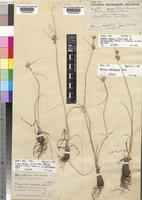
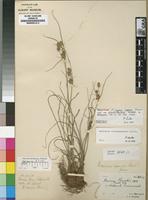
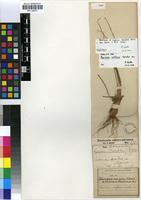
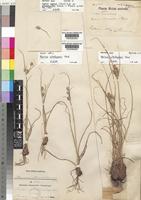
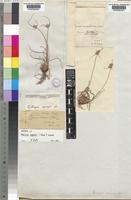
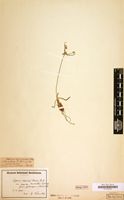
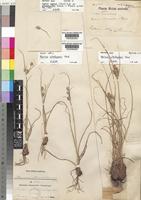
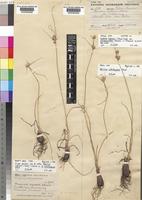
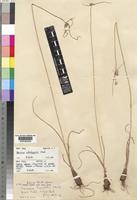
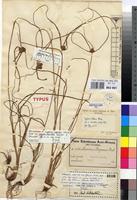
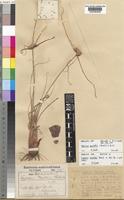
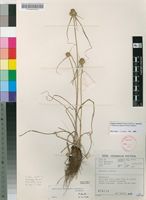
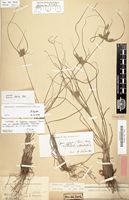
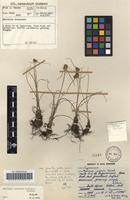
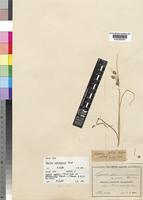
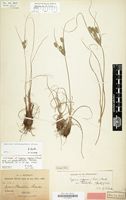
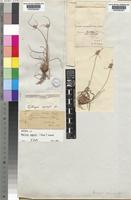
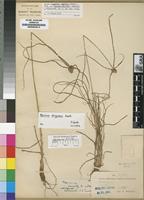
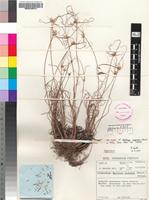
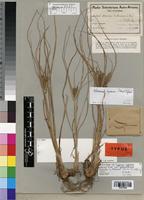
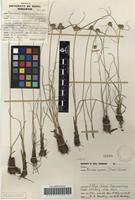
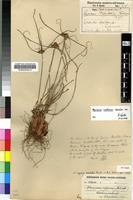
glabrous; stolons 0; stem 4–14 in. long, medium or slender, trigonous at the top, smooth; leaves often as long as the stem, 1/8– 1/6 in. broad, weak; basal sheaths inflated, brown; stem-base appearing much thickened, oblong or ovoid; inflorescence subcapitate, straw-coloured, of 1–4 short cylindric spikes, sessile or a ray rarely up to 1/3 in. in length; bracts 3–5, similar to the leaves, lowest 3–5 in. long; spikelets numerous, densely packed in each spike, 1/8– 1/5 in. long, ovoid, of 4 glumes, dehiscing from a cushion below the lowest (3rd) fertile glume; fertile glume ovoid, hardly keeled, subacute, strongly 13-ribbed throughout its breadth; rhachilla above the fertile glume winged, usually topped by a rudimentary sterile glume (4th), the whole remarkably simulating a single glume, but there are no ribs on its sides; less often the upper (4th) glume is more developed, bearing a male flower; very occasionally the 4th glume bears a bisexual flower (not perfecting a nut), but is then much smaller than the 3rd; stamens 3–2; anthers oblong, not crested; nut 3/4 the length of the glume (or more), obtusely trigonous, broadly ellipsoid, black; style 1/2 the length of the nut; branches 3, linear, long, much exserted from the glume. null