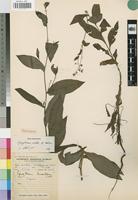
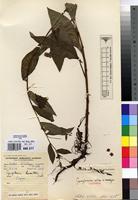
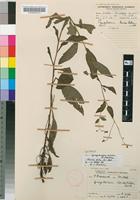
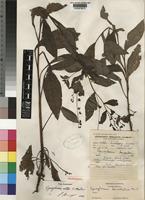
An erect biennial or perennial herb up to 0.8 m. high, unbranched or but little branched to the apex; stem subwoody below the rosette of leaves, herbaceous above, with ± scattered spreading bristles. Basal leaves (and inferior cauline ones) whithered and much eroded at flowering, with the persistent petiolar pan up to 6 cm. long, hispid above and below. Cauline leaves up to 16 x 4 cm., lanceolate, acute to shortly acuminate, long and narrowly attenuate at base into a petiolar portion up to 6 cm. long, the superior ones smaller, without petiolar portion and gradually grading into bracts of the inflorescence, shortly and sparsely hispid on both surfaces and villous to the base, membranous to papery. Cymes lax, few-flowered, slender, arranged in a lax, leafy, sometimes ± corymbiform panicle. Pedicels 1.5–3.5 mm. long, elongated up to 8 mm. and somewhat recurved in fruit. Calyx 2.0–2.5 mm. long, scabrous to shortly bristly outside on the tube and on the back, ciliate at margins, divided to near the base; lobes ovate or triangular-ovate to oblong-obovate, subacute to rounded at apex, up to 3 mm. long in fruit. Corolla glabrous, white but blue at mouth; tube 1.2–1.5 mm. long, ± campanulate; lobes 1.0–2.0 x 0.8–1.5 mm., subcircular to oblong, rounded at apex, ± spreading; fornices 0.4 x 0.6 mm., ± trapeziform, papillose. Stamens inserted about the middle of the corolla tube; anthers c. 0.5 mm. long, elliptic; filaments c. 0.2 mm. long. Style c. 0.5 mm. long, up to 1.0 mm. and persisting after nutlets are shed; stigma subcapitate. Fruit c. 8 mm. in diam.; nutlets c. 3.5 x 2.5 mm. (without glochids), ovate, flattened, not marginate, not much densely covered with columnar glochids up to 0.7 mm. long, much smaller and very scattered on lower surface, with cicatrice c. 1.0 x 1.0 mm., deltoid, seemingly free from the style.