

Compilation
Cynoglossum inyangense
1 Images see all
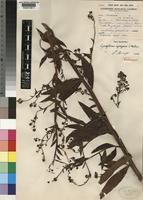
Name
Identification
Cynoglossum inyangense E.S.Martins [family BORAGINACEAE ] (stored under name); Cynoglossum coeruleum Hochst. ex A.DC. [family BORAGINACEAE ]
Related name
- Cynoglossum inyangense
- Cynoglossum coeruleum
Flora
Entry for Cynoglossum inyangense E. Martins [family BORAGINACEAE]
Herbarium
Royal Botanic Gardens, Kew (K)
Collection
Flora Zambesiaca
Resource Type
Reference Sources
Entry From
FZ, Vol 7, Part 4, page 59, (1990) Author: E. S. Martins (Trichodesma by R. K. Brummit)
Names
Cynoglossum inyangense E. Martins [family BORAGINACEAE], in Garçia de Orta, Sér. Bot.9, 1–2: 76 (1988). Type: Zimbabwe, Nyanga (Inyanga) Downs, Wild 4934 (K, holotype).
Information
A tall herb; stem (or stems) ascending, strong, hollow at least when dry, much branched, angular and ± laterally compressed, dark brown, retrorsely hispid below and acroscopicaly appressed hispid to the apex; branches with indumentum similar to the stem. Basal and lower leaves not seen. Mid cauline leaves sessile, up to 10.5(14) x 3.0 cm., lanceolate, acute and with an acumen 2.0–3.5 mm. long, constituted by the involute margins, obtuse to attenuate at base into a very short petiolar portion very narrowly decurrent on the stem, the upper ones much smaller, hispid both above and below but retrorsely below, at least on the proximal part, papery, brown-greenish to dark brown above, olivaceous to light brown below when dry; midrib, the 2 lateral nerves (triplinerved leaf) and the 4–7 secondary nerves on each side of the midrib impressed above and prominent below. Cymes ± lax, many-flowered, two at the ends of the branches, usually with a flower at the fork, the whole forming a large lax panicle. Pedicels 1.0–3.0(3.5) mm. long, not or little recurved in fruit. Calyx 1.5–2.5 mm. long, campanulate, scabrous to hispid or sometimes subglabrous but always ± ciliate at margins, usually divided to near base; lobes irregular in size and in shape, ovate or triangular to obovate or even spatulate, acute to rounded at apex. Corolla glabrous, deep blue; tube 1.2–1.7 mm. long, cylindrical; lobes 1.3–1.5 x 1.4–1.9 mm., subcircular to obovate-spatulate, apex rounded, with undulate margins, spreading; fornices c. 0.5 x 0.7 mm., ± trapeziform, slightly bilobed. Stamens inserted between 1/2 and the upper 3/4 of the tube; anthers c. 0.7 mm. long, elliptic; filaments c. 0.2 mm. long. Style c. 0 7 mm. long; stigma subcapitate. Fruit c. 6 mm. in diam.; nutlets c. 3.0 x 2.5 mm. (without glochids), ovate to subcircular in dorsal view, flattened, not marginate, outer surface flat or concave, densely glochidiate and with some minute glochids mixed with the others, glochids narrowly conical the largest ones up to 0.7 mm. long, on the margin; cicatrice c. 1 x 1 mm., deltoid.
Habitat
In rocky submontane grassland
Range
Appears to be confined to Nyanga region
Altitude range
1900–2250 m.
2250
1900
Distribution
Zimbabwe E Nyanga (Inyanga), World's View, fl. & fr. 16.ii.1974, Burrows 334 (SRGH).