JSTOR Global Plants Home
  • Home
  • Browse
  • About
  • Access
  • Account
    • Saved Items
    • Profile
  • Log in

Global Plants

Skip to Main Content
  • JSTOR Global Plants Home
  • Global Plants

    • Browse
    • About
    • Access
    • Account
      • Saved Items
      • Profile
Log in
  • Browse
  • About
  • Access
  • Account
    • Saved Items
    • Profile
Advanced Search

Compilation
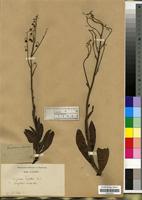
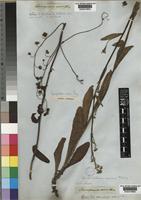
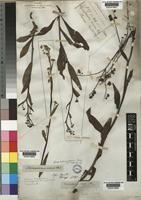
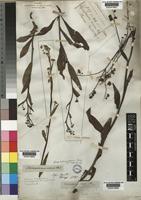
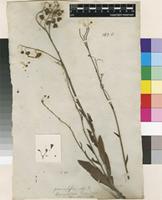
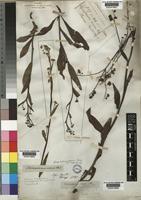
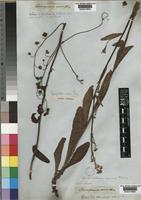
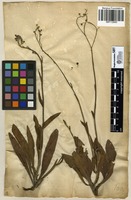
Cynoglossum hispidum

8 Images see all

Filed as Cynoglossum hispidum Thunb. [family BORAGINACEAE]
Cynoglossum hispidum Thunb. [family BORAGINACEAE]
Filed as Cynoglossum paniculatum Poepp. [family BORAGINACEAE]
Cynoglossum hispidum Thunb. [family BORAGINACEAE]
Filed as Cynoglossum hispidum Thunb. [family BORAGINACEAE]
Previous
Next

Name

Identification
Cynoglossum hispidum Thunb. [family BORAGINACEAE ] (stored under name); Verified by Not on sheet,
Related name
  • Cynoglossum hispidum
  • Echinospermum enerve
  • Cynoglossum enerve
  • Cynoglossum paniculatum

Flora

Entry for Cynoglossum hispidum Thunb. [family BORAGINACEAE]
Herbarium
Royal Botanic Gardens, Kew (K)
Collection
Flora Zambesiaca
Resource Type
Reference Sources
Entry From
FZ, Vol 7, Part 4, page 59, (1990) Author: E. S. Martins (Trichodesma by R. K. Brummit)
Names
Cynoglossum hispidum Thunb. [family BORAGINACEAE], Prodr. Pl. Cap.: 34 (1794). —C.H. Wright in F.C. 4, 2: 14 (1904). —Brand in Engl., Pflanzenr. 78 [IV, 252]: 146 (1921). —Weimarckin Bot. Notis. 1940: 65 (1940). Type from S. Africa.
Information
A biennial herb up to 0.6 m. high; stems erect, unbranched, hispid (retrorsely to the lower part), solitary or few arising from the remains of the rosette of old basal leaves. Lamina 5.0–7.5( 15?)x 0.8–1.3(2.5?) cm. in inferior cauline leaves, progressively smaller to the apex, not seen in basal leaves, oblong to oblanceolate, shortly hispid above and below, the bristles with bulbous base and surrounded by cystolith areas, apex acute to obtuse, base narrowed into a petiole in basal and inferior cauline leaves, obtuse in the cauline sessile ones, the margins entire; midnerve slightly depressed above, prominent below and with the bristles retrorse on basal pan, the secondary nerves little perceptible or even undiscernible. Cymes arranged in a terminal thyrse. Flowers with pedicels c. 1.5 mm. long, retroflexed and elongated in fruit up to 15(25) mm. Calyx lobed to near base, lobes 1.2–2.0 x 0.6–0.8 mm., ovate-lanceolate, acute, hispid outside, glabrous inside, apparently 1-nerved. Corolla tube 1.4–1.7 mm. long, widely cylindric, glabrous; limb cleft to near base; lobes 0.6–0.8 x 0.4–0.6 mm., rounded at apex, almost veinless; fornices subquadrate. Stamens inserted at c. 0.8 mm. from the base of corolla tube; anthers c. 0.8 mm, long, ovate; filaments 0.2–0.3 mm. long. Stigma globulose, terminal on the short style. Nutlets c. 3.5 x 3 mm., ovoid, free from the style, not marginate, densely and uniformly covered with short and strong glochids.
Habitat
In grasslands along streams.
Distribution
Zimbabwe E Nyanga Distr., c. 22 km. from Nyanga to Rusapi, 1800 m., fl. & fr. 9.xi.1930, Fries, Norlindh & Weimarck 2787 (LISU).
Distribution (external)
S. Africa

Related Materials

  • Terms and Conditions
  • Privacy Policy
  • Cookie Policy
  • Cookie Settings
  • Accessibility
  • Help
  • Contact Us
  • Facebook
  • Twitter
ITHAKA

JSTOR is part of ITHAKA, a not-for-profit organization helping the academic community use digital technologies to preserve the scholarly record and to advance research and teaching in sustainable ways.

©2000-2026 ITHAKA. All Rights Reserved. JSTOR®, the JSTOR logo, JPASS®, Aluka®, and ITHAKA® are registered trademarks of ITHAKA.

╳