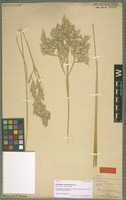
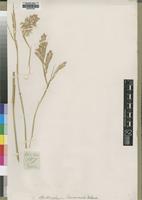
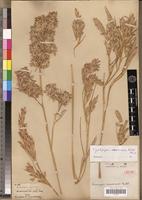
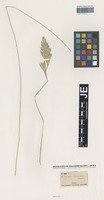
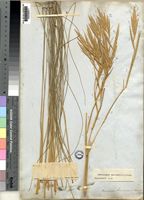
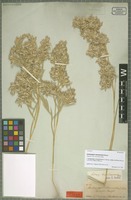
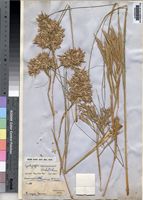
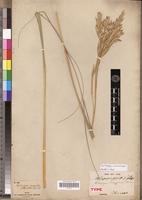
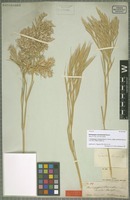
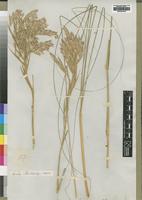
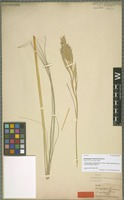
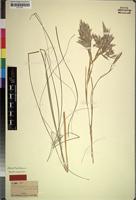
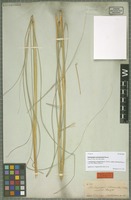
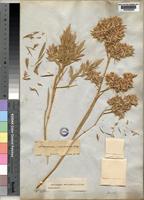
Perennial. Culms tall, erect, terete, glabrous. Leaf-sheaths compressed, very narrow, the lowest up to 8 in. long, firm and tough, slightly rough, glabrous, subglaucous; ligules oblong, membranous, up to over 2 lin. long, ciliolate; blades very narrow, linear, almost setaceous upwards, up to over 1 ft. by 1/2–1 lin., folded or the upper flat, rigid, glabrous, the basal scaberulous on all the nerves, glaucous, very closely nerved, midrib slender. Spatheate panicle decompound, obovoid, 1–1 1/2 ft. by 1/2 ft., formed upwards of more or less dense balls of racemes and spathes; lower internodes up to 5 in. long, uppermost quite short; lower primary branches from 1 1/2 to 3/4 ft. long with usually 2 very long slender internodes below the first ramifications, those above the middle rapidly decreasing in length and forming 2-rayed tiers, each ray distichously divided up-wards, resembling (before flowering) a laterally compressed ovate to ovate-lanceolate simple or compound spike 3–4 in. long with a succession of up to 10 spathes enclosing tiers of up to 3 rays; rays somewhat unequal, finely filiform, up to 4 lin. long; spathes narrowly lanceolate, rather firm, herbaceous with broader membranous to hyaline margins upwards, subglaucous, with a short herbaceous subulate to setaceous blade or bladeless, 2–2 3/4 in. long. Spatheoles narrowly lanceolate, acute, thinly herbaceous, up to 9 lin. long, pale green; peduncle 2 lin. long, filiform, tips truncate. Racemes 2-nate, divaricate, at length epinastically deflexed, 5–7 lin. long, white-villous, one subsessile, the other with a bare base, under 1 lin. long; bases pubescent to villous, with truncate ciliate or ciliolate tips, that of the subsessile raceme stout, 1/2 lin. long, the adjacent pedicel short, barrel-shaped and hard; fertile joints linear, not quite 1 1/2 lin. long, densely hairy on the back and the angles, hairs increasing upwards to over 1 1/2 lin., tips obscurely cupular; adjacent pedicels similar to the joints. Homogamous pair of spikelets 1 at the base of each raceme or only of the subsessile, sometimes the second also homogamous, but the sessile spikelet intermediate as to shape and awn. Fertile spikelets linear to lanceolate-linear, acuminate, including the callus 3–3 1/2 lin. long, glabrous, pale green, darker or brownish upwards; callus short, obtuse, shortly bearded. Glumes equal, chartaceous; lower shallowly concave on the back below the middle, keels acute, almost winged, minutely scaberulous, intracarinal nerves 4 in the acumen, the inner 2 short, the outer decurrent close to the keels; upper glume narrowly lanceolate in profile, very acute, 1-nerved, keel narrowly winged upwards. Lower floret reduced to a linear-oblong nerveless hyaline ciliolate valve, slightly shorter than the glumes. Upper floret hermaphrodite: valve very narrow, shortly 2-fid, sublinear and hyaline below the insertion of the awn, 1 1/2 in. long, lobes ovate-lanceolate, acute, ciliate; awn a straight bristle up to 3 lin. long, not or shortly exserted from the spikelet. Anther 1 1/4 lin. long. Pedicelled spikelet ♂, linear-lanceolate, subacute, 3–3 1/2 lin. long, glabrous, brownish or reddish; glumes unequal, lower chartaceous with very many close intracarinal nerves, upper shorter, membranous, 3-nerved; valve equal to the upper glume, linear-oblong, obtuse, 2-nerved, ciliolate; anthers 1 1/2 lin. long.