JSTOR Global Plants Home
  • Home
  • Browse
  • About
  • Access
  • Account
    • Saved Items
    • Profile
  • Log in

Global Plants

Skip to Main Content
  • JSTOR Global Plants Home
  • Global Plants

    • Browse
    • About
    • Access
    • Account
      • Saved Items
      • Profile
Log in
  • Browse
  • About
  • Access
  • Account
    • Saved Items
    • Profile
Advanced Search

Compilation
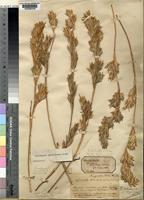
Cymbopogon densiflorus

9 Images see all

Filed as Cymbopogon densiflorus (Steud.) Stapf [family POACEAE]
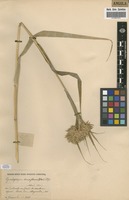
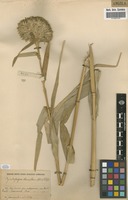
Isotype of Cymbopogon schoenanthus unrecorded var. stypticus Rendle [family POACEAE]
Type of Andropogon stypticus Welw. [family POACEAE]
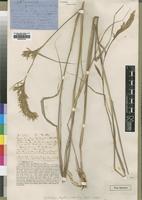
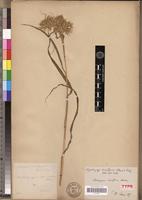
Filed as Cymbopogon densiflorus (Steud.) Stapf [family POACEAE]
Type of Andropogon densiflorus Steud. [family POACEAE]
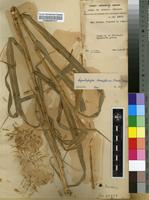
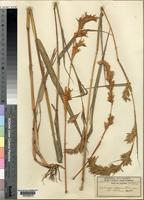
Filed as Cymbopogon densiflorus (Steud.) Stapf [family POACEAE]
Type of Andropogon densiflorus Steud. [family POACEAE]
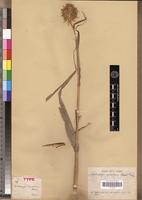
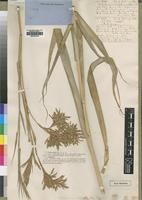
Cymbopogon densiflorus (Steud.) Stapf [family POACEAE]
Previous
Next

Name

Identification
Andropogon densiflorus Steud. [family POACEAE ] Cymbopogon densiflorus (Steud.) Stapf [family POACEAE ] (stored under name);
Related name
  • Andropogon stypticus
  • Andropogon densiflorus
  • Cymbopogon schoenanthus
  • Cymbopogon densiflorus

Flora

Entry for CYMBOPOGON densiflorus Stapf [family POACEAE]
Herbarium
Royal Botanic Gardens, Kew (K)
Collection
Flora of Tropical Africa
Resource Type
Reference Sources
Entry From
Flora of Tropical Africa, Vol 9, page 1, (1917) Author: (By O. STAPF.)
Names
CYMBOPOGON densiflorus Stapf [family POACEAE]
CYMBOPOGON stypticus Fritsch [family POACEAE], in Bull. Herb. Boiss. 2me sér. i. 1099.
CYMBOPOGON Schœnanthus Rendle var. densiflorus [family POACEAE], in Cat. Afr. Pl. Welw. ii. 154, and (the former) in Journ. Linn. Soc. Bot. xl. 225.
CYMBOPOGON Schœnanthus Rendle var. stypticus [family POACEAE], in Cat. Afr. Pl. Welw. ii. 154, and (the former) in Journ. Linn. Soc. Bot. xl. 225.
Andropogon densiflorus Steud. [family POACEAE], Syn. Pl. Glum. i. 386; Jardin, Herbor. Côte Occ. Afr. 4.
Andropogon stypticus Welw. [family POACEAE], Syn. Expl. 27.
Andropogon Schœnanthus Hack. subsp. densiflorus [family POACEAE], in DC. Monogr. Phan. vi. 611; Durand & Schinz, Consp. Fl. Afr. v. 722; and Études Fl. Congo, 317; De Wild. & Durand, Contr. Fl. Congo, i. 76; Reliq. Dewevr. 254,and Études Fl. Baset Moyen-Congo, ii. 9. Th. & Hél. Durand, Syll. Fl. Congol. 626; Eyles in Trans. Roy. Soc. S. Afr. v. 297.
Information
Perennial (always?). Culms erect, stout, up to 4 lin. in diam. below, up to 8- (and probably more) noded, simple below the false panicle, terete, smooth, sometimes waxy below the nodes, glabrous. Leaf-sheaths terete, tight, glabrous, smooth, the lowest moderately firm; ligules very short, truncate, glabrous; blades linear to linear-lanceolate from a usually wider and sometimes rounded base, long-tapering to a fine point, to over 1 ft. long and 1/2 to over 1 in. wide, glaucous, glabrous, smooth except on the upper margins; midrib rather slender, primary lateral nerves 7–11 on each side, fine, slightly raised. Spatheate panicle very dense to quite compact, ovoid to oblong or subglobose, 3 1/2 to over 6 in. by 2 1/2–4 in.; lowest internodes 1–2 1/2 in. long, the following rapidly decreasing; lowest primary branches undivided at the base with the first internode as long as or slightly shorter than the subtending sheath, like the following repeatedly divided above it, their divisions forming much contracted mixed tiers, those of the last order usually 4–2-rayed; rays finely filiform, 2–1 1/2 lin. long, glabrous; subtending sheaths with normal but shorter blades; spathes lanceolate, acutely and often finely acuminate, thinly subherbaceous, 6–8 lin. long, green, then turning reddish or brownish. Spatheoles similar but scarious, narrower and somewhat shorter; peduncles 2–1 1/2 lin. long, very slender, glabrous. Racemes 2-nate, slender, olive-green to brownish, 4–7 lin. long, obscurely hairy, one sessile or subsessile, the other with a glabrous base up to 3/4 lin. long; joints linear, very slender, 1 lin. long, glabrous on the back, very shortly ciliate except for a few cilia about 1 lin. long below the tips, tips obliquely auriculate, cupular, auricles very broad; lowest joint of sessile raceme much shorter and stout; pedicels very similar, the lowest of the sessile raceme short but very slightly stouter, free from the adjacent joint and eciliate. Homogamous pair 1 at the base of the sessile raceme. Fertile spikelets oblong, subobtuse, 1 1/2 lin. long, glabrous; callus very small, obtuse, minutely bearded. Glumes subchartaceous, equal; lower subtruncate, flat on the back, with a fine or obscure median groove, keels acute or very obscurely winged; intracarinal nerves and oil-streaks one on each side of the groove, the former usually very delicate, the latter fusing in the tip, usually obscure, unless at length turning brown; upper glume narrow in profile, acutely keeled above, 1-nerved. Lower floret reduced to an oblong obtuse sub-2-nerved sparingly ciliolate valve. Upper floret hermaphrodite: valve reduced to a subchartaceous extremely slender stipe usually without any lobes and passing gradually into a fine bristle, including it 2 1/2 lin. long. Anthers 3/4 lin. long. Pedicelled spikelets neuter, lanceolate to lanceolate-oblong, 1 1/3 lin. long; lower glume subherbaceous with 5–3 intracarinal nerves; upper membranous, white, 1- to sub-3-nerved; florets usually quite suppressed.
Distribution
Gaboon Lower Guinea Munda; Sibange, Soyaux, 422! banks of the Gaboon River, Jardin, Griffon du Bellay.Congo Lower Guinea N'Gove, Dybowski, 83, and without precise locality, Brazza & Thollon.Congo Lower Guinea Lower Congo, Cabra; Malela, in the Boma district, Laurent; Lutete, Hens, 243! in dry savannas near Stanley Pool, Demeuse, Dewèvre; Kisantu, Gillet, 312.Angola Lower Guinea Golungo Alto; Sange, Welwitsch, 2952! 3006! 7238! Pungo Andongo; banks of the River Cuanza, Welwitsch, 2725! thickets between Candumba and Mangue, Welwitsch, 7428! Malange, Gossweiler, 808! Tumbo Campole, Mechow, 551. Benguella; country of the Ganguellas and Benguellas, Gossweiler, 2574! 3119! Mossamedes; Huilla, very common in meadows and thickets throughout the country, Welwitsch, 1321! 7526! Dekindt.German East Africa Mozamb. Dist. without precise locality, Busse, 738!Nyasaland Mozamb. Dist. without precise locality, Whyte !Congo South Central Stanleyville, Pynaert. Eastern Province; Kavala Islands in Lake Tanganyika, Carson, 2! Katanga; Tschinsenda, Rogers, 10785!
Notes
Leaves and rhizome pleasantly aromatic; according to Welwitsch, smelling almost like citron, used as a tonic and styptic by the natives.

Related Materials

  • Terms and Conditions
  • Privacy Policy
  • Cookie Policy
  • Cookie Settings
  • Accessibility
  • Help
  • Contact Us
  • Facebook
  • Twitter
ITHAKA

JSTOR is part of ITHAKA, a not-for-profit organization helping the academic community use digital technologies to preserve the scholarly record and to advance research and teaching in sustainable ways.

©2000-2026 ITHAKA. All Rights Reserved. JSTOR®, the JSTOR logo, JPASS®, Aluka®, and ITHAKA® are registered trademarks of ITHAKA.

╳