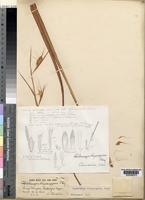
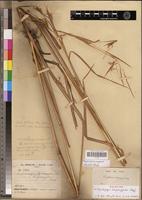
Annual, up to over 5 ft. high. Culms erect, stout, terete, glabrous and smooth. Leaf-sheaths terete, tight, firm, the lower villous-hirsute along the margins or all over in the upper part; ligules scarious, rounded, up to 1 1/2 lin. long; blades linear from a long-attenuated base (in the lowest leaves almost reduced to the stout whitish midrib) tapering to a fine point, up to over 2 1/2 ft. long and 5 lin. wide, rigid, subglaucous or reddish, rough above, very scabrid on the more or less revolute margins, loosely or sparingly hirsute on both sides, often coarsely bearded above the ligules; primary lateral nerves about 4 on each side, prominent above. Spatheate panicle elongated, lax, up to over 3 ft. long: primary internodes up to 8, the lowest 3 very long (the lowest up to 1 ft.), the upper rapidly decreasing; tiers few- to 11-rayed mixed or simple, the lowest compound rays up to 2 ft. long and 4–5-noded, the simple 2–2 1/2 in. long; subtending leaves (except the uppermost) with well-developed blades, resembling the preceding leaves. Spatheoles narrowly lanceolate, acuminate, 2–3 in. long, glaucous-reddish, glabrous, scarious, at length tightly inrolled; peduncles filiform, enclosed in the spatheole or laterally exserted and strongly recurved during flowering, at length more or less straightened and terminally exserted (by up to 1 in.), pubescent upwards, with long spreading tubercle-based hairs from the curvature. Racemes not or only slightly spreading, at length epinastically deflexed (always ?), rather dense, about 1–1 1/4 in. long, 11–13-awned per pair, silky, fulvous or almost rufous, the lower subsessile, the upper with a filiform base, 1 1/2 lin. long, both bases dark, glabrous or hairy in the fork, shortly auricled; joints filiform, to over 1 1/2 lin. long, obliquely truncate, densely and very shortly ciliate, lower cilia white, upper fulvous, or almost all fulvous; pedicels very similar but slightly longer and produced into a short linear or subulate auricle. Homogamous pair of spikelets 1 at the base of the lower raceme only. Fertile spikelets oblong, 2 1/4–3 lin. long, pale (apart from the hairs); callus very short, obtuse, minutely bearded. Glumes equal, lower subchartaceous, minutely truncate and fulvously hairy on the back, margins very narrowly involute below, inflexed above with rigidly ciliolate keels, nerves 10–12, intracarinal 4–6, fainter downwards; upper glume lanceolate-oblong, acute, 3-nerved, hairy above, ciliate upwards. Lower floret reduced to a linear-oblong hyaline obtuse reversedly ciliate valve of the same length as the glumes. Upper floret hermaphrodite: valve stipitiform, minutely 2-toothed; awn 1 1/2 in. long, column fulvously pubescent. Anthers 1 1/2–2 lin. long. Pedicelled spikelets ♂, oblong-lanceolate, 2 3/4–3 1/2 lin. long, resembling the sessile spikelets in colour and hairiness; lower glume acute, 11-nerved; upper as in the sessile spikelets; valves hyaline, ciliate, 2 1/2–2 3/4 lin. long, the lower linear-oblong, 3-nerved, the upper spathulate to linear-lanceolate from a very narrow base.