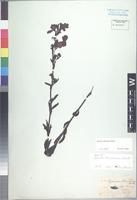
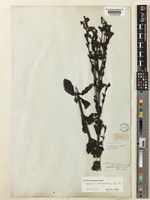
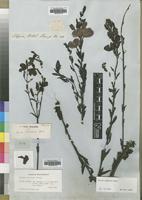
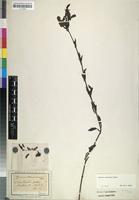
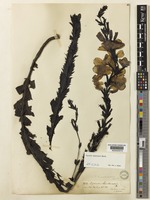
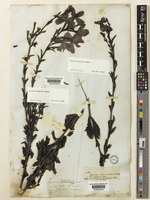
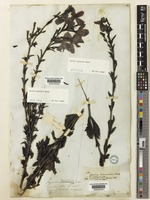
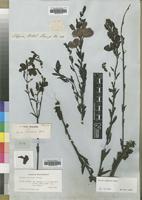
an erect herb, robust, scabrid-puberulous or nearly glabrous, 1–4 ft. high, dusky when dried, simple or sparingly branched, apparently perennial; stem somewhat angular, furrowed, leafy; branches suberect, ascending or subdivaricate; leaves opposite or almost verticillate in threes or subopposite or the upper alternate, lanceolate, oblong or elliptical, acute or apiculate, wedge-shaped or somewhat narrowed towards the base, sessile or subsessile, subentire to incise-dentate, 1–3 in. long, 1/10–1 in. broad; flowers rather numerous, pink or white, 7/8–1 1/4 in. long; racemes terminal; pedicels short or up to 3/4 in. long; bracteoles 2, sublinear, filiform or subulate, 1/6– 1/3 in. long, adnate to the base of the calyx; calyx prismatic-cylindrical, 10-ribbed, turbinate at the base, 5-dentate, nearly glabrous or hispid-scabrid at least along the ribs and margin, 3/4–1 in. long, 1/8– 1/6 in. in diam.; tube straight, 1/2– 3/4 in. long lying close to the corolla-tube; teeth lanceolate, acute or acuminate, somewhat unequal, 1/8– 1/4 in. long, somewhat spreading; corolla-tube subcylindrical, shortly exserted, curving near the apex, funnel-shaped at the apex, glabrous outside or nearly so, pilose within below, 7/8–1 1/8 in, long; limb spreading, 1 1/2–2 1/4 in. in diam.; lobes broadly obovate, 2/3–1 in. long, the two upper connate higher up than the rest; filaments bearded; anthers apiculate, obtuse at the base, glabrous; ovary fleshy, ovoid-conical; style about 1/6 in. long; stigma not much thickened. Krauss in Flora, 1844, 834; null