

Compilation
Cyathea thomsonii
1 Images see all
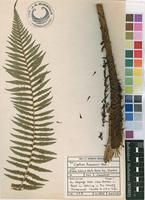
Name
Identification
Cyathea thomsonii Baker [family CYATHEACEAE ] (stored under name); Verified by Burrows, J.E.,
Related name
- Cyathea thomsonii
Flora
Entry for Cyathea thomsonii Baker [family CYATHEACEAE]
Herbarium
Royal Botanic Gardens, Kew (K)
Collection
Flora of Tropical East Africa
Resource Type
Reference Sources
Entry From
Flora of Tropical East Africa, page 1, (2005) Author: Peter J. Edwards
Names
Cyathea thomsonii Baker [family CYATHEACEAE], in J.B. 19: 180 (1881); Schelpe in F.Z. Pterid.: 72, t. 21c (1970); Holttum in K.B. 36 (3): 473 (1981); Burrows, S. Afr. Ferns: 86, fig. 84 (1990). Type: Tanzania, Njombe/Rungwe District: lower plateau N of Lake Nyassa, Thomson s.n. (K!, holo.)
Cyathea zambesiaca Baker [family CYATHEACEAE], in Ann. Bot. 8: 121 (1894). Type: Malawi, Buchanan s.n. (K!, holo.)
Alsophila thomsonii (Bak.) Tryon [family CYATHEACEAE], in Contr. Gray Herb. 200: 31 (1970); Pic. Serm. in Webbia 27: 403 (1972)
Information
Trunk erect, to 2.5 m tall and to 15 cm in diameter. Fronds to 2 m long and 80 cm wide; stipe to 30 cm long; basal scales to 20 mm long, dark reddish brown, with narrow thin fringed edges. Lamina elliptic in outline, 2-pinnate to 3-pinnatifid with varying degrees of dissection, to 2 m long, a few pairs of lower pinnae gradually reduced and more widely spaced, lowest 5–12 cm long; largest pinnae commonly 40 cm long, pinnules 10–14 mm apart; largest pinnules commonly to 6 cm long by 1 cm wide, basal 1–4 pairs with stalks less than 1 mm long, the others sessile, lobed to 1 mm from the costa, often some pinnules gradually contracted towards the base, but in all cases the basal pair of lobes conspicuously longer; costules 2.5–3 mm apart: veins commonly 4–5 pairs except in basal lobes, on largest fronds 7–8 pairs, lower ones forked near the costa. Scales and hairs on pinnules: on lower surface of costae many light brown hairs and narrow brown scales, the scales grading distally to hairs; costules and veins bearing pale less contorted to stiff, spreading and almost antrorse hairs on the lower surface. Sori near costules; up to 5 in basal lobes, usually one in each distal lobe, indusia at first forming deep cups with an uneven rim, soon breaking irregularly. Fig. 2: 3, 3A, B (page 10).
Range
DISTR. T 4, 7
Altitude range
1200–2250 m
Distribution
TANZANIA Mpanda District Mahali Mts, Sisaga, Aug. 1958, Newbould & Jefford 1932!;TANZANIA Iringa District N part of Gologolo Mts, Sep. 1970, Thulin & Mhoro 960!;TANZANIA Rungwe District Rungwe, Sep. 1912, Stolz 884!
Distribution (external)
Congo (Kinshasa)
Angola
Zambia
Malawi
Mozambique
Zimbabwe
Notes
Uses. None recorded from our area. Conservation Widespread; least concern (LC). A variable species sometimes confused with C. dregei with which it is reported tohybridize freely [Burrows 86 (1989)]. It can be distinguished from C. dregei by its narrower and shorter caudex; the stipe scales on the sheath and the fusion of many pinnules to the pinna-midrib. Holttum (1981) in his discussion of the four African groups he recognised, stated C. thomsonii looks like a hybrid or a series of hybrids between C. dregei and one or more species of his fourth group (the simply pinnate species). Stolz 907 from Tanzania, Rungwe District: Kyimbila seems a natural hybrid C. thomsonii Bak.x C. dregei Kunze.