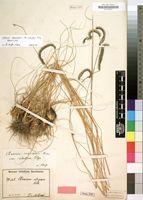
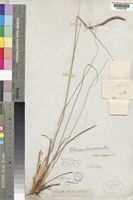
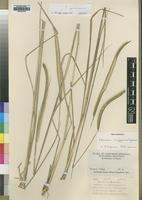
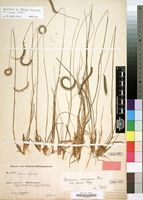
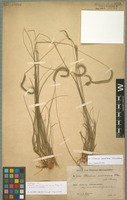
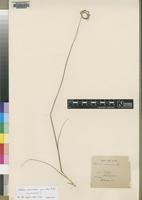
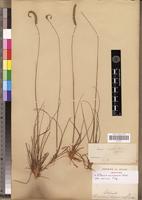
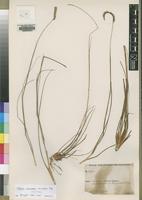
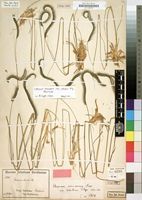
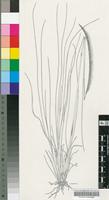
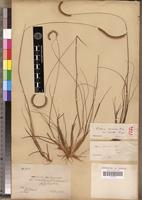
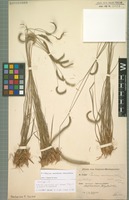
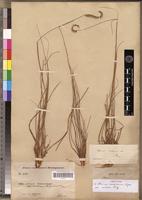
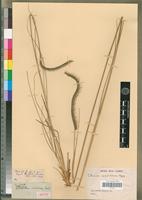
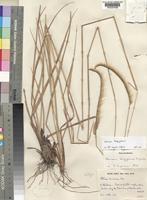
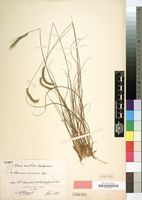
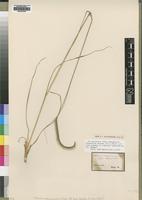
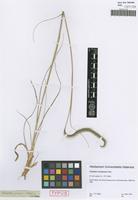
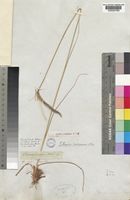
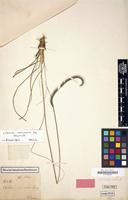
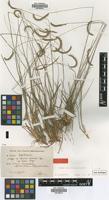
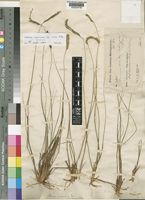
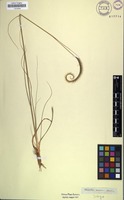
perennial, densely tufted; culms erect, 1 1/2–2 ft. long, villous or pubescent below the spike, 2-noded, upper 2 internodes very long, at length more or less exserted; leaves mostly crowded at the base; sheaths tight or the upper subtumid, striate, glabrous, smooth, the basal ones compressed, persistent; ligule extremely short, minutely ciliolate; blades narrow, linear, acute, the basal up to 1 ft. by 1/2–1 lin., flat or setaceously convolute, smooth below, scaberulous above and along the margins; spikes solitary, rarely paired, olive-grey, 3–10 in. by 2–2 1/2 lin.; spikelets 3–3 1/2 lin.; lower glume ovate, acuminate, about 1 1/2 lin. long, keel coarsely scabrid; upper glume broadly lanceolate, acuminate, 3–3 1/4 lin. long, scabrid to hispidulous, tubercled on the nerves, 2-nerved, middle nerve emitting an obliquely erect awn, not produced beyond it or faintly so or percurrent and even excurrent, side-nerve percurrent or excurrent, awn scarcely exceeding the glume; lowest valve barren, more or less cuspidate or apiculate, ciliate, 1 1/2 lin. long, awn 2–4 lin. long; second valve slightly longer, narrower, the cilia prolonged into a beard above the middle with a rudimentary pale and 2 perfect or imperfect stamens, awn 3–3 1/2 lin. long; third valve like the second, but more delicate, shorter awned, with a 2-keeled glabrous pale, and a hermaphrodite flower; fourth valve glabrous, delicate, 1 1/2 lin. long, with a broad 2-nerved delicate pale and 2 stamens; lodicules up to 1/3 lin. long; anthers of the hermaphrodite flower 1 1/2 lin. long, those of the male usually shorter, anther-cells acute; styles very short; stigmas 1 1/2 lin. long. null