

Compilation
Cryptosepalum busseanum
4 Images see all
Name
Identification
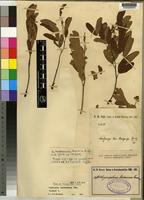
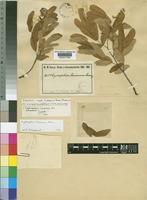
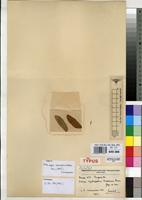
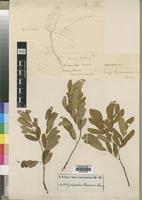
Isotype of Cryptosepalum busseanum Harms [family LEGUMINOSAE ] Cryptosepalum maraviense Oliv. [family LEGUMINOSAE ] (stored under name);
Related name
- Cryptosepalum bussianum
- Cryptosepalum busseanum
- Cryptosepalum maraviense
Flora
Entry for CRYPTOSEPALUM maraviense Oliv. [family LEGUMINOSAE-CAESALPINIOIDEAE]
Herbarium
Royal Botanic Gardens, Kew (K)
Collection
Flora of Tropical East Africa
Resource Type
Reference Sources
Entry From
Flora of Tropical East Africa, page 1, (1967) Author: J. P. M. Brenan
Names
CRYPTOSEPALUM maraviense Oliv. [family LEGUMINOSAE-CAESALPINIOIDEAE], F.T.A. 2: 304 (1871); L.T.A.: 744 (1930); T.T.C.L.: 100 (1949); J. Léon. in F.C.B. 3: 487, fig. 42/A, t. 34 (1952); F.F.N.R.: 122, fig. 25 (1962); Duvign. & Brenan in K.B. 20: 12 (1966). Type: Mozambique, Maravi country W. of Lake Nyasa, Kirk (K, holo.!, BR, iso.(fragm.)!)
CRYPTOSEPALUM dasycladum Harms [family LEGUMINOSAE-CAESALPINIOIDEAE], in E.J. 30: 319, fig. (1901); L.T.A.: 744 (1930); T.T.C.L.: 99 (1949). Types: Tanganyika, Mbeya District, Mbozi Hill, Goetze 1384 (B, SYN. †, BR, isoSYN. !) & Unyika, Kananda village, Goetze 1438 (B, SYN. †)
CRYPTOSEPALUM pulchellum Harms [family LEGUMINOSAE-CAESALPINIOIDEAE], in E.J. 30: 321 (1901); L.T.A.: 745 (1930); T.T.C.L.: 100 (1949). Type: Tanganyika, Rungwe District, Kiwira [Kivira] valley, Untali, Goetze 1472 (B, holo. †, BR, P, iso. !)
CRYPTOSEPALUM boehmii Harms [family LEGUMINOSAE-CAESALPINIOIDEAE], in E.J. 33: 156 (1902); L.T.A.: 743 (1930); T.T.C.L.: 99 (1949). Type: Tanganyika, ? Mpanda District, between Pa-kakombue [? pa-Kabombue] and Mdani [? Ndani], Boehm 17a (B, holo. †)
CRYPTOSEPALUM busseanum Harms [family LEGUMINOSAE-CAESALPINIOIDEAE], in E.J. 33: 156 (1902); L.T.A.: 743 (1930); T.T.C.L.: 99 (1949). Type: Tanganyika, Songea District, Madjanga-Kwa-Bagaya, Busse 633 (B, holo. †, BM, BR, EA, K, iso. !)
Information
Suffrutex with a thickened woody rhizomatous rootstock, whence (or from basal part of previous year’s stems) arise often tufted erect annual stems, each ± 4–40 cm. high, simple and with a single terminal inflorescence. Leaves with rhachis 3–14 cm. long; leaflets in 3–16(–18) pairs, ± asymmetrically oblong-lanceolate, oblong-elliptic or oblong, the upper ones sometimes with an obovate tendency, 0.6–8 cm. long, 0.2–2.7 cm. wide, rounded to subacute or occasionally acute at apex, asymmetric at base, usually glabrous or sub-glabrous, sometimes ± pubescent. Racemes terminal, single, 2–12(–16) cm. long, glabrous to ± pubescent. Bracteoles elliptic, 5–15 mm. long, 2.5–8 mm. wide. Sepals 1–6, small or very small. Petal 1, 7–9 mm. long, sometimes in addition with 1(–2, fide F.C.B.) smaller ones 3.5–5 mm. long and 1–1.5 mm. wide. Stamens usually 3, rarely with up to 2(–3) smaller fertile ones also; very rarely all subequal. Pods mostly 1–2-seeded, 2.5–5 cm. long, 1.5–2.7 cm. wide. Seeds 1.2–1.3 cm. long, 0.7–1.0 cm. wide. Figs. 43 & 44, p. 202.
Range
DISTR. T4, 6–8
Altitude range
300–1600 m.
Distribution
TANGANYIKA Ufipa District Sumbawanga, new road, Aug. 1952, Groome 38 !TANGANYIKA Rungwe District Kyimbila, Stolz 1679 !TANGANYIKA Songea rest-camp, 12 Sept. 1956, Semsei 2458 !
Distribution (external)
; Congo Republic
Mozambique
Malawi
Zambia
Rhodesia
Notes
I am in agreement with the opinion expressed by J. Léonard (in F.C.B. 3: 490), that this is an exceedingly variable species and that the synonymy given above is consequently justified. As Léonard states, the variable characters are fairly constant on each individual plant, and are thus likely to be frequently genetically controlled. This variation is seen in the indumentum, length of stem, number, size and shape of leaflets, length of inflorescence, size of bracteoles, and to some extent in number of sepals, petals and stamens.I am at present of the opinion that Cryptosepalum maraviense, taken in a very wide sense, is a taxonomic group which evolutionary is in full cry, so to speak. While the range of variation is, as I have implied, enormous, and there are some correlations between different characters and with geography, they appear to be still very imperfect, and generally cannot be used as a basis for clearly defining subspecies within the Flora area. Given sufficient material, however, I strongly suspect that they might be proved statistically.I have had the recent privilege of examining the splendid range of material brought together by Professor P. Duvigneaud (for whose unstinted help and advice I am most grateful) at the Universite Libre at Brussels, and I have attempted to analyse in a general way the variation occurring in the Flora area, using that material as a basis, together with that at Kew, the East African Herbarium and the British Museum (Natural History).The variations, discussed more fully in K.B. 20: 12–23 (1966), may be grouped in the following way:—1.1. Annual shoots (measured to end of inflorescence) very commonly more than 15 cm. high; basal scales on shoots mostly congested at base, sometimes a few spaced out towards lower leaves, but upper ones usually not much elongated; number of leaflets variable: 22.1. Number of pairs of leaflets not more than 8 (occurring in T4, 6, 7, 8): 33.1. Leaflets up to 13 mm. or less wide (“ variant A ”, partly): 44.1. Stems with short straight spreading hairs (e.g. Hoyle 1090, Songea District, etc.; typical C. maraviense also comes here)4.2. Stems with longer straight spreading hairs (e.g. Hoyle 1050, Kigoma District)4.3. Stems with short crisped or curled ± appressed hairs (e.g. Schlieben 1507, Ulanga District)3.2. Leaflets, at least some of them, up to 15 mm. or more wide, see fig. 44/2 (“ variant C ”): 55.1. Stems with short straight spreading hairs (e.g. C. H. N. Jackson 107, Kigoma District, Milne-Redhead & Taylor 9510, Songea District, etc.)5.2. Stems with longer straight spreading hairs (e.g. C. H. N. Jackson 106, ? Kigoma District, etc.; C. busseanum also comes here)5.3. Stems with short crisped or curled ± appressed hairs (e.g. Semsei 155 in F.H. 2586, Mpanda District, etc.)5.4. Stems glabrous or almost so (e.g. Wigg in F.H. 1495, Kigoma District, Eggeling 6371, Tunduru District, etc.)2.2. Number of pairs of leaflets, of some leaves at least, 10–13; leaflets not more than 13 mm. wide (“ variant A ”, partly, occurring in T7, only): 66.1. Stems with rather long straight spreading hairs (e.g. Stolz 435, Rungwe District, etc.; C. pulchellum also comes here)6.2. Stems glabrous or nearly so (e.g. Newbould ds Jefford 2378, 2792, Mpanda District, Stolz 1763, Rungwe District, etc.)1.2. Annual shoots short, not more than 15 cm. high (measured to end of inflorescence); basal scales on stem congested at base and also spaced out between base and lowest leaves, the upper scales usually considerably longer and bigger than the lower; some leaves always with 9 or more pairs of leaflets, see fig. 44/1 (occurring in T7 only): 77.1. Annual shoots usually very short, usually 4.5 cm. or less from base of shoot to base of inflorescence (“ variant F ”, e.g. B. D. Burtt 5852, Tanganyika, Iringa District, between Sao Hill and Iheme)7.2. Annual shoots usually 5 cm. or more from base of shoot to base of inflorescence (“ variant E ”): 88.1. Stems ± densely spreading-hairy (e.g. Stolz 1679, Rungwe District, etc.; C. dasycladum apparently also comes here)8.2. Stems glabrous (e.g. Greenway 3620, Mbeya District)I must emphasize the fact that this key is, at least in its primary divisions, attempting the impossible by separating imperfectly separated tendencies and inconstant correlations, although I suspect that the two primary divisions represent a natural divergence.The greatest range of variation in C. maraviense, taken in its widest sense, is found in Zambia, the Congo and Angola. As one might therefore expect, in Tanganyika the Province T7 shows the most diversity, the variation decreasing both northwards and eastwards from Lake Nyasa.In T4 forms with few pairs of leaflets occur exclusively (range 3–7 pairs, 22 gatherings), and the same applies in T6 and 8 (range 4–8 pairs, 9 gatherings). In T7 the range is 4–13 pairs, with 11 gatherings. I suspect that the few pairs found to the N. and E. represent a gradual dwindling of genetic potential within the species rather than any clearly defined entity.It is of interest to that in spite of the rather narrow range in number of pairs of leaflets found in T4, and also that the leaflets here have a distinct tendency to be large, there is a full range of stem indumentum in this province, from glabrous to quite densely though shortly pubescent.The other variations confined to T7 are sufficiently indicated in the key above.It may seem invidious to give so much space here to the variation of a single species. C. maraviense in its widest sense is, however, certainly one of the most protean species in all tropical Africa. It would also be a splendid subject for investigation by modern taxonomic techniques—statistical study of populations, cytology and experimental cultivation.