JSTOR Global Plants Home
  • Home
  • Browse
  • About
  • Access
  • Account
    • Saved Items
    • Profile
  • Log in

Global Plants

Skip to Main Content
  • JSTOR Global Plants Home
  • Global Plants

    • Browse
    • About
    • Access
    • Account
      • Saved Items
      • Profile
Log in
  • Browse
  • About
  • Access
  • Account
    • Saved Items
    • Profile
Advanced Search

Compilation
Croton subgratissimus

9 Images see all

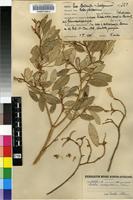
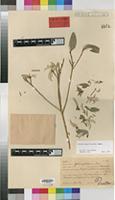
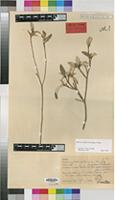
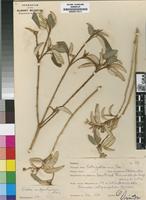
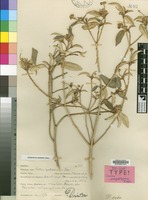
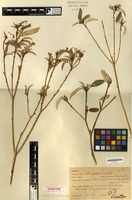
Syntype of Croton subgratissimus Prain [family EUPHORBIACEAE]
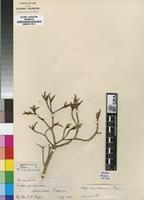
Isosyntype of Croton subgratissimus Prain [family EUPHORBIACEAE]
Croton subgratissimus Prain [family EUPHORBIACEAE]
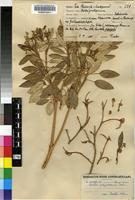
Syntype of Croton subgratissimus Prain [family EUPHORBIACEAE]
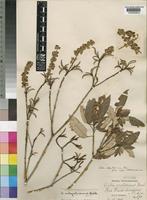
Isosyntype of Croton subgratissimus Prain [family EUPHORBIACEAE]
Previous
Next

Name

Identification
Croton subgratissimus Prain [family EUPHORBIACEAE ] Verified by Not on sheet, Croton gratissimus Burch. [family EUPHORBIACEAE ] (stored under name); Verified by Not on sheet,
Related name
  • Croton subgratissimus
  • Croton gratissimus

Flora

Entry for CROTON subgratissimus Prain [family EUPHORBIACEAE]
Herbarium
Royal Botanic Gardens, Kew (K)
Collection
Flora Capensis
Resource Type
Reference Sources
Entry From
Flora Capensis, Vol 5, Part 2, page 216, (1925) Author: (By N. E. BROWN, J. HUTCHINSON and D. PRAIN.)
Names
CROTON subgratissimus Prain [family EUPHORBIACEAE], in Kew Bulletin, 1913, 79;—Prain in Dyer, Fl. Trop. Afr. vi. i. 1050.
CROTON gratissimus Pax [family EUPHORBIACEAE], in Engl. Jahrb. x. 35, not of Burch.
Information
large shrub or small tree, 16–25 ft. high; twigs slender, angled, covered with silvery scales when young; leaves fragrant, alternate, distinctly to long-petioled, coriaceous, penninerved, ovate-lanceolate, acuminate, emarginate, base minutely narrow-cordate, margin entire, 1 1/4–3 1/2 in. long, 1/2–1 1/4 in. wide, pale green, dull and uniformly persistently stellate-puberulous above, densely clothed with silvery scales with a few rusty scales intermixed beneath; lateral nerves 12–14 a side, neither impressed above nor raised beneath; petiole 1/2–1 1/2 in. long, densely silvery and rusty lepidote, with 2 sessile glands underneath at point of attachment with blade; stipules subulate, usually short, occasionally very long, scaly; racemes androgynous, 1–4 in. long, at ends of shoots; rhachis densely silvery and rusty scaly; bracts subulate-lanceolate, scaly; male pedicels 1–2 lin. long, densely scaly; sepals ovate, obtuse, 1 1/4 lin. long, coriaceous, densely scaly outside, closely puberulous within; petals ovate, rather shorter than sepals, scaly externally, margins villous, glabrous within; disc-glands thick, glabrous; stamens 15–20, filaments thinly pubescent below; receptacle pilose; female sepals as in male; petals oblong-lanceolate, obtuse, scaly outside, hairy within; disc minute; ovary densely clothed with fringed scales; styles spreading, 6–8-partite, glabrous; capsule very slightly 3-lobed, 1/3 in. long, densely scaly; seeds smooth. null
Range
Also in Hereroland and Tropical North-west Bechuanland.
Distribution
KALAHARI REGION Bechuanaland; Lobatsi, Marloth, 3331! Transvaal; Wonderboom Poort, Rehmann, 4552! Miss Leendertz, 270! Rogers, 233! Burtt-Davy, 1849! Magaliesberg Range, Zeyher, 2767! Pretoria, Fehr, 54!
Notes
Very nearly allied to C. gratissimus, Burch., which it most resembles in general facies, and to C. zambesicus, Müll. Arg., which it most resembles as regards flowers, but equally distinct from both in having leaves which are persistently stellate-puberulous above.

Related Materials

  • Terms and Conditions
  • Privacy Policy
  • Cookie Policy
  • Cookie Settings
  • Accessibility
  • Help
  • Contact Us
  • Facebook
  • Twitter
ITHAKA

JSTOR is part of ITHAKA, a not-for-profit organization helping the academic community use digital technologies to preserve the scholarly record and to advance research and teaching in sustainable ways.

©2000-2026 ITHAKA. All Rights Reserved. JSTOR®, the JSTOR logo, JPASS®, Aluka®, and ITHAKA® are registered trademarks of ITHAKA.

╳