JSTOR Global Plants Home
  • Home
  • Browse
  • About
  • Access
  • Account
    • Saved Items
    • Profile
  • Log in

Global Plants

Skip to Main Content
  • JSTOR Global Plants Home
  • Global Plants

    • Browse
    • About
    • Access
    • Account
      • Saved Items
      • Profile
Log in
  • Browse
  • About
  • Access
  • Account
    • Saved Items
    • Profile
Advanced Search

Compilation
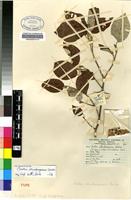
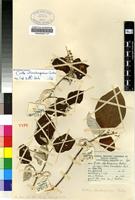
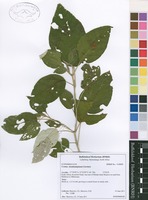
Croton steenkampianus

3 Images see all

Isosyntype of Croton steenkampianus Gerstner [family EUPHORBIACEAE]
Filed as Croton steenkampianus Gerstner [family EUPHORBIACEAE]
Previous
Next

Name

Identification
Croton steenkampianus Gerstner [family EUPHORBIACEAE ] (stored under name); Verified by J. Gerstner.,
Related name
  • Croton steenkampianus

Flora

Entry for Croton steenkampianus Gerstner [family EUPHORBIACEAE]
Herbarium
Royal Botanic Gardens, Kew (K)
Collection
Flora Zambesiaca
Resource Type
Reference Sources
Entry From
FZ, Vol 9, Part 4, (1996) Author: A. Radcliffe-Smith
Names
Croton steenkampianus Gerstner [family EUPHORBIACEAE], in J. S. African Bot. 12: 38 (1946). —K. Coates Palgrave, Trees Southern Africa, ed. 2, rev.: 419 (1983). —Radcliffe-Smith in F.T.E.A., Euphorb. 1: 143 (1987). Types from South Africa (KwaZulu-Natal).
Information
A shrub c. 2 m high, or tree to 7 m, dioecious or monoecious.Twigs greyish-brown, lenticellate.Young growth densely fulvous-lepidote.Stipules 3–10 mm long, subulate.Petioles 0.5–6 cm long.Leaf blades 2–15 × 2–10 cm, ovate, acutely shortly acuminate at the apex, sometimes obtuse or emarginate through deformity, entire or subentire on the margin, rounded to shallowly cordate at the base with a pair of sessile discoid basal glands beneath, chartaceous, sparingly scurfily stellate-pubescent and green on the upper surface, silvery-lepidote beneath; 5–9-nerved from the base, lateral nerves in 5–8 pairs, ± impressed above, prominent beneath.Racemes 2–10 cm long, terminal, mostly female with a short apical male portion, or all female; bracts minute.Male flowers: pedicels 3 mm long; sepals 5, 2 × 1 mm, triangular-ovate, yellowish-lepidote without, glabrous within; petals 5, 2 × 0.5 mm, oblong-oblanceolate, pubescent, ciliate, pale yellowish-cream in colour; disk glands 5, rounded or truncate; stamens 17–20, filaments 2–3 mm long, sparingly pubescent, anthers 1 mm long; receptacle pilose.Female flowers: pedicels 3 mm long, stouter than in the male, densely lepidote; sepals 5, 3–4 × 1.5 mm, triangular-lanceolate, subacute, lepidote without, pubescent within, greenish; petals absent; disk shallowly 5-lobed, the lobes rounded; ovary 2 mm in diameter, subglobose, densely fulvous stellate-lepidote; styles 3, 2–3 mm long, erect or spreading, twice bipartite with linear-filiform segments, sparingly stellate-pubescent abaxially, purplish. Fruits 5 × 6–7 mm, trilobate-subglobose, septicidal, evenly stellate-lepidote.Seeds 3.5–4 × 2.5–3.5 × 2–2.5 mm, ovoid, smooth, somewhat shiny, dark brown; caruncle c. 1 mm wide, ± flattened.
Habitat
In coastal semi-evergreen woodland, Androstachys johnsonii woodland, and wooded grassland with Entandrophragma, Combretum, Pteleopsis, Vitex and Croton gratissimus
Altitude range
300–350 m.
350
300
Distribution
Mozambique M Goba, fr. 3.xi.1960, Balsinhas 184 (K; LISC; LMA; PRE; SRGH).Mozambique GI Massingir, fl. 23.vii.1982, Matos 5069 (LISC).
Distribution (external)
eastern Tanzania
South Africa (Transvaal, KwaZulu-Natal)

Related Materials

  • Terms and Conditions
  • Privacy Policy
  • Cookie Policy
  • Cookie Settings
  • Accessibility
  • Help
  • Contact Us
  • Facebook
  • Twitter
ITHAKA

JSTOR is part of ITHAKA, a not-for-profit organization helping the academic community use digital technologies to preserve the scholarly record and to advance research and teaching in sustainable ways.

©2000-2026 ITHAKA. All Rights Reserved. JSTOR®, the JSTOR logo, JPASS®, Aluka®, and ITHAKA® are registered trademarks of ITHAKA.

╳