JSTOR Global Plants Home
  • Home
  • Browse
  • About
  • Access
  • Account
    • Saved Items
    • Profile
  • Log in

Global Plants

Skip to Main Content
  • JSTOR Global Plants Home
  • Global Plants

    • Browse
    • About
    • Access
    • Account
      • Saved Items
      • Profile
Log in
  • Browse
  • About
  • Access
  • Account
    • Saved Items
    • Profile
Advanced Search

Compilation
Croton inhambanensis

2 Images see all

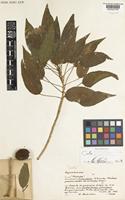
Holotype of Croton inhambanensis Radcl.-Sm. [family EUPHORBIACEAE]
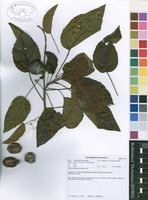
Filed as Croton inhambanensis Radcl.-Sm. [family EUPHORBIACEAE]
Previous
Next

Name

Identification
Croton echinococeus unrecorded [family EUPHORBIACEAE ] Croton inhambanensis Radcl.-Sm. [family EUPHORBIACEAE ] (stored under name); Verified by Radcliffe-Smith, A., Croton phragmatochoerocarpos unrecorded [family EUPHORBIACEAE ]
Related name
  • Croton phragmatochoerocarpos
  • Croton inhambanensis
  • Croton echinococeus

Flora

Entry for Croton inhambanensis Radcl.-Sm. [family EUPHORBIACEAE]
Herbarium
Royal Botanic Gardens, Kew (K)
Collection
Flora Zambesiaca
Resource Type
Reference Sources
Entry From
FZ, Vol 9, Part 4, (1996) Author: A. Radcliffe-Smith
Names
Croton inhambanensis Radcl.-Sm. [family EUPHORBIACEAE], in Kew Bull. 45: 559 (1990). Type: Mozambique, Inhambane, Vilanculos, Muábsa, 27.iii.1973, Balsinhas 2496 (K, holotype; LMA).
Information
A shrub or small tree up to 5 m high.Twigs sparingly stellate-pubescent to subglabrous, cinnamon-ochreous at first, later becoming greyish-tawny in colour.Stipules 5 mm long, subulate, sparingly stellate-pubescent, soon falling.Petioles 1–7 cm long, stellate-pubescent at first, later glabrescent.Leaf blades 4–10 × 2–3 cm, lanceolate to elliptic-lanceolate, acuminate at the apex, shallowly and somewhat irregularly glandular-serrulate on the margins, wide-cuneate to rounded at the base, with a pair of small stipitate or subsessile discoid glands on upper surface at the junction with the petiole, chartaceous, minutely glandular-punctate, glabrous or subglabrous on both surfaces, if subglabrous then with very few scattered stellate hairs on the lower midrib and lateral nerves; 5-nerved from the base, lateral nerves in 10–18 pairs, scarcely prominent.Male and female inflorescences and flowers unknown.Fruits 2.5–3 × 2–2.5 cm, obovoid- or ellipsoid-subglobose, scarcely 3-lobed, loculicidal, densely echinate, subglabrous except for the processes; processes up to 7 mm long, subulate, curved, sparingly stellate-pubescent.Seeds 2 × 1.5 × 1 cm, ovoid-ellipsoid, dull, light brown, tawny-mottled, recalling those of the genus Ricinus, as indeed also do the fruits.
Habitat
Low altitude coastal plain, in dry sandy soil with Androstachys johnsonii.
Range
Known only from this locality
Altitude range
Low altitude
800
0
inferred from low
Distribution
Mozambique GI 30 km Mapinhane–Mavume, fr. ii.1939, Gomes e Sousa 2216 (COI; K).
Notes
The type and the specimen cited above are the only specimens known of this very distinct species.

Related Materials

  • Terms and Conditions
  • Privacy Policy
  • Cookie Policy
  • Cookie Settings
  • Accessibility
  • Help
  • Contact Us
  • Facebook
  • Twitter
ITHAKA

JSTOR is part of ITHAKA, a not-for-profit organization helping the academic community use digital technologies to preserve the scholarly record and to advance research and teaching in sustainable ways.

©2000-2026 ITHAKA. All Rights Reserved. JSTOR®, the JSTOR logo, JPASS®, Aluka®, and ITHAKA® are registered trademarks of ITHAKA.

╳