

Compilation
Croton butaguensis
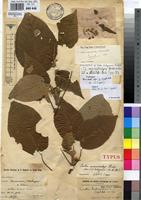
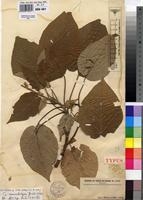
2 Images see all
Name
Identification
Croton butaguensis De Wild. [family EUPHORBIACEAE ] Verified by Not on sheet, Croton macrostachyus Del. [family EUPHORBIACEAE ] (stored under name); Verified by Unknown, 1983
Related name
- Croton butaguensis
- Croton macrostachyus
Flora
Entry for Croton macrostachyus Hochst. ex Delile [family EUPHORBIACEAE]
Herbarium
Royal Botanic Gardens, Kew (K)
Collection
Flora Zambesiaca
Resource Type
Reference Sources
Entry From
FZ, Vol 9, Part 4, (1996) Author: A. Radcliffe-Smith
Names
Croton macrostachyus Hochst. ex Delile [family EUPHORBIACEAE], in Ferret & Galinier, Voy. Abyss. 3: 158 (1848). —A. Richard, Tent. Fl. Abyss. 2: 251 (1851) (sphalm. “macrostachys”). —Müller Argoviensis in De Candolle, Prodr. 15, 2: 528 (1866). —Engler, Pflanzenw. Ost-Afrikas C: 237 (1895). —Hutchinson in F.T.A. 6, 1: 772 (1912). —Engler, Pflanzenw. Afrikas (Veg. Erde 9) 3, 2: 49 (1921). —Robyns & Tournay, Fl. Sperm. Parc Nat. Alb. 1: 449 (1948). —Brenan, Check-list For. Trees Shrubs Tang. Terr.: 205 (1949). —Eggeling & Dale, Indig. Trees Uganda, ed. 2: 120 (1952). —F.W. Andrews, Fl. Pl. Anglo-Egypt. Sudan 2: 60 (1952). —Brenan in Mem. N.Y. Bot. Gard. 9, 1: 71 (1954). —Topham, Check List For. Trees Shrubs Nyasaland Prot.: 50 (1958) (sphalm. “macrostachys”). —Keay in F.W.T.A., ed. 2, 1, 2: 394 (1958). —Dale & Greenway, Kenya Trees & Shrubs: 191 (1961). —J. Léonard in F.C.B. 8, 1: 62 (1962). —White, F.F.N.R.: 196 (1962). —Troupin, Fl. Pl. Lign. Rwanda: 256, fig. 88/2 (1982); Fl. Rwanda 2: 216, fig. 65/2 (1983). —Radcliffe-Smith in F.T.E.A., Euphorb. 1: 149 (1987). —Beentje, Kenya Trees, Shrubs Lianas: 191 (1994). Type from Ethiopia (Tigray Province).
Croton zambesicus [family EUPHORBIACEAE], sensu De Wild., Ann. Mus. Congo Belge, Bot., Sér. 5, 2: 278 (1908). —Hutchinson in F.T.A. 6, 1: 758 (1912), pro parte quoad spec. Seret 594; non Müll. Arg.
Croton butaguensis De Wild. [family EUPHORBIACEAE], in Rev. Zool. Bot. Africaines 9: 16 (1921); in Pl. Bequaert. 3: 452 (1926). —Robyns & Tournay, Fl. Sperm. Parc Nat. Alb. 1: 450 (1948). Type from Zaire (Kivu Province).
Information
A tree up to 30 m tall, dioecious or sometimes monoecious; crown much-branched, spreading, rounded.Bole up to 1.8 m in circumference.Bark smooth to closely reticulate, pale grey or greyish-brown, slightly corky.Young twigs, petioles and inflorescence axes densely, evenly or sparingly greyish appressed or patent stellate-pubescent, later glabrescent and becoming dark grey-brown and lenticellate.Stipules 5–7 mm long, linear to filiform-setaceous, soon falling.Petioles 3–12 cm long.Leaf blades 6–18 × 4–14 cm, ovate, acuminate at the apex, shallowly crenate-serrate to subentire on the margins, cordate or subcordate at the base with a pair of shortly stipitate to subsessile basal discoid glands on the lower surface, chartaceous, sparingly appressed stellate-pubescent to fimbriate-lepidote above, and sparingly to densely so or patent stellate-tomentose beneath; 5–7-nerved from the base, lateral nerves in 4–9 pairs, ± prominent beneath.Racemes up to 35 cm long, terminal, usually androgynous, sometimes male or female; bracts shorter than the stipules but otherwise resembling the stipules.Flowers fragrant.Male flowers: pedicels 0.5–1 cm long; sepals 5, 3 × 2–2.5 mm, ovate, stellate-lepidote without, pubescent within, pale green; petals 5, 3–3.5 × 1.5–2 mm, oblanceolate-oblong, subglabrous without, villous within and on the margin, pale creamy-yellow in colour; disk glands rounded, pilose; stamens 15–20, filaments 4 mm long, villous below, anthers c. 1 mm long; receptacle densely villous.Female flowers: pedicels 2–5 mm long, not or scarcely extending in fruit, stout, densely stellate-pubescent; sepals 5, 3–3.5 × 1.5–2 mm, ovate-lanceolate, evenly stellate-lepidote without, sparingly stellate-pubescent within, grey-green; petals 0 or 5, 0.5–1 mm long, linear to subulate, subglabrous; disk 5-lobed, the lobes truncate, pubescent; ovary 2 mm in diameter, trigonous or quadrangular, densely lepidote; styles 3–4, 3 mm long, spreading, 2-partite with the segments filiform-linear, minutely puberulous.Fruits 0.8–1 × 0.8–1.5 cm, trilobate or quadrilobate, loculicidal or septicidal, densely to evenly scurfily stellate-pubescent, pale greyish-green.Seeds 7 × 4 mm, ellipsoid, rugulose, grey; caruncle 4.5 × 4 mm, waxy.
Habitat
Evergreen forest, Brachystegia woodland and wooded grassland in submontane localities, often on rocky hillsides, in evergreen riverine and gully forest, and mushitu margins (swamp forest), also on termitaria
Range
throughout tropical Africa from Guinée eastwards to Ethiopia and southwards to Angola and Mozambique; also in Madagascar
Altitude range
825–1830(2165) m.
1830
825
Distribution
Mozambique T Angónia, y. fr. 13.v.1948, Mendonça 4223 (LISC).Malawi S Zomba, male fl. 21.xi.1978, Salubeni 2398 (MAL; MO; SRGH).Malawi C Dedza, Mphunzi Hill, fl. & fr. 22.i.1959, Robson 1306 (BM; K; LISC; PRE; SRGH).Mozambique Z Mt. Milange, fr. 30.vii.1943, Torre 4834a (LISC; PRE).Zambia E Chama Distr., Nyika Plateau, Chowo Forest, fr. only 13.viii.1975, Pawek 10036 (K; MAL; MO; SRGH; UC).Malawi N Mzuzu, male fl. 15.ii.1976, Pawek 10858 (MO; PRE; SRGH; UC).Zimbabwe E Chimanimani, fl. vi.1958, Boughey 4450 (SRGH).Zambia N Mbala (Abercorn) Agric. Station, fr. 27.iii.1960, Angus 2177 (FHO; K; MO; SRGH).
Notes
Vernacular names as recorded in specimen data include: “tensa” (chiNyanja), “mughogha” (Malawi), “nakawalika” (chiYao).