JSTOR Global Plants Home
  • Home
  • Browse
  • About
  • Access
  • Account
    • Saved Items
    • Profile
  • Log in

Global Plants

Skip to Main Content
  • JSTOR Global Plants Home
  • Global Plants

    • Browse
    • About
    • Access
    • Account
      • Saved Items
      • Profile
Log in
  • Browse
  • About
  • Access
  • Account
    • Saved Items
    • Profile
Advanced Search

Compilation
Crossandra jashi

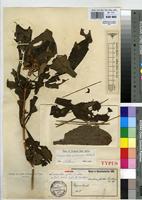
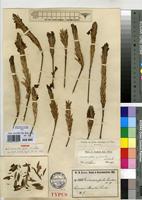
2 Images see all

Syntype of Crossandra jashi Lindau [family ACANTHACEAE]
Previous
Next

Name

Identification
Crossandra jashi Lindau [family ACANTHACEAE ] Verified by Not on sheet, Crossandra puberula Klotzsch [family ACANTHACEAE ] (stored under name); Verified by Vollesen K., 1988
Related name
  • Crossandra jashi
  • Crossandra puberula

Flora

Entry for Crossandra puberula Klotzsch [family ACANTHACEAE]
Herbarium
Royal Botanic Gardens, Kew (K)
Collection
Flora of Tropical East Africa
Resource Type
Reference Sources
Entry From
Flora of Tropical East Africa, page 1, (2008) Author: Kaj Vollesen
Names
Crossandra puberula Klotzsch [family ACANTHACEAE], in Peters, Reise Mossamb. Bot. 1: 214 (1861); Lindau in P.O.A. C: 370 (1895); Clarke in F.T.A. 5: 117 (1899); E.A. Bruce in Fl. Pl. Afr. 28: pl. 1098 (1951); Vollesen in Opera Bot. 59: 80 (1980) & in K.B. 45: 521 (1990); Lebrun & Stork, Enum. Pl. Afr. Trop. 4: 476 (1997). Type: Mozambique, Rios de Sena, Peters s.n. (B†, holo.). Neotype: Mozambique, Mocuba District: Namagoa, Faulkner P.317 (K!, neo.; BR!, COI!, EA!, K!, P!, PRE!, S!, SRGH!, iso.)
Crossandra pubescens Klotzsch [family ACANTHACEAE], in Peters, Reise Mossamb. Bot. 1: 213 (1861); Lindau in P.O.A. C: 370 (1895) & in E. & P. Pf. IV, 3b: 319 (1895). Type: Mozambique, Boror, Peters s.n. (B†, holo.)
Crossandra jashi Lindau [family ACANTHACEAE], in E. J. 38: 70 (1905); Mildbraed in N.B.G.B.11: 823 (1933); T.T.C.L.: 6 (1949). Types: Tanzania, Lindi District: Maua, Kipindimbi, Busse 2655 (BM!, BR!, EA!, HBG!, isosyn.) & Seliman-Mamba, Busse 2666 (BM!, BR!, EA!, HBG!, isosyn.)
Information
Erect perennial or shrubby herb to 40 cm tall, from creeping woody rhizome; young stems puberulous or sparsely so. Leaves in pseudo-whorls of 4, sessile or petiole up to 1 cm long; lamina usually abruptly narrowed (lyrate) below middle, more rarely gradually narrowed, upper part ovate to elliptic, largest 11.5–21≈4.5–10 cm, entire or slightly crenate, apex subacute to broadly rounded, sparsely puberulous, densest on veins. Spikes 4–25 cm long; peduncle 1–17 cm long, sparsely to densely puberulous; fertile bracts 15–21 mm long, narrowly ovate, glumaceous, green with a broad white margin when young, becoming frayed with age, glabrous to finely puberulous, with several parallel longitudinal veins, no reticulum; bracteoles glumaceous, elliptic, 9–14 mm long, with a fine terminal bristle 1–2 mm long, finely puberulous. Sepals ovate, terminating in a bristle 1–2 mm long, puberulous towards tip, dorsal and ventral 6–9 mm long, lateral ± 2 mm shorter. Corolla pale peach or salmon pink; tube 2–3 cm long, slightly widened above insertion of stamens, slightly bent; limb 1.3–1.8 cm long. Style hairy. Capsule 9–11 mm long. Seed 3–4≈3–4 mm. Fig. 23, p. 146.
Range
DISTR. T 6, 8
Altitude range
200–900 m
Distribution
TANZANIA Morogoro District Mikumi National Park, 12 Apr. 1970, Batty 1049!TANZANIA Masasi District Masasi, 13 Mar. 1960, Hay 88!TANZANIA Tunduru District 32 km on Tunduru–Songea road, 4 Mar. 1963, Richards 17727!
Distribution (external)
Malawi
Mozambique
Zimbabwe
Notes
C. pubescensis no more than a form ofC. puberulawith a slightly denser indumentum than usual, especially on peduncles and bracts. It is also a pyrophytic rosette herb, but both subglabrous pyrophytic plants and hairy subshrubs have been seen, and – as no other differences have been found – it seems best only to recognise one taxon.FaulknerP.317 from Mozambique has been particularly useful in illustrating the variation possible within a single population.

Related Materials

  • Terms and Conditions
  • Privacy Policy
  • Cookie Policy
  • Cookie Settings
  • Accessibility
  • Help
  • Contact Us
  • Facebook
  • Twitter
ITHAKA

JSTOR is part of ITHAKA, a not-for-profit organization helping the academic community use digital technologies to preserve the scholarly record and to advance research and teaching in sustainable ways.

©2000-2026 ITHAKA. All Rights Reserved. JSTOR®, the JSTOR logo, JPASS®, Aluka®, and ITHAKA® are registered trademarks of ITHAKA.

╳