JSTOR Global Plants Home
  • Home
  • Browse
  • About
  • Access
  • Account
    • Saved Items
    • Profile
  • Log in

Global Plants

Skip to Main Content
  • JSTOR Global Plants Home
  • Global Plants

    • Browse
    • About
    • Access
    • Account
      • Saved Items
      • Profile
Log in
  • Browse
  • About
  • Access
  • Account
    • Saved Items
    • Profile
Advanced Search

Compilation
Crinum bulbispermum

4 Images see all

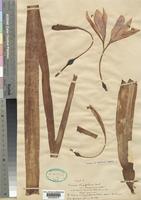
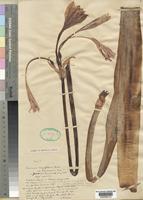
Type of Crinum longifolium Thunb. var. farinianum Baker [family AMARYLLIDACEAE]
Crinum bulbispermum (Burm.f.) Milne-Redh. & Schweick.
Previous
Next

Name

Identification
Crinum bulbispermum (Burm.f.) Milne-Redh. & Schweick. [family AMARYLLIDACEAE ]
Related name
  • Crinum bulbispermum

Flora

Entry for Crinum bulbispermum (Burman f.) Milne-Redhead & Schweickerdt [family AMARYLLIDACEAE]
Herbarium
Flora of North America (FNA)
Collection
Flora of North America
Resource Type
Reference Sources
Entry From
Flora of North America, Vol 26,
Names
Crinum bulbispermum (Burman f.) Milne-Redhead & Schweickerdt [family AMARYLLIDACEAE], J. Linn. Soc., Bot., 52: 161. 1939
Amaryllis bulbisperma Burman f. [family AMARYLLIDACEAE], Fl. Indica, 9. 1768
Treatment Author(s)
Walter C. Holmes
Information
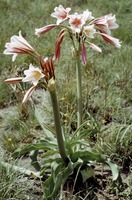
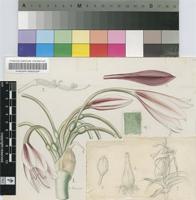
Bulbs 8–10 × 6–8 cm. Leaves 5–8 dm × 3–5 cm; blade lorate. Scape 4–7.5 dm. Umbels 8–13-flowered. Flowers: perianth pink to red, funnelform, tube narrow, 5–10 cm, limb lobes lanceolate-linear, lanceolate-elliptic, or lanceolate-ovate, 6–11 × 1–1.7 cm; pedicel (2–)4–6 cm. Capsules not seen at maturity, beak very short to absent.
Phenology
mar-may (spring), jun-aug (summer)
Altitude range
0–200 m;
Distribution
S. Africa.USA Fla.USA La.USA N.C.USA Tex.
Discussion
Crinum bulbispermum is apparently the nonnative species of Crinum that is most commonly cultivated outdoors. The name C. longifolium (Linnaeus) Thunberg was long misapplied to this species.
Native/Introduced
introduced;

Related Materials

  • Terms and Conditions
  • Privacy Policy
  • Cookie Policy
  • Cookie Settings
  • Accessibility
  • Help
  • Contact Us
  • Facebook
  • Twitter
ITHAKA

JSTOR is part of ITHAKA, a not-for-profit organization helping the academic community use digital technologies to preserve the scholarly record and to advance research and teaching in sustainable ways.

©2000-2026 ITHAKA. All Rights Reserved. JSTOR®, the JSTOR logo, JPASS®, Aluka®, and ITHAKA® are registered trademarks of ITHAKA.

╳