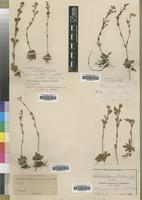
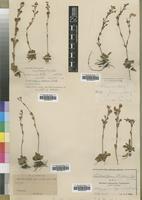
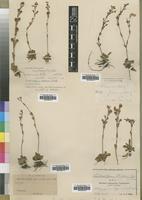
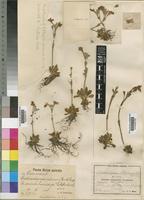
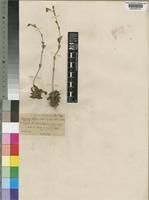
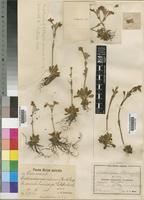
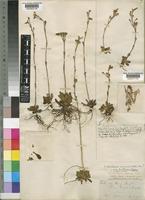
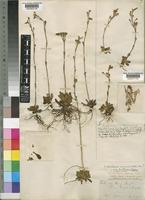
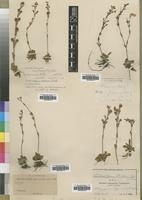
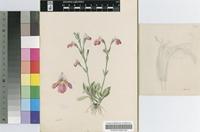
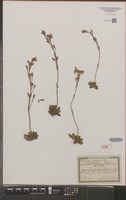
an erect herb, pilose with short spreading whitish hairs, apparently perennial, 2 1/4–12 in. high, with the habit of some species of Primula; stems rather slender, rigid, scape-like, simple, usually solitary, densely leafy at the base, sparingly leafy above; radical leaves rosulate, obovate or spathulate, rounded or obtuse, narrowed towards the base, thick, fleshy, glabrous above or nearly so, finely pilose beneath and on the margin, entire, 1/3–1 in. long, 1/5– 1/3 in. broad, not conspicuously nerved; petioles broad, 1/8– 3/8 in. long; stem-leaves opposite, few, distant, oblong or oval, obtuse, sessile or subsessile, 1/4– 1/2 in. long; flowers several, racemose, 3–15 on the scape, 1/2– 3/4 in. long; pedicels 1/8– 1/2 in. long, bracteate at the base, pilose; bracts like the stem-leaves but rather smaller and alternate; inflorescence 3/4–6 in. long; calyx about 1/4– 1/3 in. long in flower, rather longer in fruit, more or less pilose, turbinate-oblong, shortly 5-toothed; teeth triangular, pointed, 1/16– 1/12 in. long; corolla glabrous outside, pubescent within the throat; upper lip and bottom of the lower lip white, the rest of the lower lip bright pink with two yellow spots at the base on each side of the middle lobe; filaments of the anterior stamens much thickened and kneed about the base; anthers pilose on the edges and back; capsules oval, somewhat compressed, 1/3 in. long. null