

Compilation
Crassula zombensis
1 Images see all
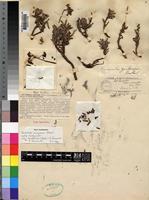
Name
Identification
Crassula zombensis Baker f. [family CRASSULACEAE ] Crassula swaziensis Schönland [family CRASSULACEAE ] (stored under name); Verified by Fernandes, R.,
Related name
- Crassula swaziensis
- Crassula zombensis
Flora
Entry for Crassula zombensis Bak. f. [family CRASSULACEAE]
Herbarium
Royal Botanic Gardens, Kew (K)
Collection
Flora Zambesiaca
Resource Type
Reference Sources
Entry From
FZ, Vol 7, Part 1, page 3, (1983) Author: R. Fernandes
Names
Crassula zombensis Bak. f. [family CRASSULACEAE], in Kew Bull. 1897: 266 (1897). — Binns, H.C.L.M.: 41 (1968). Type: Malawi, Zomba Mt., Whyte s.n. (K).
Crassula swaziensis var. zombensis Bak. f. R. Fernandes [family CRASSULACEAE], in Bol. Soc. Brot., Sér. 2, 52: 196, t. 14ett. 15(1978).
Information
A mat forming perennial herb or suffrutex with prostrate, woody, leafless, glabrous, branched main stem which emits erect or ascending branches. Branches inserted 0·7-3 cm. apart, up to 11 cm. long and 0·5 cm. in diam., subquadrangular or cylindric, often 2-forked or sometimes simple, with brown-scarious ± fissured bark, leafless or, when simple, leafy upwards, glabrescent, with the scars of the fallen leaves ring-shaped and pale, rather visible but not prominent; branchlets of the year usually the only leafy, 1·5-6 cm. long, herbaceous, grey or green-yellowish, hispidulous, the hairs short, whitish; internodes 0·2-1·5 cm., all ± shorter than the leaves, the apical of the leafy branchlets the shortest ones. Leaves 1·3-4·5 cm. long and 2-10 mm. broad, linear, 3-gonous or semiterete (convex beneath and canaliculate above in the living state), obtuse at the apex, entire, slightly attenuate towards the base, sessile and very shortly connate, not ciliate at the obtuse margins, ± covered with whitish, short, appressed or subspreading, subretrorse hairs, fleshy in living state, rigid on drying, erect or erect-spreading, somewhat arched; leaves of the old branches falling off together with the connate base. Flowers 5-merous, disposed in dense cymes, forming 4-7 branched corymb-like, terminal inflorescences, 2·3 cm. long and 3·5-5 cm. in diam.; peduncule 7·5-9 cm. long, slender, hispidulous, with 2-3 pairs of opposite bracts; pedicels up to 1·5 mm. long. Calyx 2·5 mm. long, densely hispidulous by whitish hairs; sepals c. 2 x 1 mm., oblong-triangular, convex, fleshy. Corolla 3·25-4·5 mm. long, stellate, white in living state, dark-brown on drying and forming a strong contrast in colour with the whitish calyx; petals 1·5-2·25 mm. broad, obovate, rounded at the top and with a subapical small mucro on the outside, smooth or nearly so, reflexed. Filaments ± 2·75 mm. long. Follicles 2·5-3·5 mm. long, rather attenuate, with distinct, divergent styles and apical stigmas. Scales 0·4 mm., subrectangular.
Habitat
On rocks in dry situations.
Range
Known only from Malawi and Mozambique
Distribution
Mozambique Z Namuli Peaks, W. face, c. 1440 m., 26.vii.1962, Leach & Scheipe 11483 (K; LISC; SRGH). Also cultivated in a Garden at Sintra (Portugal) from Torre & Correia 14734 and 16030 (Gúruè,Malawi S Zomba Distr., Zomba Plateau, below road to summit opposite Malosa saddle, rocky slopes, 1900 m., 2.viii.1970, Brummitt & Banda 12377 (K).