

Compilation
Crassula retrorsa
2 Images see all
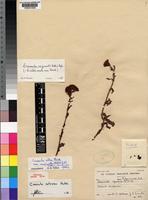
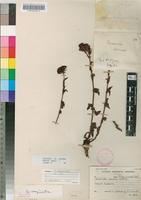
Name
Identification
Crassula alba Forssk. [family CRASSULACEAE ] Verified by Tolken, H.R., Crassula recurva N.E.Br. [family CRASSULACEAE ] Crassula vaginata Eckl. & Zeyh. [family CRASSULACEAE ] (stored under name); Verified by Fernandes, R., Crassula retrorsa Hutchinson [family CRASSULACEAE ]
Related name
- Crassula vaginata
- Crassula retrorsa
- Crassula alba
- Crassula recurva
Flora
Entry for Crassula vaginata Eckl. & Zeyh. [family CRASSULACEAE]
Herbarium
Royal Botanic Gardens, Kew (K)
Collection
Flora Zambesiaca
Resource Type
Reference Sources
Entry From
FZ, Vol 7, Part 1, page 3, (1983) Author: R. Fernandes
Names
Crassula vaginata Eckl. & Zeyh. [family CRASSULACEAE], Enum. Pl. Afr.Austr. 3: 298 (1837). — Walp.,Repert. 2: 254 (1843). — Harv. in Harv. & Sond., F.C. 2: 341 (1862). — M. Wood, Handb. Fl. Natal: 46 (1907). — Schönl. in Engl., Bot. Jahrb. 43: 359 (1909); in Trans. Roy. Soc. S. Afr. 17, 3: 226 (1929). — Burtt Davy, F.P.F.T. 1: 140 (1926). — Berger in Engl. & Prantl, Nat. Pflanzenfam. ed. 2, 18a: 394 (1930). — Hutch., Botanist in S. Afr. : 404 (1946). — Letty, Wild Fl. Transv.: 149 (1962). — Riley, Fam. Fl. Pl. S. Afr. : 157 (1963). — J. H. Ross, Fl. Natal: 180 (1972). — Tölken in Contr. Bol. Herb. 8, 2: 356 (1977). — R. Fernandes in Bol. Soc. Brot., Sér. 2, 55: 115 (1928). — G. E. Wickens in Kew Bull. 36, 4; 667 (1982). TAB. 4 fig. B. Type from S. Africa (Cape Prov.).
Crassula mannii Hook. f. [family CRASSULACEAE], in Journ. Linn. Soc., Bot. 7: 193 (1864). — Hutch. & Dalz., F.W.T.A. 1, 1: 104 (1927). — Merxm. & al. in Ann. Naturh. Mus. Wien 75: 113 (1971). Type from Cameroon.
Crassula schweinfurthii De Wild. [family CRASSULACEAE], Ic. Set. Hort. Then. 1: 93, t. 22 (1900). Type a cultivated plant of Ethiopian origin.
Crassula abyssinica var. angolensis Schönl. [family CRASSULACEAE], loc. cit. (1909); tom. cit.: 227 (1929). Holotype from Angola.
Crassula abyssinica var. nyikensis Schönl. [family CRASSULACEAE], loc. cit. (1909). Type: Malawi, Nyika Plateau, alt. 1920-2240 m., Whyte 165 (B, holotype).
Crassula abyssinica var. robusta Schönl. [family CRASSULACEAE], loc. cit, (1909). Syntypes from Angola, Malawi and Kenya (lectotype: Malawi, Buchanan 340 (K)).
Crassula abyssinica var. ovata Schönl. [family CRASSULACEAE], loc. cit. (1909). Syntypes from Tanzania and Cameroon lectotype: Kilimandjaro, Volkens 1905 (K)).
Crassula abyssinica var. transvaalensis Schönl. [family CRASSULACEAE], tom. cit.: 226 (1929). Type from S. Africa (Transvaal).
Crassula alba [family CRASSULACEAE], sensu.: Berger in Engl. & Prantl, Nat. Pflanzenfam. ed. 2, 18a: 394 (1930) pro parte. — Brenan in Mem, N.Y. Bot. Gard. 8, 5: 434 (1954). — Cufod. in Bull. Jard. Bot. Brux. 24, Suppl.: 169 (1954) pro parte. — Keay in F.W.T.A. ed. 2, 1, 1: 116 (1954) pro parte; — Hedbergin Symb. Bot. Upsal. 15, 1: 101 (1957) pro parte; — Chapman, Veg. Mlanje Mt. Nyasal.: 52 et 56 (1962); — Binns,H.C.L.M.:41 (1968) non Forsskal.(1775).
Crassula retrorsa Hutch. [family CRASSULACEAE], in Kew Bull. 1933: 420 (1933). — Jacobsen, Das Sukk. Lexicon: 147 (1970). Type from S. Africa (Transvaal).
Crassula abyssinica [family CRASSULACEAE], sensu Britten, F.T.A. 2: 388 (1871) pro parte. — Engl., Hochgebirgsfl. Trop. Afr. : 231 (1892) pro parte. — Burtt Davy, loc. cit. — Gilliland in Journ. S. Afr. Bot. 4: 91 (1938). — Toussaint in F.C.B. 2: 569 (1951). Non A. Rich. (1847).
Crassula abyssinica var. mannii Hook. f. Engl. [family CRASSULACEAE], loc. cit. (1892). — Schönl, tom. cit.: 360 (1909). Type as for Crassula mannii.
Crassula abyssinica var. vaginata Eckl. & Zeyh. Engl. [family CRASSULACEAE], Pflanzenw. Ost. Afr.C: 189 (1895). — Hiern, Cat. Afr.Pl. Welw. 1: 326 (1896). — De Wild. in Ann. Mus. Congo, Bot., Sér. 2, 2: 20 (1900). Type as for Crassula vaginata.
Sedum vaginatum Eckl. & Zeyh. Kuntze [family CRASSULACEAE], Rev. Gen. Pl. 3, 2: 86 (1898). Type as above.
Information
A succulent, 8-90 cm. high perennial, forming clumps up to about 90 cm. in diameter. Stem arising from a fleshy to woody obconical or swollen tuber, erect, straight, usually simple, ± stout (up to 10 mm. in diameter at the base) or sometimes ± slender, terete, pale- or yellow-green below, bright red to reddish-brown above, usually crimson on drying, glabrous towards the base, papillose-hairy or shortly papillose upwards below the nodes along two ± short stripes alternating with the lamina of the leaves (the papillae usually very short, patent, obtuse or, if long, then hair-like), or completely glabrous, rarely papillose throughout. Leaves 2·5-26·5 x (0·1-0·2) 0·4-2·7(3·3) cm., sometimes up to 37 times longer than wide, the basal ones the longest and rosulate, oblong- to linear-lanceolate or linear, ± attenuate, the lower cauline leaves similar to the basal ones but shorter, the succeeding ones lanceolate or linear to oblong- or ovate-lanceolate, the uppermost sometimes bract-like, all acute or subacute at the apex, entire and with a row of short, contiguous, obtuse, white papillose cilia at the margin, sessile, ± long-connate at the base, clasping the stem below, then subappressed to it, finally erect or somewhat arched, flat, fleshy (but not very thick), pale to bright green when fresh, greenish-brown or dark brown when dry, usually glabrous on both faces or very rarely papillose-hairy beneath or on both surfaces; sheath (0·5)1-3 cm. long in the lower cauline leaves, shortening in the following; all internodes shorter than the leaves (sometimes the stem completely concealed by the sheaths and the clasping part of the laminas) or the upper ones subequalling or longer than them. Flowers 5-merous in a repeatedly dichotomous, usually very dense, subhemispherical, corymbose inflorescence, 1·5-22(30) cm. in diam.; branches ± papillose to nearly glabrous; pedicels 2-6 mm. long, glabrous or sparsely papillose. Calyx (1)1·5-3(4) mm. long, 1/3-1/2 (2/3) as long as corolla, rarely subequalling it, pale green; sepals ovate-lanceolate or ovate-elliptic to linear-lanceolate, not or ± attenuate, acute, with one terminal ± long obtuse papilla at the apex, usually entire and without marginal papillae or sometimes obtuse papillae present over a short to ±: long extent of the margin as well as on the median nerve above. Corolla (2·25)2·5-3·5(4·5) mm. long, white, pinkish-white or cream-white, sometimes red-tipped, or yellow, rarely red; petals 0·75-1·5(2) mm. wide, elliptic-oblong to ovate-oblong or ovate, obtuse or nearly so, slightly thickened at the top, not or indistinctly mucronate below the apex, smooth. Filaments 1·5-2 mm. long; anthers (0·25)0·3-0·4(0·5) mm., subcircular. Follicles (incl. styles) 2-2·5(2·75) mm. long, contracted into the very short styles. Seeds c. 0·5 mm. long, oblong.
Habitat
In open grassland or among rocks on mountain slopes
Range
from the Cameroons to Angola
Altitude range
up to 2680 m.
2680
0
inferred only top
Distribution
Mozambique MS Monte Chimanimane, 6.vi.1949, Munch 166 (SRGH).Mozambique T Angónia, Monte Dómuè, c. 1700 m., 9.iii.1964, Torre & Paiva 11117 (LISC).Malawi S Zomba Mt., Forest Nursery, 1830 m., E. M. & W. 756 (BM; LISC; SRGH).Malawi C Dedza Distr., Chongoni, on slopes of Ciwau near the Meteorological Station, 8.iii.1961, Chapman 1163 (K; SRGH).Zambia E Lundazi distr., Nyika Plateau, c. 2100 m., 3.i.1959, Richards 10428 (K; SRGH).Zambia C Sérenje, 18.ii.1955, Fanshawe 2086 (BR; K).Zambia W Mwinilunga, Lisombo R., 11.vi.1963, Loveridge 919 (K; SRGH).Mozambique N Massangulo Mt., 41 mil. N. of Mandimba, c. 1440 m., 26.v.1961, Leach & Rutherford-Smith 11039 (K; LISC; SRGH).Malawi N Mzimba Distr., Viphya, 28.iii.1954, G. Jackson 1289 (BM; K).Zimbabwe E Melsetter distr., Chimanimani Mts., behind the mountain hut, c. 1760 m., 10.iv.1967, Grosvenor 370 (K; LISC; PRE; SRGH).Zambia N Abercorn distr., Sunzu Hill, c. 2176 m., 28.iv.1936, B. D. Burtt 6145 (BM; K).
Distribution (external)
Ethiopia
Sudan
Kenya
Uganda
Tanzania
Swaziland
S. Afr. (Natal, Transvaal, Orange Free State and the Cape)
Notes
This species is similar to C. alba Forssk. (= C. abyssinica A. Rich.) The two can be distinguished as follows (some characters not included in the key are mentioned here):Indumentum relatively sparse, composed of relatively short papillae; sheaths of lower leaves 1 (rarely less)-3 cm. long; sepals usually up to half as long as corolla, not denticulate, either entire or with obtuse marginal papillae; petals smooth and indistinctly mucronate; anthers suborbicular, 0·3-0·5 mm. longC. vaginataIndumentum relatively dense, composed of longer papillae; sheaths of lower leaves usually less than 1 cm. long; sepals longer than 1/2-up to as long as corolla, the margins acutely denticulate; petals sometimes subtuberculate-scabrous on the upper part of the outer surface, distinctly mucronate; anthers oblong, 0·5-1 mm. long C. albaMany specimens of C. vaginata from S. Africa have broader and denser leaves than is usual in the F.Z. area, as well as more frequently glabrous or subglabrous stems and sepals lacking marginal papillae. However, similar leaves have been found in other regions, as in the Cameroons (C. mannii), Sudan, Uganda, Tanzania (C. abyssinica var. ovata), Zaire and Angola; and they occur here and there in the F.Z. area. Sepals without marginal papillae are also known in both F.Z. specimens and ones from other tropical countries.As can be seen from the synonymy many varieties have been distinguished. However, it seems quite impossible to separate infraspecific taxa within C. vaginata, based on such characters as stem stoutness, leaf size and shape, presence, absence or quantity of indumentum or occurrence of marginal papillae on sepals, because they vary independently.C. vaginata was described with “flores flavi”. Unless it was noted by the collector, it is often impossible to decide on the original petal colour; nearly all specimens have reddish- to blackish-brown corollas, although they were ± white at anthesis. However, yellow corollas have never been mentioned by collectors in the F.Z. area. Torre & Correia 15377 (LISC) from Mozambique has red corollas.The many specimens seen from Mulanje Mt. (Malawi) have a characteristic habit, being only (2·5)4-10(12) cm. high, with the rosulate leaves narrowly linear and more persistent than usual, and the cauline leaves similar. They seem to represent a dwarf altitudinal form of exposed places and thin soil over rock. As intermediates occur at lower altitudes between them and more robust plants of the normal form, it is advisable not to recognise them formally.Several specimens from the Chimanimani Mts. region of Zimbabwe (E) and Mozambique (MS), for example Goodier 177 (SRGH), Phipps 647 (K; SRGH), Hall 429 (SRGH) and Pereira, Sarmento & Marques 1315 (LMU) are distinctly low-growing, with small, relatively broad leaves connate for not more than 5 mm. at the base, and with a long, dense, stem indumentum. They may be hybrids between C. vaginata and C. setulosa, of which the latter also grows in this area,