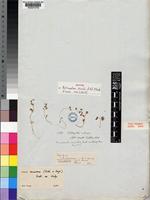
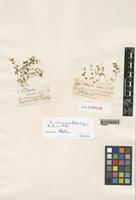
Isotype of Crassula nivalisEndl. [family CRASSULACEAE ] (stored under name); Verified by Not on sheet, Petrogeton nivaleEckl. et Zeyh. [family CRASSULACEAE ] Verified by Drége J. F. ?,
Related name
Petrogeton nivale
Crassula nemorosa
Crassula nivalis
Flora
Entry for CRASSULA nivalis E. & Z. [family CRASSULACEAE]
Herbarium
Royal Botanic Gardens, Kew (K)
Collection
Flora Capensis
Resource Type
Reference Sources
Entry From
Flora Capensis, Vol 2, page 327, (1894) Author: (By W. H. HARVEY).
Names
CRASSULA nivalisE. & Z. [family CRASSULACEAE], ! 1860
Petrogeton nivaleE. & Z. [family ], ! l. c.
Information
stem herbaceous, simple or forked, with distant nodes, slender and pellucid; leaves opposite or subfasciculate, on long petioles, subrotund, entire, or obscurely repand, thin and membranous when dry, glabrous; flowers on very long threadlike pedicels, axillary or terminal, or 2–3 together in an imperfect cyme; calyx-lobes nearly equalling the petals, thin, elliptic-oblong, obtuse, nerved; petals ovate or ovate-elliptical, acute; styles shortly subulate. Resembles the weaker states of C. dentata; but differs in inflorescence. Leaves 1/4– 1/2 inch wide; petioles 1/2–1 inch. Stem 3–4 inches long. Pedicels uncial.
Distribution
SOUTH AFRICA Mountain rocks of the Winterberg, Kaffr.. E. & Z.! (Herb. Sond.)