JSTOR Global Plants Home
  • Home
  • Browse
  • About
  • Access
  • Account
    • Saved Items
    • Profile
  • Log in

Global Plants

Skip to Main Content
  • JSTOR Global Plants Home
  • Global Plants

    • Browse
    • About
    • Access
    • Account
      • Saved Items
      • Profile
Log in
  • Browse
  • About
  • Access
  • Account
    • Saved Items
    • Profile
Advanced Search

Compilation
Crassula montana

9 Images see all

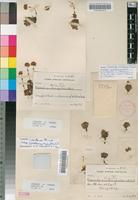
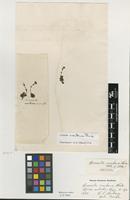
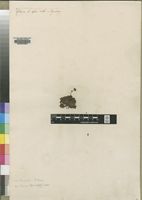
Isotype of Crassula quadrangularis Schönland [family CRASSULACEAE]
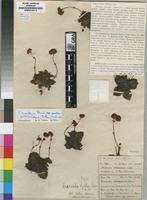
Type of Crassula montana Thunb. [family CRASSULACEAE]
Filed as Crassula montana L.f. [family CRASSULACEAE]
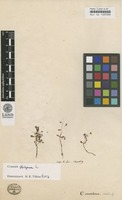
Isotype of Crassula quadrangularis Schönland [family CRASSULACEAE]
Isotype of Crassula montana Thunb. [family CRASSULACEAE]
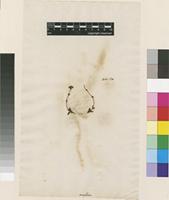
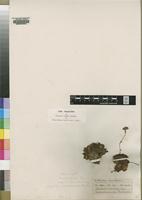
Holotype of Crassula gillii Schonland [family CRASSULACEAE]
Isotype of Crassula gillii Schoënl. [family CRASSULACEAE]
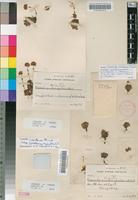
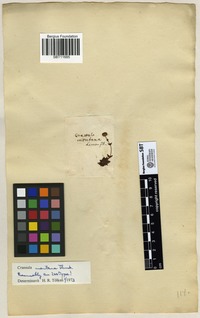
Isotype of Crassula montana Thunb. [family CRASSULACEAE]
Type of Crassula montana L.f. [family CRASSULACEAE]
Previous
Next

Name

Identification
Crassula montana L.f. [family CRASSULACEAE ] (stored under name);
Related name
  • Crassula montana
  • Crassula gillii
  • Crassula quadrangularis

Flora

Entry for Crassula montana subsp montana [family CRASSULACEAE]
Herbarium
South African National Biodiversity Institute, Compton Herbarium, Cape Town (SAM)
Collection
Flora of Southern Africa
Resource Type
Reference Sources
Entry From
Flora of South Africa, (2003) Author: Dr J.P. Roux
Names
Crassula montana subsp montana [family CRASSULACEAE]
Common names
Crassula montana Thunb. in Nova Acta Phys.-Med. Acad. Caes. Leop.-Carol., Nat. Cur. 6, 329, 332 (1778); Prodr. 55 (1794); Fl. Cap. edn Schultes 285 (1823); L.f., Suppl. 189 (1781); DC, Prodr. 3: 388 (1828); Harv. in F.C. 2: 367 (1862). Purgosea montana (Thunb.) G. Don, Gen. Syst. 3: 104 (1834). Crassula engleri Schonl. in Rec. Albany Mus. 2: 146 (1907); in Trans. R. Soc. S. Afr. 17: 251 (1929). Type: Cape, eastern slopes of Bokkeveld, Diets 574 (GRA, holo.!).
Habitat
The inflorescence of this species is usually spike­like but may occasionally be a little more branched. Problems in distinguishing this subspecies may arise be­cause depauperate specimens of both subspecies pro­duce only one terminal dichasium. The shape of the squamae and the distribution help to identify critical specimens such as Thunberg's type specimen.
Use
(a). subsp. montana

Related Materials

  • Terms and Conditions
  • Privacy Policy
  • Cookie Policy
  • Cookie Settings
  • Accessibility
  • Help
  • Contact Us
  • Facebook
  • Twitter
ITHAKA

JSTOR is part of ITHAKA, a not-for-profit organization helping the academic community use digital technologies to preserve the scholarly record and to advance research and teaching in sustainable ways.

©2000-2026 ITHAKA. All Rights Reserved. JSTOR®, the JSTOR logo, JPASS®, Aluka®, and ITHAKA® are registered trademarks of ITHAKA.

╳