

Compilation
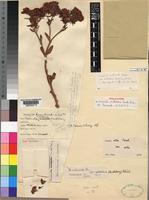
Crassula milleriana
1 Images see all
Name
Identification
Crassula milleriana Burtt Davy [family CRASSULACEAE ] Verified by Burtt Davy, J., Crassula rubicunda unrecorded [family CRASSULACEAE ] Crassula rubicunda E.Mey. ex Harv. & Sond. [family CRASSULACEAE ] Verified by Schonland, S., Crassula alba Forssk. [family CRASSULACEAE ] (stored under name); Verified by Tolken, H.R.,
Related name
- Crassula alba
- Crassula rubicunda
- Crassula milleriana
Flora
Entry for Crassula alba Forssk. [family CRASSULACEAE]
Herbarium
Royal Botanic Gardens, Kew (K)
Collection
Flora Zambesiaca
Resource Type
Reference Sources
Entry From
FZ, Vol 7, Part 1, page 3, (1983) Author: R. Fernandes
Names
Crassula alba Forssk. [family CRASSULACEAE], Fl. Aegypt.-Arab.: 60 (1775). — DC., Prodr. 3: 390 (1828). — Schweinf. in Bull. Herb. Boiss. 4, App. 2: 197 (1896). — Berger in Engl. & Prantl, Nat. Pflanzenfam, ed. 2, 18a: 394 (1930). — Cufod. in Bull. Jard. Bot. Brux. 24, Suppl.: 169 (1954) pro parte; in Senckenb. Biol. 39: 123 (1958). — Hedbergin Symb. Bot. Upsal. 15, 1: 101 (1957),proparte. — KeayinF.W.T.A.,ed .2,2: 116 (1954) quoad syn. pro parte. — Tölken in Contr. Bolus Herb. 8, 2: 362 (1977). — R. Fernandes in Bol. Soc. Brot., Sér. 2, 55: 100 (1982). — G. E. Wickens in Kew Bull. 36, 4: 669 (1982). TAB. 4 fig. A. Type from Arabia.
Crassula puberula R. Br. [family CRASSULACEAE], in Salt, Voy. Abyssinia, App. 4: 64 (1814) nom. nud.
Crassula rubicunda Drège [family CRASSULACEAE], Zwei Pfl. Doc.: 155 (1843) num. nud.
Globulea stricta Drège [family CRASSULACEAE], Zwei Pfl. Doc.: 159 (1843) nom. nud.
Crassula abyssinica A. Rich. [family CRASSULACEAE], Tent. Fl. Abyss. 1: 309 (1848). — Schweinf. & Aschers. in Schweinf., Beitr. Fl. Aeth., Aufzähl. 271 (1867). — Britten in F.T.A. 2: 388 (1871) pro parte. — Engl., Hochgebirgsfl. Trop. Afr. : 231 (1892) pro parte; in Ann. R. 1st. Bot. Roma, 9: 252 (1902). — Sacleux in Bull. Hist. Nat. Mus. Paris, 14: 243 (1908). — Hutch. & Bruce in Kew Bull. 1941; 88 (1941). — Type from Ethiopia.
Crassula abyssinica var. typica Schönl. [family CRASSULACEAE], in Engl., Bot. Jahrb. 43: 359 (1909).
Crassula ellenbeckiana Schönl. [family CRASSULACEAE], op. cit. 39: 361 (1909) — G. E. Wickens, tom. cit.: 666 (1982). Type from Ethiopia.
Crassula abyssinica var. -Schönl. [family CRASSULACEAE], in S. Afr.Journ. Sci. 17, 2: 188 (1921).
Crassula milleriana Burtt Davy [family CRASSULACEAE], op. cit.: 38 et 140 (1926). Type from Swaziland. Crassula stewartiae Burtt Davy, loc. cit. — Type from Swaziland.
Crassula rubincunda var. typica Schönl. [family CRASSULACEAE], loc. cit.: 229 (1929). Type as for C. rubicunda.
Crassula rubicunda var. milleriana Burtt Davy Schönl. [family CRASSULACEAE], tom. cit.: 230 (1929). Type as for C. milleriana.
Crassula rubicunda var. hispida Schönl. [family CRASSULACEAE], loc. cit. (1929). — Guillarmod, loc. cit. Lectotype from Lesotho.
Crassula rubicunda var. subglabra Schönl. [family CRASSULACEAE], tom. cit.: 231 (1929). Type from Natal.
Crassula rubicunda var. flexuosa Schönl. [family CRASSULACEAE], loc. cit. (1929). Type from Transvaal.
Crassula rubicunda Drège ex Harv. [family CRASSULACEAE], in Harv. & Sond., F.C. 2: 341 (1862). — Bak. in Saunders Ref. Bot. 5: t. 339 (1863). — M. Wood, Handb. Fl. Natal: 46 (1907). — Schönl. in Rec. Albany Mus. 3, 1: 57 (1914); in Trans. Roy. Soc. S. Afr.17, 3: 229 (1929). — Burtt Davy, F.P.F.T. 1: 140 (1926). — Dyer in Fl. Pl. S. Afr.38: t. 1520 (1967). — Jacobs., Das Sukk. Lexikon: 147 (1970). — Guillarmod, Fl. Lesotho: 183 (1971). — Venter in Journ. S. Afr. Bot. 37, 2: 106 (1971). — J. H. Ross, Fl. Natal: 180 (1972). — Type from Natal.
Crassula recurva N.E. Br. [family CRASSULACEAE], in Gard. Chron., Ser. 3, 8: 684 (1890). — M. Wood, Natal. Pl. 6: t. 576 (1912). — Schönl. in Trans. R. Soc. S. Afr.27, 3: 231 (1929). — Jacobsen, Das Sukk. Lexikon: 147 (1970). — J. H. Ross, loc. cit. (1972). Type a cultivated plant in Kew Gardens of Zululandian origin.
Information
A perennial or biennial succulent herb up to 90 cm. high with a tuberous root producing one to many flowering stems, surrounded at base by dense rosulate leaves which usually disappear at anthesis. Stem ± stout, erect, terete, simple, fleshy, from base to apex ± covered all around with retrose, appressed, whitish, ± long hair-like papillae (or papillae short, obtuse or acute, sometimes nearly bulliform), rarely glabrous, fleshy, green or reddish-purple. Rosette-leaves up to 16(20) x 2·5 cm., oblong-lanceolate or lanceolate, attenuate towards the acute apex, entire and ciliate or pectinate-ciliate at the margin (the cilia usually nearly contiguous, acute), sessile and connate at the base, flat, fleshy but not very thick, usually glabrous, sometimes papillose-pilose, green, sometimes with purple marks or ± purple beneath, deflexed; cauline leaves similar to the basal ones but usually smaller, the lower longer than the internodes, the upper successively shorter, becoming erect and ± clasping the stem, the upper cauline leaves sometimes ovate-lanceolate or elliptic-oblong, sometimes nearly bract-like; sheaths of lower cauline leaves 0·2-0·8(1·2) cm. long, those of the upper ones very short. Flowers 5-merous, arranged in a terminal, ± dense, up to 17(30) cm. in diam., corymbose, flat-topped inflorescence, with papillose or hairy branches; pedicels up to 15 mm. long, glabrous or nearly so. Calyx (2·5)3-5·5(6·5) mm. long, usually longer than 5 corolla to equalling it; sepals 1-1·25 mm. broad, lanceolate to linear-lanceolate, very attenuate, ± acute, Sérrulate or denticulate to ciliate-pectinate at the margins (cilia acute, ± rigid), or entire, green or reddish-purple. Corolla (4·5)5·7 mm. long; petals 1·25-2 mm. broad, oblong, obtuse or subacute, erect but with ± reflexed or spreading tips, mucronate below the slightly inflexed apex, sometimes minutely scabrid outside towards the apex, white, greenish-white flushed with pink or bright to deep red. Filaments (2)2·5-3(3·5) mm. long; anthers (0·5)-0·75(1) mm. long, rectangular. Follicles (2·75)3-5-5·5 mm. long including the styles. Scales ± 0·5 mm. long, rectangular or subquadrate, truncate.
Habitat
In woodland and savannas.
Distribution
Zimbabwe S Victoria, Kyle National Park Game Reserve, near the base of Mtunumashawa Hill, corolla red, 21.v.1971, Grosvenor 514 (SRGH).Zimbabwe C Selukwe Peak, c. 1615 m., corolla whitish 19.iii.1964, Wild 6433 (K; LISC; PRE; SRGH).Mozambique M Bela Vista, Zitundo, Ponta do Ouro, corolla red, 3.x.1968, Balsinhas 1343 (LISC; LMA; PRE).Zimbabwe W Bulawayo, corolla whitish, v.1915 Rogers 13711 (K; Z).
Distribution (external)
Arabia
Ethiopia
Uganda
Kenya
Tanzania
Swaziland
Lesotho
S. Africa (Transvaal Natal, Orange Free State and the Cape)
Notes
The type of C. alba is an Arabian specimen with white flowers; both flowers and fruits are slightly smaller than those of most specimens from the F.Z. area. Thus in typical C. alba the calyx is 2·5-3 mm. long, the corolla is 4-4·5 mm., the filaments are ± 2 mm., the anthers 0·5 mm. and the follicles (including styles) 3-3·5 mm. long, whereas in plants from the F.Z. area and from S. Africa the calyx is 3·5-5·5(6) mm., the corolla is (4·5)5-7 mm., the filaments are 2·75-3·5 mm., the anthers are (0·5)0·75-1 mm. and follicles 3·5-5·5 mm. long. Flowers and fruits as large as these, in which the corollas may be either white or red, are also found in Eritrea, Ethiopia and elsewhere (some of these have been determined as C. ellenbeckiana at K). Apart from their large flowers, plants from both the F.Z. area and S. Africa have sepals almost free at the base and with longer marginal cilia than in specimens outside this region where the sepals are often entire or have only very short cilia which are sometimes replaced by denticula. One could only decide whether the southern plants should be regarded as a distinct infraspecific taxon after detailed statistical studies on more material. C. abyssinica (whose type has a red corolla but is identical in other important characters with the type of C. alba) has frequently been confused with C. vaginata. For a discussion on the differences between C. alba and C. vaginata, see under the latter species (no. 14).