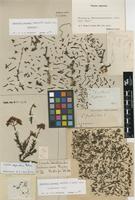
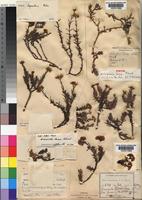
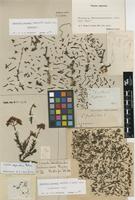
Crassula fruticulosaL. [family CRASSULACEAE ] Crassula harveyiBritten & Baker f. [family CRASSULACEAE ] Verified by Schonland, S., Crassula dependensBolus [family CRASSULACEAE ] (stored under name); Verified by Tolken, H.R., Crassula laxaSchönland [family CRASSULACEAE ]
Related name
Crassula acutifolia
Crassula dependens
Crassula harveyi
Crassula laxa
Crassula fruticulosa
Flora
Entry for CRASSULA fruticulosa Linn.? [family CRASSULACEAE]
Herbarium
Royal Botanic Gardens, Kew (K)
Collection
Flora Capensis
Resource Type
Reference Sources
Entry From
Flora Capensis, Vol 2, page 327, (1894) Author: (By W. H. HARVEY).
Names
CRASSULA fruticulosaLinn.? [family CRASSULACEAE], ;—Zey! Z. n. N. n. E. 109. 2.
Information
stem suffruticose, spreading, branching; leaves connato-perfoliate, fleshy, subulate, acuminate, glabrous, longer than the internodes; cymes terminal, pedunculate, corymbose, with subulate bracts, few-flowered; calyx-lobes one-third of petals, broadly lanceolate, keeled, subacute; petals connate at base, oblong, subacute, suberect; styles subulate. This has the foliage nearly of C. acutifolia, but larger flowers and proportionably longer petals. Flowers white, 2–2 1/2 lines long. Leaves an inch or 1 1/4 inch long, shrivelling. The specimens are much broken.