JSTOR Global Plants Home
  • Home
  • Browse
  • About
  • Access
  • Account
    • Saved Items
    • Profile
  • Log in

Global Plants

Skip to Main Content
  • JSTOR Global Plants Home
  • Global Plants

    • Browse
    • About
    • Access
    • Account
      • Saved Items
      • Profile
Log in
  • Browse
  • About
  • Access
  • Account
    • Saved Items
    • Profile
Advanced Search

Compilation
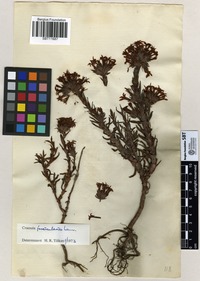
Crassula fascicularis

3 Images see all

Filed as Crassula fascicularis Lam. [family CRASSULACEAE]
Previous
Next

Name

Identification
Crassula fascicularis Lam. [family CRASSULACEAE ] (stored under name); Verified by HBG-formal name change, 2008 Rochaea odoratissima (Andr.) Link [family CRASSULACEAE ] Verified by Not on sheet,
Related name
  • Rochaea odoratissima
  • Crassula subulata
  • Crassula fascicularis

Flora

Entry for Crassula fascicularis [family CRASSULACEAE]
Herbarium
South African National Biodiversity Institute, Compton Herbarium, Cape Town (SAM)
Collection
Flora of Southern Africa
Resource Type
Reference Sources
Entry From
Flora of South Africa, (2003) Author: Dr J.P. Roux
Names
Crassula fascicularis [family CRASSULACEAE]
Common names
Larochea fascicularis (Lam.) J. A. Schultes, Syst. Veg. 6: 709 (1820). Rochea fascicularis (Lam.) DC, Prodr. 3: 394 (1828). Kalosanthes fascicularis (Lam.) G. Don, Gen. Syst. 3: 108 (1834). Crassula subulata sensu Berg., PI. Cap. 83 (1767); sensu L., Mant. Alt. 360 (1771); sensu Thunb., Prodr. 55 (1794); Fl. Cap. edn Schultes 284 (1823), non L. Ro­chea subulata (L.) Adamson in Jl S. Afr. Bot. 8: 277 (1942), pro parte; in Adamson & Salter. Fl. Cape Penins. 438 (1950), pro parte; Rice & Compton, Wild Flow. CapeG. H. pi.48,2(1951),pro parte,typoexcl. Crassula odoratissima Andr., Bot. Rep. 1, pi. 26 (1797); Jacq., Hort Schoenbr. 4: 17, pi. 434 (1804); Dietr., Syn. PI. 2: 1032 (1840). Larochea odoratissima (Andr.) Haw., Syn. PI. Succ. 51 (1812); Schultes, Syst. Veg. 6: 708 (1820). Kalosanthes odoratissima (Andr.) Haw., Rev. PI. Succ. 7 (1821). Rochea odoratissima (Andr.) Link, Enum. PI. Hort. Berol. 2: 300 (1821); DC, Prodr. 3: 394 (1828); Harv. in F.C. 2: 369 (1862); Marloth, Fl. S. Afr. 2, 1: 24, pi. 7B (1926); Phill. in Flower. PI. S. Afr. 18, pi. 694 (1938). Dietrichia odora­tissima (Andr.) Tratt. ex Eckl. & Zeyh., Enum. 305 (1837). Type: Bot. Rep. 1, pi. 26. Crassula biconvexa Haw., Misc. 176 (1803); Syn. PI. Succ. 53 (1812); Dietr., Syn. PI. 2: 1032 (1840). Kalo­santhes biconvexa (Haw.) Haw. in Phil. Mag. 64: 165 (1824). Rochea biconvexa (Haw.) DC, Prodr. 3: 394 (1828). Type: plate 766 (K, lecto.!). Larochea cymosa (Berg.) Haw., Syn. PI. Succ. 50 (1812), pro parte, typo excl. Kalosanthes cymosa (Berg.) Haw., Rev. PI. Succ. 7 (1821), pro parte, typo excl. Kalosanthes bicolor Haw., Rev. PI. Succ. 7 (1821). Rochea odoratissima (Andr.) Link var. bicolor (Haw.) DC, Prodr. 3: 394 (1828). Dietrichia bicolor (Haw.) Eckl. & Zeyh., Enum. 305 (1837). Rochea bicolor (Haw.) Steud., Nom. edn 2, 2: 462 (1840). Type: plate 766 (K, lecto.!). Kalosanthes media Haw., Rev. PI. Succ. 7 (1821). Rochea media (Haw.) DC, Prodr. 3: 394 (1828). Dietrichia media (Haw.) Eckl. & Zeyh., Enum. 304 (1837). Crassula media (Haw.) Dietr., Syn. PI. 2: 1032 (1840). Type: unknown. Crassula capitata Lodd., Bot. Cab. 11, pi. 1029 (1825), non Lam. Kalosanthes capitata (Lodd.) Sweet, Hort. Brit, edn 2, 224 (1830). Rochea odoratissima (Andr.) Link var. alba DC, Prodr. 3: 394 (1828). Kalo­santhes odoratissima (Andr.) Haw. var. alba (DC) G. Don, Gen. Syst. 3: 107 (1834). Type: Bot. Cab. 11, pi. 1029. Larochea tiniflora Lem. in Illustr. Hort. sub. pi. 269 (1861). Type: unknown. Rochea versicolor sensu Harv. in F.C. 2: 369 (1862), pro parte, non (Ker-Gawl.) Link.
Information
Perennials with erect branches up to 0,4 m high, more or less branched, branches 2-4 mm in diameter, internodes visible between leaves, not rooting at nodes, old leaves not deciduous. Leaves linear-lanceolate, (15-)20-35 x (l-)2-3 mm, acute or obtuse, spreading or erect, usually dorsiventrally flattened or more or less convex on both surfaces, sometimes slightly cymbiform, usually with recurved cilia, scarcely fleshy, green to brown. Inflorescence a cymose-cap-titate thyrse with one to few dichasia with flowers sessile (or almost so), without pe­duncle. Calyx: lobes lanceolate, 10-13 mm long, usually of different lengths, acute, with spreading or recurved cilia, slightly fleshy, green to brown. Corolla tubular, fused at base for 4-5 mm, cream or pale yel­lowish green, rarely white tinged pink; lobes elliptic-oblong, 20-32 mm long, acute and slightly hooded, with recurved parts 2-3 mm broad. Stamens with black anthers. Squa­mae narrowly oblong, 0,8-1 x 0,1-0,2 mm, usually truncate, slightly constricted down­wards, fleshy, yellow.
Habitat
Most of the variation present in this species is due to environment. At times the leaves are as small as those of C. obtusa (below), but plants of C. fascicularis can always be recognised by the sessile flowers, by the base of each flower being partly covered by bracts, and by the narrow petal apices. Under particularly favour­able conditions the leaves might be as much as 3-4 mm broad, which is within the range of C. coccinea (no. 83) but the latter species is easily distinguished as it usually has larger flowers and the leaves tend to be 2-3 times longer than broad.
Use
81. Crassula fascicularis Lam., Encycl. 2: 171 (1786); Tolken in Contr. Bolus Herb. 8: 311 (1977). Type: Caput Bonae Spei, sine leg. (P-LA, holo.!).
Range
Found in the south-western Cape Province from near Vanrhynsdorp to near Bredasdorp; growing in gravelly or sandy soils on slopes in fynbos. Flowering period: (September) October, November.

Related Materials

  • Terms and Conditions
  • Privacy Policy
  • Cookie Policy
  • Cookie Settings
  • Accessibility
  • Help
  • Contact Us
  • Facebook
  • Twitter
ITHAKA

JSTOR is part of ITHAKA, a not-for-profit organization helping the academic community use digital technologies to preserve the scholarly record and to advance research and teaching in sustainable ways.

©2000-2026 ITHAKA. All Rights Reserved. JSTOR®, the JSTOR logo, JPASS®, Aluka®, and ITHAKA® are registered trademarks of ITHAKA.

╳