

Compilation
Crassula clavata
1 Images see all
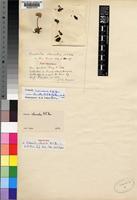
Name
Identification
Crassula clavata N.E.Br. [family CRASSULACEAE ] (stored under name); Verified by Tolken, H.R., Crassula inamoena N.E.Br. [family CRASSULACEAE ] Verified by Tolken, H.R., Crassula clavata N.E.Br. [family CRASSULACEAE ] Verified by Brown, N.E.,
Related name
- Crassula clavata
- Crassula inamoena
Flora
Entry for Crassula clavata [family CRASSULACEAE]
Herbarium
South African National Biodiversity Institute, Compton Herbarium, Cape Town (SAM)
Collection
Flora of Southern Africa
Resource Type
Reference Sources
Entry From
Flora of South Africa, (2003) Author: Dr J.P. Roux
Names
Crassula clavata [family CRASSULACEAE]
Information
Perennials, usually with several basal rosettes, sparsely or rarely much branched, with carnose to slightly woody branches, with old leaves not deciduous. Leaves ob-lanceolate to obovate or elliptic, rarely lin-ear-oblanceolate, 20-40(-60) x 5-13 mm, obtuse to rounded, flat or slightly convex above, very much convex below, recurved and more or less flat on the ground, rarely stiffly erect, glabrous, rarely with short hairs and/or marginal cilia, usually purplish red, rarely yellowish green or green. InfloresÂcence an elongate thyrse with many dichasia (i.e. part-inflorescences are produced by 3-5 nodes of central axis), with peduncle 0,l-0,2(-0,3) m long, glabrous or with fine hairs. Calyx: lobes oblong-triangular, l,5-2(-2,5) mm long, obtuse, with fine hairs or papillae and short marginal cilia, fleshy, green to red. Corolla tubular to almost cyÂlindrical, fused at base for 0,8-1 mm, cream to pale yellow; lobes panduriform, 2,5-3,5 mm long, each with almost spherical dorsal appendage in terminal position and with membranous apex on inside. Stamens with yellow anthers. Squamae oblong-cuneate, 0,6-1 x 0,4-0,6 mm, truncate to slightly emarginate, usually at first abruptly, later gradually constricted towards base, fleshy, yellow to orange.
Habitat
Although this species has quite small flowers it is often a distinct feature of the vegetation on the Gif-berg, Cedarberg range and Skurfteberge, because of its deep purplish red leaves. Plants on the Knersvlakte are usually much more robust, and their leaves are reÂcurved and usually flat on the ground as in plants from the mountains from the Gifberg to the Skurfteberge. On the lower slopes a very abrupt transition occurs beÂtween the forms with long and with short leaves, but it could not be conclusively shown whether this was due to hybridization or to a cline.
Use
147. Crassula clavata N.E. Br. in Kew Bull. 1914: 167 (1914); Schonl. in Trans. R. Soc. S. Afr. 17: 279 (1929); Tolken in Contr. Bolus Herb. 8: 543 (1977). Type: Cape, Prince Albert Division, Pearson s.n. (K, holo.!).
Range
Found in the Cape Province from a single locality at the top of Helskloof to Vanrhynsdorp where it is ofÂten common along the mountains west of the Tanqua Karoo and south of the great Karoo as far east as Prince Albert; growing in rock crevices or often on shallow soil on rocks, usually on sandstone or quartzite outÂcrops. Flowering period: September, October.