JSTOR Global Plants Home
  • Home
  • Browse
  • About
  • Access
  • Account
    • Saved Items
    • Profile
  • Log in

Global Plants

Skip to Main Content
  • JSTOR Global Plants Home
  • Global Plants

    • Browse
    • About
    • Access
    • Account
      • Saved Items
      • Profile
Log in
  • Browse
  • About
  • Access
  • Account
    • Saved Items
    • Profile
Advanced Search

Compilation
Crassula browniana

2 Images see all

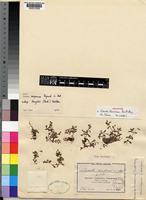
Holotype of Crassula browniana Burtt Davy [family CRASSULACEAE]
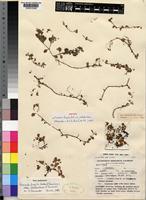
Isotype of Crassula fragilis Baker subsp. suborbicularis R. Fernandes [family CRASSULACEAE]
Previous
Next

Name

Identification
Crassula browniana Burtt Davy [family CRASSULACEAE ] Verified by Burtt Davy, J., Crassula expansa Dryand. in Ait. [family CRASSULACEAE ] (stored under name); Verified by Tolken, H.R., Crassula diaphana Drège ex Harv. [family CRASSULACEAE ]
Related name
  • Crassula fragilis
  • Crassula browniana
  • Crassula diaphana
  • Crassula expansa

Flora

Entry for Crassula fragilis var. fragilis [family CRASSULACEAE]
Herbarium
Royal Botanic Gardens, Kew (K)
Collection
Flora Zambesiaca
Resource Type
Reference Sources
Entry From
FZ, Vol 7, Part 1, page 3, (1983) Author: R. Fernandes
Names
Crassula furcata Schönl. [family CRASSULACEAE], in S. Afr.Journ. Sci. 17, 2: 188 (1921) nom. nud., non (Eckl. & Zeyh.) Endl. ex Walp. (1843).
Crassula browniana Burtt Davy [family CRASSULACEAE], F.P.F.T. 1: 38, 141 (1926). — Schönl. in Trans. Roy. Soc. S. Afr. 17, 3: 185 (1929). — Berger in Engl. & Prantl, Nat. Pflanzenfam. ed 2, 18a: 388(1930). — Suesseng. & Merxm. in Trans. Rhod. Sci. Assoc .43: 15 (1951). — Wild in Rhod. Agr. Journ. 49, 5: 286 (1952); Fl. Vict. Falls: 143 (1953). — Jacobs., Das Sukk. Lexikon: 140 (1970). — Schijff & Schoonr. in Bothalia 10, 3: 489 (1971). — J. H. Ross, Fl. Natal: 179 (1972). Type from Transvaal.
Crassula fragilis var. fragilis [family CRASSULACEAE]
Habitat
In humus-pockets in rock crevices, on termite mounds, in wet, shady situations in bush, tree savanna, riverine forests, etc.
Distribution
Mozambique M 9 miles N. of Moamba, c. 96 m., 29.ix.1963, Leach & Bayliss 11746 (COI; K; LISC; SRGH).Zimbabwe S Chibi, Nyoni Hills, 3.iii.1970, Mavi 1061 (K; PRE; SRGH).Zimbabwe E Umtali, cliffs of W. slope of Murakwa’s Hill, Commonage, c. 1300 m., Chase 8156 (K; LISC; SRGH).Zimbabwe C Salisbury, Prince Edward Dam, c. 1600 m., 8.i.1952, Wild 3741 (K; LISC; SRGH).Zimbabwe W Bulalima-Mangwe, about 10 km. N. of Marula on road to Mananda Dam, 20.iv.1972, Grosvenor 748 (COI; SRGH).Mozambique MS ridge ascending Garuso, iv.1935, Gilliland 1958 (BM; K).Zambia S Victoria Falls, 10.iv.1955, E. M. & W. 1453 (BM; LISC; SRGH).Zimbabwe N Lomagundi, Farm Whindale below “The Cliffs”, c. 1230 m., 18.ii.1968, Jacobsen 3386 (PRE; SRGH).
Distribution (external)
Angola
Swaziland
S. Africa (Natal, Transvaal and the Cape Prov.)
Madagascar
Notes
Similar to C. expansa subsp. expansa but differing in the following characters: habit usually procumbent, with thicker, longer stems and branches; leaves thinner, always flat, larger and relatively broader (2·5-13 mm. broad as against up to 3 mm. in C. expansa); hydathodes scattered over the upper leaf surface (compared with the situation in C. expansa where they are in 1-2 marginal rows); pedicels shorter in fruit; calyx, filaments, anthers and follicles usually a little longer; indumentum present on stem, leaves, pedicels and calyx. Specimens of C. fragilis from the African continent have larger anthers and longer styles than the holotype, Baron 3348 (K) which is from Madagascar. Thus, the mainland plants, corresponding with C. browniana Burrt Davy, have anthers and styles c. 0·5 mm. long, whereas in Baron 3348 they are c. 0·25 mm. long. We have seen only this one specimen from Madagascar. Should the differences just noted be constant, the continental plant would perhaps be considered as a distinct variety or form. C. thorncroftii Burtt Davy and C. woodii Schönl. are placed as synonyms of C. fragilis by Tölken (loc. cit., 1977). However, from their descriptions, both are completely glabrous (even on the calyx) and have shorter pedicels than the latter. C. woodii, in addition, has smaller sepals and petals. Both taxa are placed by Schönland (tom. cit.: 1929) in a different section from C. fragilis (as C. browniana). C. zimmermannii Engl. from Tanzania (Usambara) seems from description to be close to C. fragilis, but the type is apparently lost. The specimen Leach & Bayliss 11746 has a stronger, not hispidulous but only shortly papillose-puberlous stem, relatively broader leaves and slightly larger flowers than most of the specimens.

Related Materials

  • Terms and Conditions
  • Privacy Policy
  • Cookie Policy
  • Cookie Settings
  • Accessibility
  • Help
  • Contact Us
  • Facebook
  • Twitter
ITHAKA

JSTOR is part of ITHAKA, a not-for-profit organization helping the academic community use digital technologies to preserve the scholarly record and to advance research and teaching in sustainable ways.

©2000-2026 ITHAKA. All Rights Reserved. JSTOR®, the JSTOR logo, JPASS®, Aluka®, and ITHAKA® are registered trademarks of ITHAKA.

╳