JSTOR Global Plants Home
  • Home
  • Browse
  • About
  • Access
  • Account
    • Saved Items
    • Profile
  • Log in

Global Plants

Skip to Main Content
  • JSTOR Global Plants Home
  • Global Plants

    • Browse
    • About
    • Access
    • Account
      • Saved Items
      • Profile
Log in
  • Browse
  • About
  • Access
  • Account
    • Saved Items
    • Profile
Advanced Search

Compilation
Corispermum villosum

11 Images see all

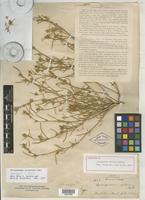
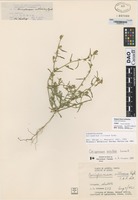
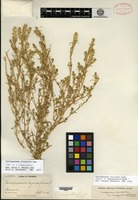
Isotype of Corispermum villosum Rydberg, P.A. 1897 [family CHENOPODIACEAE]
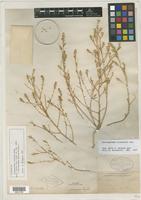
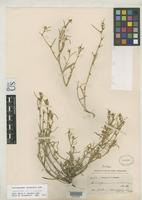
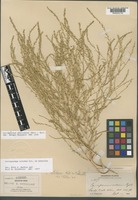
Isotype of Corispermum emarginatum Rydb. [family AMARANTHACEAE]
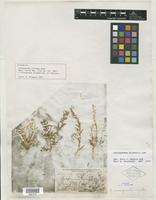
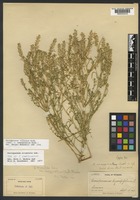
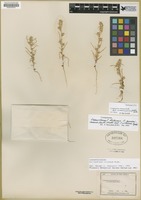
Holotype of Corispermum welshii Mosyakin [family AMARANTHACEAE]
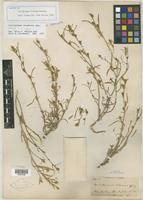
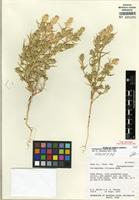
Type of Corispermum emarginatum Rydberg [family CHENOPODIACEAE]
Syntype of Corispermum villosum Rydb. [family CHENOPODIACEAE]
Isotype of Corispermum villosum Rydb. [family CHENOPODIACEAE]
not on sheet of Corispermum villosum Rydberg [family CHENOPODIACEAE]
Paratype of Corispermum marginale Rydb. [family AMARANTHACEAE]
Filed as Corispermum villosum Rydb. [family AMARANTHACEAE]
Holotype of Corispermum villosum Rydb. [family CHENOPODIACEAE]
Syntype of Corispermum villosum Rydb. [family CHENOPODIACEAE]
Previous
Next

Name

Identification
Corispermum welshii Mosyakin [family AMARANTHACEAE ] (stored under name); Verified by S.L. Mosyakin,, Corispermum villosum Rydb. [family AMARANTHACEAE ] Verified by Not on sheet,
Related name
  • Corispermum welshii
  • Corispermum villosum
Common name
  • Hairy bugseed, Flora of North America Vol. 4

Flora

Entry for Corispermum villosum Rydberg [family CHENOPODIACEAE]
Herbarium
Flora of North America (FNA)
Collection
Flora of North America
Resource Type
Reference Sources
Entry From
Flora of North America, Vol 4,
Names
Corispermum villosum Rydberg [family CHENOPODIACEAE], Bull. Torrey Bot. Club, 24: 191. 1897
Corispermum emarginatum Rydberg [family CHENOPODIACEAE]
Corispermum orientale Lamarck var. emarginatum (Rydberg) J. F. Ma cbride [family CHENOPODIACEAE]
Past names
Coriospermum
Treatment Author(s)
Sergei L. Mosyakin
Information
Plants usually branched from the base, (5–)10–30(–35) cm, densely or sparsely covered with dendroid or stellate hairs (rarely with scattered papillae at margins of bracts), occasionally becoming glabrous. Leaf blades linear-oblanceolate, linear, or rarely narrowly linear (usually rather abruptly narrowed into mucronulate apex), usually plane, (1–)1.5–3.5 × (0.1–)0.2–0.3 cm. Inflorescences rather compact, dense, condensed in distal 1/2, occasionally interrupted in proximal 1/2, usually clavate or clavate-linear (rarely ± ovate). Bracts ovate, ovate-lanceolate, or narrowly ovate-lanceolate, 0.5–1.5(–2.5) × (0.3–)0.5–1 cm. Perianth segment 1. Fruits yellowish brown, light brown, or dark brown, usually with reddish brown spots and occasionally whitish warts, strongly convex abaxially, plane or slightly convex (occasionally slightly concave) adaxially, elliptic or obovate-elliptic, usually broadest beyond middle, 1.8–3(–3.2) × 1.5–2 mm, dull; wing absent or to 0.1(–0.15) mm wide, margins entire, apex triangular.
Phenology
jun-aug (summer), sep-nov (fall)
Distribution
elevation not knownUSA Colo.USA IdahoUSA Ill.USA Minn.USA Mo.USA Mont.USA N.Dak.USA Oreg.USA UtahUSA Wash.USA Wis.USA Wyo.Canada Alta.Canada Ont.Canada Que.Canada Sask.
Discussion
Corispermum villosum may also occur in British Columbia, Manitoba, Nevada, South Dakota, and Utah. It is probably introduced rather than native in Ontario (where it is found mostly in Thunder Bay district, known for its grain elevators and mills), Quebec, and Wisconsin. Plants from Minnesota and North Dakota are transitional toward C. americanum.
Corispermum villosum is also distinguished by having style bases forming a triangular “beak” distinctly protruding over the edge of the wing/fruit. Some specimens of C. villosum are very similar to the small-fruited and narrow-winged European representatives of C. pallasii. Together with some Eurasian species, C. pallasii, C. americanum, and C. villosum belong to the same group of closely related species, and occasional transitional forms between these taxa are not uncommon in North American material.
The names Corispermum orientale Lamarck and C. hyssopifolium were commonly misapplied to C. villosum.

Related Materials

  • Terms and Conditions
  • Privacy Policy
  • Cookie Policy
  • Cookie Settings
  • Accessibility
  • Help
  • Contact Us
  • Facebook
  • Twitter
ITHAKA

JSTOR is part of ITHAKA, a not-for-profit organization helping the academic community use digital technologies to preserve the scholarly record and to advance research and teaching in sustainable ways.

©2000-2026 ITHAKA. All Rights Reserved. JSTOR®, the JSTOR logo, JPASS®, Aluka®, and ITHAKA® are registered trademarks of ITHAKA.

╳