JSTOR Global Plants Home
  • Home
  • Browse
  • About
  • Access
  • Account
    • Saved Items
    • Profile
  • Log in

Global Plants

Skip to Main Content
  • JSTOR Global Plants Home
  • Global Plants

    • Browse
    • About
    • Access
    • Account
      • Saved Items
      • Profile
Log in
  • Browse
  • About
  • Access
  • Account
    • Saved Items
    • Profile
Advanced Search

Compilation
Corispermum pacificum

10 Images see all

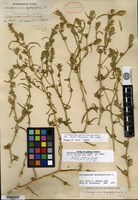
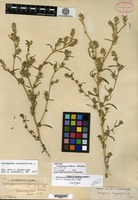
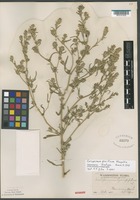
Isotype of Corispermum pacificum Mosyakin, S. 1995 [family CHENOPODIACEAE]
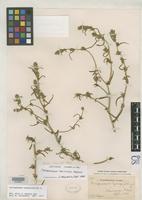
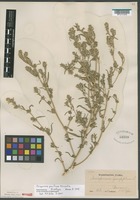
Paratype of not on sheet [family NOT ON SHEET]
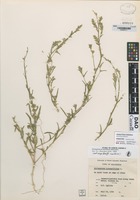
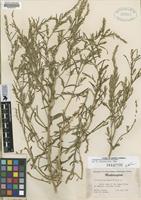
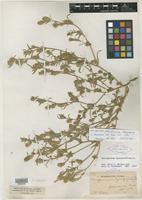
Isotype of Corispermum pacificum Mosyakin [family CHENOPODIACEAE]
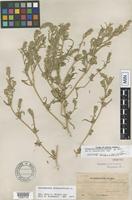
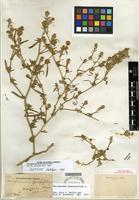
Paratype of Corispermum pacificum [family CHENOPODIACEAE]
Isotype of Corispermum pacificum Mosyakin [family AMARANTHACEAE]
Isotype of Corispermum pacificum Mosyakin [family CHENOPODIACEAE]
Holotype of Corispermum pacificum Mosyakin [family CHENOPODIACEAE]
Previous
Next

Name

Identification
Isotype of Corispermum pacificum Mosyakin [family CHENOPODIACEAE ] (stored under name); Verified by S.L. Mosyakin, 1994 Corispermum pacificum Mosyakin [family CHENOPODIACEAE ] Verified by Not on sheet,
Related name
  • Corispermum hyssopifolium
  • Corispermum pacificum
Common name
  • Pacific bugseed, Flora of North America Vol. 4

Flora

Entry for Corispermum pacificum Mosyakin [family CHENOPODIACEAE]
Herbarium
Flora of North America (FNA)
Collection
Flora of North America
Resource Type
Reference Sources
Entry From
Flora of North America, Vol 4,
Names
Corispermum pacificum Mosyakin [family CHENOPODIACEAE], Novon, 5: 345, fig. 1A. 1995
Treatment Author(s)
Sergei L. Mosyakin
Information
Plants usually branched from base, (5–)15–40 cm, glabrous or sparsely covered with dendroid hairs (especially when young). Leaf blades narrowly lanceolate, linear-lanceolate, or linear, flat or nearly so, 2–5(–7) × 0.2–0.6 cm. Inflorescences usually compact, rather dense, or sometimes ± lax, condensed only near apex, ovoid, oblong-ovate, obovate, broadly linear, or occasionally clavate. Bracts ovate-lanceolate, narrowly ovate-lanceolate, almost ovate, or lanceolate, (1–)1.5–2.5 × 0.3–0.7(–0.9) cm. Perianth segment 1, sometimes absent in distal flowers. Fruits usually black (rarely deep olive green, especially when immature), sharply contrasting with greenish semitransparent wings, without spots and warts, slightly convex abaxially, flat or slightly concave adaxially, orbiculate-obovate to almost orbiculate, broadest near middle (or occasionally slightly beyond), 3–4 × 2.7–3.8 mm, shiny; wing translucent, thin, (0.2–)0.3–0.6 mm wide, margins slightly undulate or indistinctly erose-denticulate, apex rounded or occasionally indistinctly notched.
Conservation Status
of conservation concern;
Phenology
jun-aug (summer), sep-nov (fall)
Altitude range
0–500 m;
Distribution
USA IdahoUSA Oreg.USA Wash.
Discussion
Corispermum pacificum seems to be closely related to Siberian C. crassifolium Turczaninov and C. maynense Ignatov. The latter species occurs in the northeastern Russian Far East and may be expected to occur in Alaska. Corispermum pacificum differs from C. maynense by its usually more robust habit, and its wing rounded (rarely rounded-truncate or indistinctly emarginate, but not triangular) at apex. From C. crassifolium it may be distinguished by the constant presence of perianth segments, and more flattened black mature fruits. Corispermum pacificum probably also occurs in adjacent regions of British Columbia. Corispermum pacificum is placed in subsect. Crassifolia (S. L. Mosyakin 1997). This subsection seems to be of Siberian origin, with its central species, C. crassifolium, being closest to the hypothetic ancestral taxon. The presence of perianth segments in C. pacificum may be explained by ancient hybridization with representatives of subsect. Pallasiana.
Reproductive isolation between the sympatric species of Corispermum may be achieved by different flowering periods. Occasional hybrids between C. pacificum and C. villosum are similar in their habit to C. pacificum in having usually broad leaves and rather dense inflorescences but they have mostly aborted fruits suggesting that C. pacificum and C. villosum are taxonomically distant species.

Related Materials

  • Terms and Conditions
  • Privacy Policy
  • Cookie Policy
  • Cookie Settings
  • Accessibility
  • Help
  • Contact Us
  • Facebook
  • Twitter
ITHAKA

JSTOR is part of ITHAKA, a not-for-profit organization helping the academic community use digital technologies to preserve the scholarly record and to advance research and teaching in sustainable ways.

©2000-2026 ITHAKA. All Rights Reserved. JSTOR®, the JSTOR logo, JPASS®, Aluka®, and ITHAKA® are registered trademarks of ITHAKA.

╳