JSTOR Global Plants Home
  • Home
  • Browse
  • About
  • Access
  • Account
    • Saved Items
    • Profile
  • Log in

Global Plants

Skip to Main Content
  • JSTOR Global Plants Home
  • Global Plants

    • Browse
    • About
    • Access
    • Account
      • Saved Items
      • Profile
Log in
  • Browse
  • About
  • Access
  • Account
    • Saved Items
    • Profile
Advanced Search

Compilation
Corispermum marginale

3 Images see all

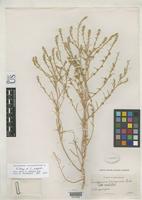
Isotype of Corispermum marginale Rydberg, P.A. 1903 [family CHENOPODIACEAE]
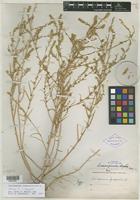
Holotype of Corispermum marginale Rydb. [family CHENOPODIACEAE]
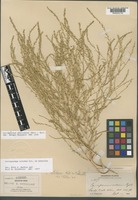
Paratype of Corispermum marginale Rydb. [family AMARANTHACEAE]
Previous
Next

Name

Identification
Corispermum marginale Rydb. [family CHENOPODIACEAE ] (stored under name); Verified by Not on sheet,
Related name
  • Corispermum marginale
Common name
  • American bugseed, Flora of North America Vol. 4

Flora

Entry for Corispermum americanum (Nuttall) Nuttall [family CHENOPODIACEAE]
Herbarium
Flora of North America (FNA)
Collection
Flora of North America
Resource Type
Reference Sources
Entry From
Flora of North America, Vol 4,
Names
Corispermum americanum (Nuttall) Nuttall [family CHENOPODIACEAE], Trans. Amer. Philos. Soc., n. s., 5: 165. 1834
Corispermum hyssopifolium Linnaeus var. americanum Nuttall [family CHENOPODIACEAE], Gen. N. Amer. Pl., 1: 4. 1818
Corispermum imbricatum A. Nelson [family CHENOPODIACEAE]
Corispermum marginale Rydberg [family CHENOPODIACEAE]
Corispermum simplicissimum Lunell [family CHENOPODIACEAE]
Treatment Author(s)
Sergei L. Mosyakin
Information
Plants branched from or beyond base (rarely simple or with few simple branches), 10–35(–50) cm, sparsely covered with dendroid or stellate hairs, often becoming glabrous. Leaf blades linear or narrowly linear (occasionally linear-lanceolate or almost filiform), usually plane or occasionally folded (especially in dry plants), 1.5–3.5(–4) × 0.1–0.3 cm. Inflorescences usually lax, interrupted, rarely ± condensed distally, linear, narrowly linear, or occasionally narrowly clavate. Bracts ovate-lanceolate,lanceolate, linear-lanceolate, or occasionally proximal ones almost linear, much longer than distal, 0.5–2(–3.5) × (0.2–)0.3–0.7 cm. Perianth segment 1. Fruits yellowish brown, greenish brown, light brown, or brown, often with reddish brown spots and whitish warts, slightly convex abaxially, usually plane or slightly concave adaxially, obovate or obovate-elliptic, usually broadest beyond middle, (2.3–)2.5–4.5 × 2–3.5 mm, shiny or dull; wing translucent, thin, (occasionally translucent only at margin, thick), (0.15–)0.2–0.3(–0.4) mm wide, margins entire or rarely indistinctly erose, apex broadly triangular, less commonly truncate or rounded.
Distribution
North AmericaMexico.
Discussion
Corispermum americanum var. americanum may also occur in British Columbia, where only immature specimens have been seen. Specimens from Oregon and Wyoming are transitional toward Corispermum villosum. The names C. hyssopifolium and C. nitidum were commonly misapplied to this native species by many authors (see also note under C. nitidum).

Related Materials

  • Terms and Conditions
  • Privacy Policy
  • Cookie Policy
  • Cookie Settings
  • Accessibility
  • Help
  • Contact Us
  • Facebook
  • Twitter
ITHAKA

JSTOR is part of ITHAKA, a not-for-profit organization helping the academic community use digital technologies to preserve the scholarly record and to advance research and teaching in sustainable ways.

©2000-2026 ITHAKA. All Rights Reserved. JSTOR®, the JSTOR logo, JPASS®, Aluka®, and ITHAKA® are registered trademarks of ITHAKA.

╳