JSTOR Global Plants Home
  • Home
  • Browse
  • About
  • Access
  • Account
    • Saved Items
    • Profile
  • Log in

Global Plants

Skip to Main Content
  • JSTOR Global Plants Home
  • Global Plants

    • Browse
    • About
    • Access
    • Account
      • Saved Items
      • Profile
Log in
  • Browse
  • About
  • Access
  • Account
    • Saved Items
    • Profile
Advanced Search

Compilation
Cordia torrei

3 Images see all

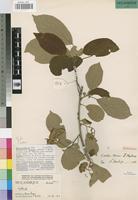
Holotype of Cordia torrei E.Martins [family BORAGINACEAE]
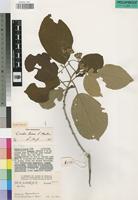
Isotype of Cordia torrei E.Martins [family BORAGINACEAE]
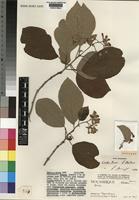
Cordia torrei E.S.Martins [family BORAGINACEAE]
Previous
Next

Name

Identification
Cordia torrei E.S.Martins [family BORAGINACEAE ] (stored under name); Verified by [Illegible], Cordia unrecorded unrecorded [family BORAGINACEAE ]
Related name
  • Cordia unrecorded
  • Cordia torrei

Flora

Entry for Cordia torrei E. Martins [family BORAGINACEAE]
Herbarium
Royal Botanic Gardens, Kew (K)
Collection
Flora Zambesiaca
Resource Type
Reference Sources
Entry From
FZ, Vol 7, Part 4, page 59, (1990) Author: E. S. Martins (Trichodesma by R. K. Brummit)
Names
Cordia torrei E. Martins [family BORAGINACEAE], in Garçia de Orta, Sér. Bot. 9, 1–2: 71, t. 2 (1988). Type: Mozambique, Monapo, 7 km. from Namialo to Meserepane, Torre & Paiva 9261 (LISC, holotype).
Information
Shrub c. 5 m. high, dioecious, deciduous; branches densely clothed with grey-brownish appressed 2-branched, medifixed and shortly pediculated trichomes 0.5–1.0 mm. long, soon glabrescent, mature light grey and marked with prominent leaf-scars. Leaves alternate; petiole 1.5–3.3 cm. long, slender, with indumentum as on the young branches; lamina 5.5–12.0 x 3.0–7.5 cm., obovate to elliptic, on mature leaves glabrous or subglabrous above, shortly woolly below, the trichomes easily removable, green-brownish or brown above, grey-yellowish or grey-brownish below in sicco, subacute, acute or acuminate to obtuse acuminate or rounded at apex, subacute to rounded at base, margins subentire to irregularly serrate-dentate, papery, with 4–6 secondary nerves on each side of the midrib, the lower ones subopposite appearing 3–5-nerved from or near base. Cymes arranged in a panicle 3–9 cm. long and 4–8 cm. wide with indumentum like the branches, peduncle as long as half of the whole, slender. Flowers subsessile. Female flowers with calyx 7–9 mm. long, narrowly infundibuliform, slightly ridged, minutely tomentose-woolly outside, puberulous inside, 4–5-toothed, the teeth soon eroded, papery; corolla (? white) glabrous, tube 6.5–8.0 mm. long, 1.5 mm. wide, cylindrical, lobes 4, 6.0–6.5 x 2.5–3.0 mm., oblanceolate, obtuse; staminodes 4, filaments c. 1 mm. long, sterile anthers c. 0.7 mm. long; ovary c. 2 mm. long, ovoid; style 10–11 mm. long, first-forked at 3–4 mm. and with stigmatic branches 4–6 mm. long, linear but a little flattened, denticulate. Male flowers and fruits unknown.
Habitat
In woodland with Sterculia appendiculata. Acacia nigrescens and Pterocarpus angolensis
Altitude range
c. 180 m.
180
180
Distribution
Mozambique N Nampula (Mozambique), Monapo, 7 km. from Namialo on the track to Meserepane, fl. 24.xi.1963, Torre & Paiva 9261 (C; COI; K; LISC; LMU).
Distribution (external)
Tanzania

Related Materials

  • Terms and Conditions
  • Privacy Policy
  • Cookie Policy
  • Cookie Settings
  • Accessibility
  • Help
  • Contact Us
  • Facebook
  • Twitter
ITHAKA

JSTOR is part of ITHAKA, a not-for-profit organization helping the academic community use digital technologies to preserve the scholarly record and to advance research and teaching in sustainable ways.

©2000-2026 ITHAKA. All Rights Reserved. JSTOR®, the JSTOR logo, JPASS®, Aluka®, and ITHAKA® are registered trademarks of ITHAKA.

╳