JSTOR Global Plants Home
  • Home
  • Browse
  • About
  • Access
  • Account
    • Saved Items
    • Profile
  • Log in

Global Plants

Skip to Main Content
  • JSTOR Global Plants Home
  • Global Plants

    • Browse
    • About
    • Access
    • Account
      • Saved Items
      • Profile
Log in
  • Browse
  • About
  • Access
  • Account
    • Saved Items
    • Profile
Advanced Search

Compilation
Cordia milleni

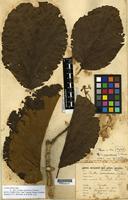
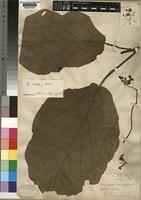
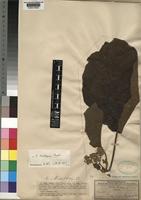
3 Images see all

Isotype of Cordia milleni Bak. [family BORAGINACEAE]
Type of Cordia longipes Baker [family BORAGINACEAE]
Previous
Next

Name

Identification
Cordia milleni Baker [family BORAGINACEAE ] (stored under name); Cordia longipes Baker [family BORAGINACEAE ]
Related name
  • Cordia unrecorded
  • Cordia longipes
  • Cordia milleni

Flora

Entry for CORDIA Milleni Baker [family BORAGINACEAE]
Herbarium
Royal Botanic Gardens, Kew (K)
Collection
Flora of Tropical Africa
Resource Type
Reference Sources
Entry From
Flora of Tropical Africa, Vol IV, Part 2, page 5, (1905) Author: (By J. G. Baker, with additions by C. H. Wright.)
Names
CORDIA Milleni Baker [family BORAGINACEAE], in Kew Bulletin, 1894, 27.
Information
A large tree, with stout woody branchlets. Leaves cordate-suborbicular, 6–8 in. long and broad, finely pubescent all over beneath; petiole reaching 3–4 in. long. Cymes forming an ample panicle, with long spreading branches. Calyx 1/4 in. long, densely coated with drab tomentum, faintly ribbed but not sulcate; tube oblong; lobes small, ovate, acuminate. Corolla-tube cylindrical, slightly longer than the calyx; limb 1/2 in. in diam.; lobes ovate-oblong, 4 lin. long, 1 1/2 lin. broad. Stamens inserted in the corolla-throat; filaments 1 1/2 lin. long, with a few long hairs near the base. Ovary conical, gradually tapering into the style, occasionally 6-celled; style-arms long, slender, fimbriate at the margins.
Distribution
Lagos Upper Guinea Inland forests, Millen, 12!
Notes
According to Millen, β€œthe wood is said not to be attacked by ants.”

Related Materials

  • Terms and Conditions
  • Privacy Policy
  • Cookie Policy
  • Cookie Settings
  • Accessibility
  • Help
  • Contact Us
  • Facebook
  • Twitter
ITHAKA

JSTOR is part of ITHAKA, a not-for-profit organization helping the academic community use digital technologies to preserve the scholarly record and to advance research and teaching in sustainable ways.

©2000-2026 ITHAKA. All Rights Reserved. JSTOR®, the JSTOR logo, JPASS®, Aluka®, and ITHAKA® are registered trademarks of ITHAKA.

╳