

Compilation
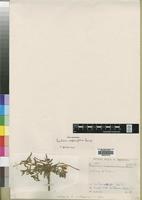
Corchorus mucilagineus
1 Images see all
Name
Identification
Corchorus mucilagineus Gibbs [family TILIACEAE ] Verified by Wild,H., 1958 Corchorus asplenifolius Burch. [family TILIACEAE ] (stored under name);
Related name
- Corchorus asplenifolius
- Corchorus mucilagineus
Flora
Entry for Corchorus asplenifolius Burch. [family TILIACEAE]
Herbarium
Royal Botanic Gardens, Kew (K)
Collection
Flora Zambesiaca
Resource Type
Reference Sources
Entry From
FZ, Vol 2, Part 1, page 33, (1963) Author: H. Wild
Names
Corchorus trilocularis [family TILIACEAE], sensu Eyles, tom. cit.: 410 (1916) pro parte quoad specim. Eyles.
Corchorus mucilagineus Gibbs [family TILIACEAE], in Journ. Linn. Soc., Bot. 37: 433 (1906). — Eyles in Trans. Roy. Soc. S. Afr. 5: 409 (1916). Type: S. Rhodesia, Matopos, Gibbs 8 (BM, holotype).
Corchorus serrifolius Burch. [family TILIACEAE], tom. cit.: 537 (1822). — Harv. in Harv. & Sond., F.C. 1: 229 (1860). — Bak. f. in Journ. Linn. Soc., Bot. 40: 33 (1911). — Eyles in Trans. Roy. Soc. S. Afr. 5: 410 (1916). — Burtt Davy, F.P.F.T. 1: 257 (1926). — Weim. in Bot. Notis. 1936: 36 (1936). — Mendonça & Torre, Contr. Conhec. Fl. Moçamb. 1: 25 (1950). Type from Cape Province (Asbestos Mts.).
Corchorus asplenifolius Burch. [family TILIACEAE], Trav. Int. S. Afr. 1: 400 (1822). — Harv. in Harv. & Sond., F.C. 1: 229 (1860). — Eyles in Trans. Roy. Soc. S. Afr. 5: 409 (1916). — Burtt Davy, F.P.F.T. 1: 257, fig. 39 (1926). — Martineau, S. Rhod. Wild Fl.: 46, t. 16 fig. 3 (1953). Type from Cape Province (Vaal River).
Information
Perennial herb, with prostrate or suberect annual stems from a woody rootstock; stems glabrous or with a line of short curly hairs on one side only, or with spreading hairs all round the stem as well as the line of short curly hairs. Leaf-lamina 1·5–8 × 0·2–1·5 cm., lanceolate, narrowly oblong or almost linear, apex acute or subacute, rounded or broadly cuneate at the base, dentate-crenate or serrate, toothing very variable in size, sometimes irregular or biserrate and from very coarsely to rather finely toothed, basal setae absent, glabrous on both surfaces or sparsely to densely hispid with tubercle-based hairs; petiole up to 1 cm. long, pubescent at least on the upper side; stipules up to 1 cm. long, setaceous, setulose-pubescent. Inflorescences of solitary 1–3-flowered cymes opposite or subopposite the upper leaf-axils; peduncle obsolete or up to 4 mm. long, pubescent or glabrous; pedicels similar, up to 5 mm. long; bracts c. 2·5 mm. long, setaceous, pubescent. Sepals 6–10 mm. long, linear to linear-oblanceolate, glabrous on both sides or setulose-pubescent at the back, acuminate but not caudate at the apex, not keeled. Petals yellow, the same length as the sepals, oblanceolate to obovate, with a basal ciliate claw c. 0·75 mm. long. Androgynophore c. 0·3 mm. long, extended above into a slightly undulate annulus. Stamens very numerous. Ovary trigonously subcylindric, very shortly setulose-pubescent, 3-locular; style 2–7 mm. long, glabrous. Capsule 2–3 cm. long, many-seeded, often on a rather twisted pedicel and therefore variable in its presentation, subcylindric not 3-angled, sparsely setulose-scabrid, attenuated to a blunt undivided apex. Seeds dark brown, 1·3–2 × 0·75–1·0 mm., shortly cylindric.
Habitat
This species is one of those which, without protection, are regularly burnt down to ground level in the dry season. It occurs in open woodland and at the margins of seasonal swamps (vleis or dambos).
Distribution
Zimbabwe S Beitbridge, fl. & fr. 15.ii.1955, E.M. & W. 427 (BM; LISC; SRGH).Zimbabwe E Inyanga, Cheshire, fl. & fr. 14.i.1931, Norlindh & Weimarck 4293 (BM; LD).Zimbabwe C Enkeldoorn, fl. 21.iii.1937, Eyles 8955 (SRGH).Zimbabwe W Shangani, fl. & fr. iii.1918, Eyles 946 (BM; K; SRGH).Zimbabwe N Urungwe, Kariba, fl. i.1956, Goodier 21 (K; SRGH).Botswana SE Mahalapye, fl. & fr. 3.i.1912, Rogers 6095 (BM; K; PRE; SRGH).Zambia S Mazabuka, fl. 15.xii.1931, Vet. Dept. CRS 544 (PRE).Botswana N Ngamiland, Kwebe Hills, fl. & fr. 18.i.1898, Lugard 115 (K).
Distribution (external)
Cape Prov
Transvaal
SW. Africa
Notes
Like so many species of this habit and ecology it is extremely polymorphic, but all the variations intergrade so freely that it hardly seems worth while to subdivide it even at the varietal level. As regards pubescence, for instance, every stage exists between the form with numerous bulbous-based hairs on the leaves, represented by the type of C. mucilagineus, and the quite glabrous leaves of the type of C. serrifolius. Unlike most species of this type, which flower mainly in the pre-rainy season, C. asplenifolius flowers mainly between December and March in the mid-rainy season.