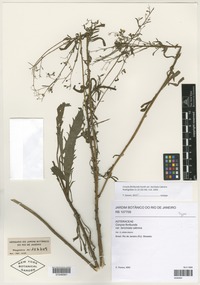
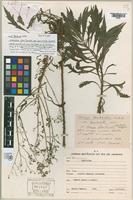
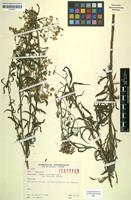
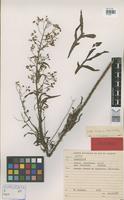
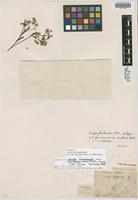
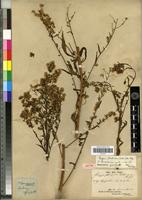
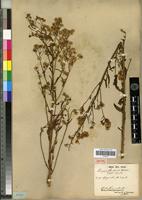
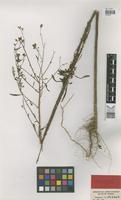
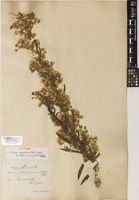
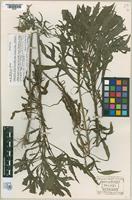
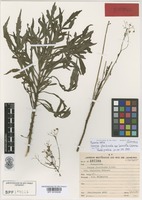
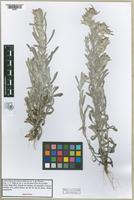
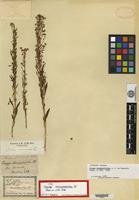
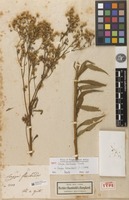
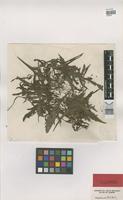
Conyza floribunda is thought to be native to South America.
In some floras of the past 50 or so years, Conyza bilbaoana has been treated as distinct from C. floribunda; in others, C. bilbaoana and C. floribunda have been treated as synonyms of C. bonariensis. For some traits (e.g., indument, phyllaries, florets), members of C. floribunda are intermediate to C. bonariensis and C. canadensis; some specimens that I have called C. floribunda may be hybrids. For example, a robust specimen from Santa Cruz Island, California, was originally labeled “C. bonariensis ×canadensis (?).” Locally (e.g., in Berkeley, California), C. canadensis usually comes into flower as C. bonariensis goes to seed. So far as sampled, C. canadensis is diploid; C. bonariensis is hexaploid. Pollen stainability in the Santa Cruz Island specimen is ca. 99%.
If treated as a variety of Conyza bonariensis, the correct name for the taxon treated here as C. floribunda is C. bonariensis var. leiotheca.
Some botanists, e.g., J. B. Marshall (1974), have treated the nomenclatural types of Conyza floribunda and C. sumatrensis (Retzius) E. Walker (= Erigeron sumatrensis Retzius) as conspecific.