JSTOR Global Plants Home
  • Home
  • Browse
  • About
  • Access
  • Account
    • Saved Items
    • Profile
  • Log in

Global Plants

Skip to Main Content
  • JSTOR Global Plants Home
  • Global Plants

    • Browse
    • About
    • Access
    • Account
      • Saved Items
      • Profile
Log in
  • Browse
  • About
  • Access
  • Account
    • Saved Items
    • Profile
Advanced Search

Compilation
Convolvulus schweinfurthii

3 Images see all

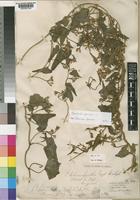
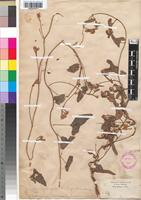
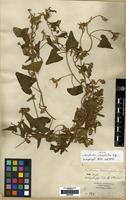
Convolvulus farinosus L. [family CONVOLVULACEAE]
Isotype of Convolvulus schweinfurthii Engl. [family CONVOLVULACEAE]
Type of Convolvulus schweinfurthii Engl. [family CONVOLVULACEAE]
Previous
Next

Name

Identification
Convolvulus schweinfurthii Engl. [family CONVOLVULACEAE ] (stored under name); Verified by Engler, 1892
Related name
  • Convolvulus penicillatus
  • Convolvulus farinosus
  • Convolvulus schweinfurthii

Flora

Entry for CONVOLVULUS farinosus L. [family CONVOLVULACEAE]
Herbarium
Royal Botanic Gardens, Kew (K)
Collection
Flora of Tropical East Africa
Resource Type
Reference Sources
Entry From
Flora of Tropical East Africa, page 1, (1963) Author: B. VERDCOURT (East African Herbarium)
Names
CONVOLVULUS farinosus L. [family CONVOLVULACEAE], Mant. 2 : 203 (1771); Bak. & Rendle in F.T.A. 4 (2) : 98 (1905); Meeuse in Bothalia 6 : 684 (1958). Type : Sweden, a specimen cultivated in Uppsala, specimen 218.6 (LINN, lecto.!)
CONVOLVULUS quinqueflorus Vahl [family CONVOLVULACEAE], Symb. 3 : 31 (1794). Type : Bourbon, ex Herb. Thouin (C, holo.!)
CONVOLVULUS cordifolius Thunb. [family CONVOLVULACEAE], Prodr. : 35 (1794). Type : South Africa, “ Cape of Good Hope ”, Thunberg (U, holo.!)
CONVOLVULUS penicellatus A. Rich. [family CONVOLVULACEAE], Tent. Fl. Abyss. 2 : 74 (1851). Type : Ethiopia, Tigré, Tcheleukote, Quartin Dillon (P, holo.!)
CONVOLVULUS schweinfurthii Engl. [family CONVOLVULACEAE], Hochgeb. Trop. Afr. : 348 (1892). Type : Ethiopia, Anedehr, Schimper 599 (B, holo.†, BM, iso. !)
Information
Perennial; stems twining or prostrate, long-pubescent, velvety silky when young. Leaf-blade triangular-ovate or ovate, rarely lanceolate, up to 6(–7.5) cm. long and 3.8(–4.5) cm. wide, obtuse, acute or apiculate at the apex, subsagittate or cordate at the base, ± shallowly crenate, shortly pubescent; petiole up to 4.5 cm. long. Inflorescence 1–6-flowered; peduncle up to 4.5(–6) cm. long; pedicels up to 1.5 cm. long; bracts minute. Sepalsovate-orbicular, ovate or elliptic, 6–7(–9) mm. long, 3–4.5 (–5) mm. wide, acute, ± coriaceous; outer often pubescent all over; inner pubescent in middle only, or all sepals only ciliate, often purplish at the tips. Corolla white or tinged pinkish-purple, 11 (–16) mm. long, shortly lobed, pubescent at the tips. Capsule 5–8 mm. in diameter, globose, pale brown. Seeds globose, subtrigonous, black, 3.5–4 mm. long, 2.5 mm. wide.
Range
DISTR. U2; K3, 4, 6; T1–3, 7
Altitude range
1300–2600 m.
Distribution
KENYA Kiambu District Muguga, 20 June 1953, Verdcourt 987 !KENYA Nairobi, 10 Oct. 1930, Napier 456 !KENYA Meru, May 1951, Hancock 54 !, 126 !TANGANYIKA Arusha, 5 Mar. 1954, C. van Someren H110/54!;TANGANYIKA Moshi District Lyamungu, 16 Feb. 1942, Wallace 1049 ! ;TANGANYIKA Lushoto District Usambara Mts., Holst 672!UGANDA Kigezi District Kachwekano Farm, July 1949, Purseglove 2974! & Mt. Mgahinga, June 1951, Purseglove 3709 ! ;UGANDA Toro District Ibanda, Mubuku Valley, 7 Sept. 1952, Ross 1037 !
Distribution (external)
; Eritrea
Ethiopia
South Africa
Madagascar
Mascarene Is
western Mediterranean
Notes
All authors have mistakenly referred C. penicellatus A. Rich. to a variety of C. sagittatus presumably because they did not see the type specimen. This specimen and also the original description leave no doubt as to the identity of Richard’s species. The type of C. schweinfurthii has triangular-hastate leaves with concave sides whereas the Linnean type of C. farinosus has more regularly ovate leaves with convex denticulate margins. These two forms are joined by intermediates, e.g. Orde Brown (from Mt. Kenya, Feb. 1914).

Related Materials

  • Terms and Conditions
  • Privacy Policy
  • Cookie Policy
  • Cookie Settings
  • Accessibility
  • Help
  • Contact Us
  • Facebook
  • Twitter
ITHAKA

JSTOR is part of ITHAKA, a not-for-profit organization helping the academic community use digital technologies to preserve the scholarly record and to advance research and teaching in sustainable ways.

©2000-2026 ITHAKA. All Rights Reserved. JSTOR®, the JSTOR logo, JPASS®, Aluka®, and ITHAKA® are registered trademarks of ITHAKA.

╳