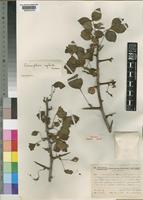
Isotype of Commiphora neglectaI.Verd. [family BURSERACEAE ] (stored under name);
Related name
Commiphora neglecta
Flora
Entry for Commiphora neglecta [family BURSERACEAE]
Herbarium
South African National Biodiversity Institute, Compton Herbarium, Cape Town (SAM)
Collection
Flora of Southern Africa
Resource Type
Reference Sources
Entry From
Flora of South Africa, (2003) Author: Dr J.P. Roux
Names
Commiphora neglecta [family BURSERACEAE]
Information
Polygamous or dioecious many-stemmed shrub or small tree up to 8 m tall; bark grey to green, smooth or flaking in small yellowish papery pieces; young branchlets with a few short hairs, spine-tipped. Leaves trifoliolate, with a few short hairs, green; petiole 5-45 mm long; leaflets elliptic or ovate to broadly ovate; petiolules usually less than 1 mm long; margins entire or upper half finely crenate-serrate, apex acute, base cuneate, terminal leaflet up to 45 X 30 mm, lateral leaflets up to 30 x 22 mm. Inflorescence: axillary dichasial cymes or flowÂers borne in clusters. Flowers bisexual or uniÂsexual, hypogynous, Pedicel 2-5 mm long, pedicel and calyx often with a few short hairs. Disc 4-lobed, not adnate to perianth. Stamens 8. Fruit subglobose, ± 15 x 14 x 14 mm, glabrous; putamen smooth; pseudo-aril red, with 4 arms, 2 commissural arms reaching alÂmost to apex of putamen, 2 facial arms shorter.
Habitat
C. neglecta differs from related species in its particular combination of characteristics rather than in any single outstanding feature. This is probably the reason why it was described only in 1951.
Use
10. Commiphora neglecta Verdoorn in Bothalia 6: 214 (1951); Wild in F.Z. 2: 271 (1963); J. J. A. v.d. Walt in Bothalia 11: 71, fig. 33-38 (1973). Type: Transvaal, Skukuza, Codd & Verdoorn 5498 (PRE, holo.!).
Range
Occurs in central and northern Tvl., and is widely distributed in Natal, being particularly common in northern Zululand. It usually grows on the slopes of mountains or in sandy, well-drained soil. Also recorded from Mozambique. Map 12.