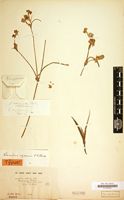
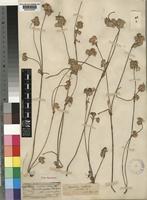
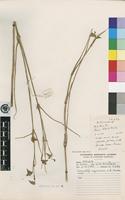
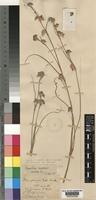
Commelina nyasensisC.B.Clarke [family COMMELINACEAE ] (stored under name); Verified by Not on sheet.,
Related name
Commelina fluviatilis
Commelina nyasensis
Commelina subulata
Flora
Entry for COMMELINA nyasensis C. B. Clarke [family COMMELINACEAE]
Herbarium
Royal Botanic Gardens, Kew (K)
Collection
Flora of Tropical Africa
Resource Type
Reference Sources
Entry From
Flora of Tropical Africa, Vol 8, page 25, (1902) Author: (By C. B. Clarke.)
Names
COMMELINA nyasensisC. B. Clarke [family COMMELINACEAE]
Information
Nearly glabrous. Stems 12–20 in. long, much divided, rather slender, with very long internodes up to 6–8 in. long; base of the stem (imperfectly preserved) appears similar to that of C. purpurea. Leaves 6 by 1/6 in., narrowly linear. Spathes scattered on axillary branches, approximate, sometimes many in dense clusters, less than 1/2 in. long, simply folded, broadly ovate, with a very short acute deflexed tip, striated by coloured veins (blue to chocolate in the dried plants), which are very prominent or nearly disappear in spathes on the same stem. Capsule 5-seeded; seeds moderately wrinkled or pitted.
Distribution
Nyasaland Mozamb. Dist. Tanganyika Plateau, at Fort Hill, 3500–4000 ft., Whyte! Monganja Highlands, 4000 ft., Kirk!