JSTOR Global Plants Home
  • Home
  • Browse
  • About
  • Access
  • Account
    • Saved Items
    • Profile
  • Log in

Global Plants

Skip to Main Content
  • JSTOR Global Plants Home
  • Global Plants

    • Browse
    • About
    • Access
    • Account
      • Saved Items
      • Profile
Log in
  • Browse
  • About
  • Access
  • Account
    • Saved Items
    • Profile
Advanced Search

Compilation
Commelina angustissima

3 Images see all

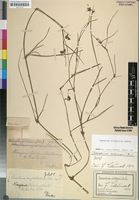
Aneilema angustissima Dinter [family COMMELINACEAE]
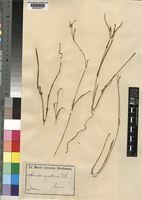
Commelina subulata Roth [family COMMELINACEAE]
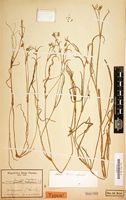
Type of Commelina angustissima K.Schum. [family COMMELINACEAE]
Previous
Next

Name

Identification
Commelina angustissima K.Schum. [family COMMELINACEAE ] (stored under name); Verified by Not on sheet.,
Related name
  • Commelina angustissima
  • Commelina subulata

Flora

Entry for COMMELINA angustissima K. Schum. [family COMMELINACEAE]
Herbarium
Royal Botanic Gardens, Kew (K)
Collection
Flora of Tropical Africa
Resource Type
Reference Sources
Entry From
Flora of Tropical Africa, Vol 8, page 25, (1902) Author: (By C. B. Clarke.)
Names
COMMELINA angustissima K. Schum. [family COMMELINACEAE], in Engl. Pfl. Ost-Afr. C. 134.
Information
Annual. Stems slender, 16 in. high. Leaves 7 by 1/3 in., very narrowly linear. Spathes solitary, less than 1/3 in. long, villous. Flowers deep blue; otherwise as C. subulata, Roth.
Distribution
German East Africa Mozamb. Dist. Usinja; Karumo district, Stuhlmann, 3564.Angola Lower Guinea Pungo Andongo; on sandy rocks of the Præsidium, 2400–3800 ft., Welwitsch, 6633 partly!German East Africa Mozamb. Dist. Kesokwe, Hannington! in wet ground on the edges of streams at Tabora (Kaseh), 3960 ft., Speke & Grant!
Notes
No example seen; but the three subjoined plants agree with the description in the long linear leaves, and small spathes shaggy with white multicellular hairs.

Related Materials

  • Terms and Conditions
  • Privacy Policy
  • Cookie Policy
  • Cookie Settings
  • Accessibility
  • Help
  • Contact Us
  • Facebook
  • Twitter
ITHAKA

JSTOR is part of ITHAKA, a not-for-profit organization helping the academic community use digital technologies to preserve the scholarly record and to advance research and teaching in sustainable ways.

©2000-2026 ITHAKA. All Rights Reserved. JSTOR®, the JSTOR logo, JPASS®, Aluka®, and ITHAKA® are registered trademarks of ITHAKA.

╳