

Compilation
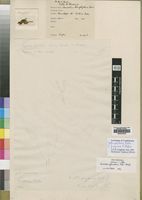
Combretum tetraphyllum
1 Images see all
Name
Identification
Combretum tetraphyllum Diels [family COMBRETACEAE ] Combretum fragrans F.Hoffm. [family COMBRETACEAE ] (stored under name);
Related name
- Combretum tetraphyllum
- Combretum fragrans
Flora
Entry for COMBRETUM fragrans F. Hoffm. [family COMBRETACEAE]
Herbarium
Royal Botanic Gardens, Kew (K)
Collection
Flora of Tropical East Africa
Resource Type
Reference Sources
Entry From
Flora of Tropical East Africa, page 1, (1973) Author: G. E. WICKENS
Names
COMBRETUM fragrans F. Hoffm. [family COMBRETACEAE], Beitr. Kenntn. Fl. Centr.-Ost-Afr.: 31 (1889); P.O.A. C: 289 (1895); Engl. & Diels in E.M. 3: 51 (1899); T.T.C.L.: 140 (1949); Exell in Kirkia 7: 183 (1970). Types: Tanganyika, Mpanda District, Ugalla, Boehm 32A (B, syn. †, Z, isosyn. !, K, fragment!) & Pa-Kabombue, Boehm 16A (B, syn. †, Z, isosyn. !)
COMBRETUM reticulatum [family COMBRETACEAE], sensu Laws, in F.T.A. 2: 432 (1871), pro parte quoad specim. Grant 734.5; Oliv. in Trans. Linn. Soc. 29:71 (1873); I.T.U., ed. 2: 85 (1952), non Presl (1827), nee Fresen. (1837)]
COMBRETUM kilossanum Engl. & Diels [family COMBRETACEAE], in N.B.G.B. 2: 193 (1898); T.T.C.L.: 140 (1949). Type: Tanganyika, Kilosa, Brosig (B, holo. †)
COMBRETUM albidiflorum Engl. & Diels [family COMBRETACEAE], in E.M. 3: 46, t. 14/A (1899); T.T.C.L.: 140 (1949). Type: Tanganyika, foothills of Uluguru Mts., Stuhlmann 8991 (B, holo. †, BM, fragment!)
COMBRETUM ghasalense Engl. & Diels [family COMBRETACEAE], in E.M. 3: 47, t. 15/B (1899); F.P.S. 1: 206 (1950); I.T.U., ed. 2: 86 (1952); K.T.S.: 145 (1961); Liben in F.C.B., Combr.: 75 (1968). Types: Sudan, Bahr el Ghazal, Sabbi [Ssabi], 1869, Schweinfurth 2730 & Bahr el Ghazal, R. Tuju [Tudje], 1869, Schiveinfurth 2745 (both B, syn. †, BM, fragments !, K, isosyn. !)
COMBRETUM multispicatum Engl. & Diels [family COMBRETACEAE], in E.M. 3: 47, t. 15/A (1899); F.P.S. 1: 204 (1950); Liben in F.C.B., Combr.: 75 (1968). Type: Sudan, Bahr el Ghazal, R. Tuju-Sabbi [Tudje-Ssabi], 1869, Schweinfurth 2662 (B, holo. †, BM, fragment!, K, iso. !)
COMBRETUM subvernicosum Engl. & Diels [family COMBRETACEAE], in E.M. 3: 48 (1899); T.T.C.L.: 141 (1949). Types: Tanganyika, Buha/Kigoma Districts, Malagarasi, von Trotha 34 (B, holo. †)
COMBRETUM undulatum Engl. & Diels [family COMBRETACEAE], in E.M. 3: 48, t. 15/C (1899); F.P.S. 1: 204 (1950). Types: Sudan, Bahr el Ghazal, Schweinfurth 1306, 1511, 2802A & 2815 (B, syn. †, BM, fragment of 2815 !, K, isosyn. of 2815 !)
COMBRETUM ternifolium Engl. & Diels [family COMBRETACEAE], in E.M. 3: 49, t. 14/D (1899); T.T.C.L.: 141 (1949). Type: Tanganyika, Morogoro District, Mgeta, Stuhlmann 9272 (B, holo. †, BM, K !, fragments)
COMBRETUM tetraphyllum Diels [family COMBRETACEAE], in E.J. 39: 499 (1907); T.T.C.L.: 141 (1949). Type: Rhodesia/Zambia, Victoria Falls, Engler 2916 (B, holo. †, BM, fragment!)
COMBRETUM sp. near C. ghasalense [family COMBRETACEAE], sensu Burtt Davy, Check-lists Brit. Emp. 1, Uganda: 36 (1935)
COMBRETUM sp. [family COMBRETACEAE], sensu Burtt Davy, Check-lists Brit. Emp. 1, Uganda: 37 (1935), pro specim. Chandler 178 ! & 398 !
Information
Small tree up to 10(–12) m. high; bark grey, reticulately fissured; branches peeling to give dark reddish brown colour; branchlets glabrous, glutinous or pubescent. Leaves opposite or 3(–4)-verticillate; lamina papyraceous to coriaceous, narrowly to broadly ovate-elliptic to ovate, up to 15(–20) cm. long and 9(–11) cm. wide, apex acute or obtuse, base usually cuneate, usually glutinous, especially so when young, rarely tomentose in East Africa to nearly glabrous (except for the scales), sparsely lepidote above, scales almost contiguous beneath but often very difficult to see due to the glutinous exudation; lateral nerves 7–10(–13) pairs, usually prominent on both surfaces, reticulation slightly raised beneath; petiole up to 1.5 cm. long, leaves sometimes subsessile, leaving a prominent circular scar when fallen, especially so on the swollen nodes of the older wood. Inflorescences axillary, either single simple spikes or clusters of such spikes borne on very much reduced axillary shoots or single axillary spikes on elongated shoots (20 cm.) that are leafless at flowering thus giving the appearance of a branched inflorescence, both short and elongated shoots densely yellow-brown pubescent. Flowers (fig. 3/11, p. 14) greenish yellow to white becoming yellow, fragrant. Lower receptacle usually tomentose; upper receptacle infundibuliform to broadly campanulate at the base and cupuliform at the apex, 2–3 mm. long, 2–3 mm. in diameter, pubescent to tomentose. Sepals broadly triangular. Petals cuneate or spathulate to obovate, 2–3 mm. long, 1–1.5 mm. wide, glabrous. Stamen-filaments 5–6 mm. long, inserted at the margin of the disk; anthers 0.8–1 mm. long. Disk with pilose free margin. Style 3–4 mm. long. Fruit (fig. 4/11, p. 15) subcircular to elliptic in outline, 2.5–3.5 cm. long, 2.5–3 cm. wide, yellow-brown to brown, glutinous, rather inconspicuously lepidote, otherwise glabrous; apical peg up to 3 mm. long; wings up to 12 mm. broad; stipe up to 5(–7) mm. long. Cotyledons 2, arising below soil-level and borne above ground on a long stalk formed by the connate petioles. Scales (fig. 2/11, p. 13) 50–65 μ in diameter.
Range
DISTR. U1, 3, 4; K5, 6; T1, 3–8 W. Africa, extending to Zaire and Sudan, also Zambia, Rhodesia, Malawi, Mozambique and Botswana
Altitude range
50–1700 m.
Distribution
KENYA Central Kavirondo/Kisumu District escarpment above Kano Plain, near Songhor, 28 Jan. 1964, Brunt 1428!;KENYA Masai District Kilaguni, 1 July 1968, V. G. Gilbert 2761!TANGANYIKA Shinyanga District Mwantine Hills, Oct. 1935, B. D. Burtt 5292 !TANGANYIKA Tanga/Pangani District Songa [Mabatini], 14 Sept. 1960, Paulo 780!;TANGANYIKA Tabora District Itulu Hill, Sept. 1951, Groome 22 !UGANDA W. Nile District Rhino Camp, 27 Mar. 1936, Michelmore 1395 !;UGANDA Karamoja District Namalu, 2 Dec. 1958, Langdale-Brown 84!;UGANDA Teso District Serere, Eggeling 759 in Brasnett 1153 !
Notes
The identity of C. albidiflorum and C. kilossanum is not certain in the absence of authentic material, but from the descriptions they seem most likely to belong here.