JSTOR Global Plants Home
  • Home
  • Browse
  • About
  • Access
  • Account
    • Saved Items
    • Profile
  • Log in

Global Plants

Skip to Main Content
  • JSTOR Global Plants Home
  • Global Plants

    • Browse
    • About
    • Access
    • Account
      • Saved Items
      • Profile
Log in
  • Browse
  • About
  • Access
  • Account
    • Saved Items
    • Profile
Advanced Search

Compilation
Combretum katangensis

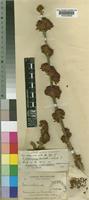
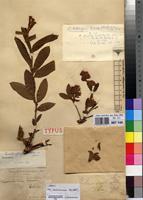
2 Images see all

Combretum katangensis De Wild. [family COMBRETACEAE]
Type of Combretum katangensis De Wild. [family COMBRETACEAE]
Previous
Next

Name

Identification
Combretum katangensis De Wild. [family COMBRETACEAE ] Verified by Not on sheet, Combretum platypetalum Welw. ex Laws. [family COMBRETACEAE ] (stored under name); Verified by Liben L., 1964
Related name
  • Combretum platypetalum
  • Combretum unrecorded
  • Combretum katangensis

Flora

Entry for Combretum platypetalum Welw. ex Laws. [family COMBRETACEAE]
Herbarium
Royal Botanic Gardens, Kew (K)
Collection
Flora Zambesiaca
Resource Type
Reference Sources
Entry From
FZ, Vol 4, Part 0, page 100, (1978) Author: A. W. Exell
Names
Combretum platypetalum Welw. ex Laws. [family COMBRETACEAE], in Oliv., F.T.A. 2: 433 (1871).— Engl. & Diels in Engl., Mon. Afr. Pflanz. 3: 68 (1899).—Eyles in Trans. Roy. Soc. S. Afr. 5, 4: 428 (1916).—Burtt Davy & Hoyle, N.C.L.: 39 (1936).—Stace in Mitt. Bot. Staatssamml. München 4: 14 (1961).—F. White, F.F.N.R.: 280 (1962).— Liben in Bull. Jard. Bot. Brux. 35, 2: 179, 180 (1965); F.C.B. Combret.: 39 (1968).—Exell in Bol. Soc. Brot., Sér. 2, 42: 7 (1968); in Kirkia, 7, 2: 214 (1970).— Wickens, F.T.E.A. Combret.: 54 (1973).—Faria in Mem. Inst. Invest. Agron. Moçamb. 4: 97 (1973). TAB. 31 fig. A. Type from Angola.
Combretum katangensis De Wild. [family COMBRETACEAE], in Fedde Repert. 11: 516 (1913). Type from Katanga.
Combretum zastrowii Dinter [family COMBRETACEAE], in Fedde Repert. 16: 174 (1919).—O. B. Mill., B.C.L.: 44 (1948). Type from SW. Africa.
Information
Shrublet usually c. 15–30 cm. high but occasionally a shrub up to 3 m. (probably intermediates with C. paniculatum) with a thick woody rhizome, often leafless when flowering on annually produced shoots; bark grey-brown to grey-black; branchlets tomentose to glabrous. Leaves opposite, subopposite or alternate or occasionally 3-verticillate; lamina from 1 x 1·4 cm. to 10 x 5 cm. extremely variable in size and shape (from subcircular to very narrowly elliptic) and in indumentum (glabrous to densely tomentose). Inflorescences and flowers (red) indistinguishable from those of C. paniculatum. Fruits as in C. paniculatum and C. micorphyllum but more elliptic and rarely subcircular, sometimes up to 5·5 x 3·5 cm. often with a distinct apical peg and stipe 2·6 mm. long.
Range
Throughout our area
Distribution (external)
Zaire
Angola
SW. Africa
Tanzania
Notes
The relationship between this species and C. paniculatum and C. microphyllum have been discussed under C. microphyllum. There remains the problem of extreme variability within the species itself for of all the savanna and grassland shrublets notorious for their difficulty this is one of the worst in its excessive variability. Forms appear with long narrow leaves or with narrow oblong fruits about twice the usual length and there is nothing to show whether they remain constant or not or whether they are thrown up from time to time by genetical disturbances caused by fire. Until a species like this one is properly studied in Africa by breeding experiments, effect of protection from fire, transplant experiments, edaphic variation in the individual and germination of seedlings we shall not understand the acute taxonomic problems with which these savanna species confront us. Owing to the time factor it will be much easier to study one of these shrublets than a savanna tree like C. molle. When the facts are known it will be time to consider a suitable nomenclatural system; but I am sure that it would be wrong to try to contort the facts to bring them within a rigid nomenclatural framework which may prove to be quite unsuitable. Meanwhile in the absence of the necessary facts the system here proposed is only a temporary makeshift.

Related Materials

  • Terms and Conditions
  • Privacy Policy
  • Cookie Policy
  • Cookie Settings
  • Accessibility
  • Help
  • Contact Us
  • Facebook
  • Twitter
ITHAKA

JSTOR is part of ITHAKA, a not-for-profit organization helping the academic community use digital technologies to preserve the scholarly record and to advance research and teaching in sustainable ways.

©2000-2026 ITHAKA. All Rights Reserved. JSTOR®, the JSTOR logo, JPASS®, Aluka®, and ITHAKA® are registered trademarks of ITHAKA.

╳