

Compilation
Combretum kamatutu
1 Images see all
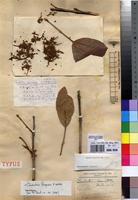
Name
Identification
Combretum kamatutu De Wild. [family COMBRETACEAE ] Verified by Not on sheet, Combretum fragrans F.Hoffm. [family COMBRETACEAE ] (stored under name); Verified by Not on sheet,
Related name
- Combretum kamatutu
- Combretum fragrans
Flora
Entry for Combretum fragrans F. Hoffm. [family COMBRETACEAE]
Herbarium
Royal Botanic Gardens, Kew (K)
Collection
Flora Zambesiaca
Resource Type
Reference Sources
Entry From
FZ, Vol 4, Part 0, page 100, (1978) Author: A. W. Exell
Names
Combretum fragrans F. Hoffm. [family COMBRETACEAE], Beitr. Kenntn. Fl. Centr.-Ost Afr.: 31 (1899).— Engl. & Diels in Engl., Mon. Afr. Pflanz. 3: 51 (1899).—Exell in Kirkia, 7, 2: 183, t.1 fig. 12 (1970).—Wickens, F.T.E.A. Combret.: 29, fig. 2(11), 3(11), 4(11) (1973).— Faria in Mem. Inst. Invest. Agron. Moçamb. 4: 32 (1973). TAB. 30 fig. F; TAB. 32 fig. 11; TAB. 34 fig. C. Syntypes from Tanzania.
Combretum kilossanum Engl. & Diels [family COMBRETACEAE], in Notizbl. Bot. Gart. Berl. 2: 193 (1898); in Engl., tom. cit.: 52 (1899).—Burtt Davy & Hoyle, N.C.L.: 39 (1936). Type from Tanzania.
Combretum albidiflorum Engl. & Diels [family COMBRETACEAE], in Engl., tom. cit.: 46, t. 14 fig. A (1899). Type from Tanzania.
Combretum ghasalense Engl. & Diels [family COMBRETACEAE], in Engl., tom. cit.: 47, t. 15 fig. B (1899).— Exell & Garcia in Contr. Conhec. Fl. Moçamb. 2: 116 (1954).—Rattray in Kirkia, 2: 80 (1961).—Dale & Greenway, Kenya Trees and Shrubs: 145 (1961).—F. White, F.F.N.R.: 285, fig. 50C (1962).—Boughey in Journ. S. Afr. Bot. 30,4: 167 (1964).— Liben, F.C.B. Combret.: 75 (1968).—Exell in Bol. Soc. Brot., Sér. 2, 42: 8, t. 2 fig. 10 (1968).—Wild in Kirkia, 7, 1: 53 (1968).—Gillett & McDonald, N.C.K.: 14 (1970).—Jacobsen in Kirkia, 9, 1: 168 (1973). Syntypes from the Sudan.
Combretum multispicatum Engl. & Diels [family COMBRETACEAE], in Engl., tom. cit.: 47, t. 15 fig. A (1899). Type from the Sudan.
Combretum undulatum Engl. & Diels [family COMBRETACEAE], in Engl., tom. cit.: 48, t. 15 fig. C (1899). Syntypes from the Sudan.
Combretum ternifolium Engl. & Diels [family COMBRETACEAE], in Engl., tom. cit.: 48, t. 14 fig. D (1899).— Burtt Davy & Hoyle, loc. cit.—O. B. Mill., B.C.L.: 43 (1948).—Wild in Rhod. Agric. Journ. 50, 5: 6 (1953).—Brenan in Mem. N.Y. Bot. Gard. 8, 5: 437 (1954).— Williamson, Useful Pl. Nyasal.: 39 (1956).—Duvign. in Bull. Soc. Bot. Belg. 88: 70 (1956). Type from Tanzania.
Combretum kamatutu De Wild. [family COMBRETACEAE], in Ann. Mus. Congo Belge, Bot. Sér. 4: 215 (1903).—Diels in Engl., Bot. Jahrb. 39: 497 (1907).—Engl., Pflanzenw. Afr. 3, 2: 700 (1921) (“kamatula”). Type from Zaire.
Combretum tetraphyllum Diels [family COMBRETACEAE], in Engl., Bot. Jahrb. 39: 499 (1907).—Monro in Proc. & Trans. Rhod. Sci. Ass. 8, 2: 80 (1908).—Eyles in Trans. Roy. Soc. S. Afr. 5, 4: 429 (1916).—Wild, Guide Fl. Vict. Falls: 146 (1953).—F. White, F.F.N.R.: 287 (1962). Type: Rhodesia or Zambia, Victoria Falls, Engler 2916 (B+, holotype).
Information
Deciduous shrub or small tree up to c. 10(12) m. high; crown obovoid or rounded; bark creamy-brown or grey-brown, vertically cracked, scaly, exuding gum. Leaves opposite or very frequently 3–1-verticillate; lamina up to 20 x 9 cm., usually glutinous especially when young, ovate or ovate-elliptic, tomentose to nearly glabrous (except for scales) and lepidote (often rather inconspicuously), apex acute to rounded, base usually cuneate; lateral nerves 7–10 pairs, rather prominent beneath; petiole up to 1·5 cm. long or sometimes very short (leaf subsessile), leaving a prominent circular scar. Inflorescences of axillary spikes up to 7 cm. long, sometimes branched, often appearing before the leaves in axils of fallen leaves; rhachis usually densely pubescent; bracts 1·5 mm. long, deciduous. Flowers sessile, greenish or dirty-white or yellow. Lower receptacle 1·5–3 mm. long, usually tomentose; upper receptacle 2–3 x 2–3 mm., infundibuliform to broadly campanulate at the base and cupuliform at the apex, pubescent to tomentose. Sepals 1 x 1·5 mm., broadly triangular. Petals 2–3x 1–1·5 mm., cuneate or spathulate to obovate, glabrous. Stamen-filaments 5–6 mm. long, inserted at the margin of the disk; anthers 0·8–1 mm. long. Disk with a pilose free margin. Fruit brown or reddish-yellow, 2·5–3·5 x 2·5–3 cm., glutinous, subcircular to elliptic in outline, rather inconspicuously lepidote otherwise glabrous, apical peg up to 3 mm. long, wings up to 12 mm. broad, stipe up to 5(7) mm. long. Cotyledons 2, 2 x 3 cm., transversely elliptic, arising as in the sectional description. Scales as for the section.
Habitat
Dry lowland tree savanna with Setaria etc.; edges of dambos (seasonal swamps) with Adansonia, Kirkia and Sterculia; plateau Acacia-Comhretum-Terminalia open woodland; lake basin chipya (in Zambia); mopane scrub; tree savannas; rocky places; heavy soils; and occasional on copper-bearing soils.
Range
Also from West Africa to the Sudan, Zaire, Kenya and Tanzania
Altitude range
from low to medium altitudes
1500
0
inferred from medium and low
Distribution
Mozambique MS Chemba, near Maringuè, fr. 5.x.1944, Mendonça 2357 (BM; LISC).Mozambique T between Tete and Zóbuè, fl. 18.vi.1941, Torre 2907 (BM; K; LISC).Mozambique Z Morrumbala, fl. 3.x.1949, Andrada 1939 (COI; LISC).Malawi S Balaka, fl. 7.x.1955, Jackson 1758 (FHO).Malawi C Dedza Distr., Mua-Livulezi Reserve, fr. 17.xi.1954, Adlard 199 (FHO).Zimbabwe S Ndanga Distr., Chiredze R., fr. 15.x.1951, Wormald 89/51 (SRGH).Zimbabwe E Hondi Valley, fr. 27.xi.1948, Chase 1279 (BM; COI; FHO; LISC; SRGH).Zimbabwe C Salisbury, fl. 5.x.1910, Mundy (K).Zimbabwe W Wankie, fl. 26.ix.1929, Pardy 4695 (FHO; SRGH).Zambia S Mazabuka Distr., near Municke R., fl. 2.viii.1952, Angus 139 (BM; FHO; K).Zambia E Fort Jameson, fl. ix.1951, Gilges 104 (PRE; SRGH).Zambia C Mt. Makulu, fl. 3.ix.1956, Angus 1403 (FHO).Zambia W Mufulira, fl. 28 viii.1955, Fanshawe 2437 (K; SRGH).Zambia N Kasama Distr., Mungwe, fl. 8.x.1960, Robinson 3922 (SRGH).Mozambique N 10 km. from Mutual; on road to Lioma, fl. 8.xi.1953, Gomes e Sousa 4112 (K; LISC; PRE).Malawi N Rumphi, c. 1065 m., fr. ix.1953, Chapman 177 (FHO).Zimbabwe N Lomagundi, Silverside Mine, 1130 m., fl. 3.ix.1963, Jacobsen 2209 (PRE).Zambia B Balovale, 1065 m., fr. viii.1952, Gilges 176 (PRE; SRGH).Botswana N Ngamiland, fr. i.1931, Curson 119 (PRE).
Notes
This widespread and ecologically important species has usually been known as C. ghasalense in the northern part of its range and as C. ternifolium in the south. These were united under C. ghasalense. Recently Wickens examined authentic material of C. fragrans, an earlier name, which he found to be the same species, and Stace has confirmed that the scales are identical. The name must therefore unfortunately be changed again, it is to be hoped for the last time. It is a curious fact that this common and widespread species, found throughout our area, has never been discovered in Angola, where one would certainly expect it to occur. Although C. fragrans is very variable in indumentum and leaf-shape as well as in the arrangement of the leaves in 2’s, 3’s or 4’s the species, perhaps because of its characteristic glutinous nature, is usually easily recognizable and there has not been the same tendency, as in most of the other very variable savanna species of Combretum, either to describe each form as a new species or to divide it into a number of intraspecific taxa.