

Compilation
Cola usambarensis
1 Images see all
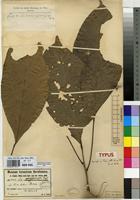
Name
Identification
Cola usambarensis Engl. [family STERCULIACEAE ] (stored under name); Verified by Not on sheet,
Related name
- Cola usambarensis
Flora
Entry for Cola usambarensis Engl. [family STERCULIACEAE]
Herbarium
Royal Botanic Gardens, Kew (K)
Collection
Flora of Tropical East Africa
Resource Type
Reference Sources
Entry From
Flora of Tropical East Africa, page 1, Author: MARTIN CHEEK AND LAURENCE DORR
Names
Cola usambarensis Engl. [family STERCULIACEAE], in E.J. 39: 595 (1907); Brenan in B.J.B.B. 18: 4 (1946); T.T.C.L.: 594 (1949); Brenan in K.B. 11: 151 (1956). Type: Tanzania, Lushoto District: Amani, Engler 3423 (B†, holo.)
Information
Evergreen tree up to 15 m high; stems terete, 1.5–4 mm wide, brown or grey, sparsely covered with appressed grey stellate hairs when young, soon becoming glabrous; bud-scales falling early, ovate-triangular, 1–3 mm long, ± 1 mm wide. Leaves often with spherical woody galls ± 5 mm diameter on the petiole, less often on the blade; blade oblanceolate to narrowly elliptic, the smallest ovate to elliptic, 2.5–25 cm long, 1.2–10(–13) cm wide, acumen blunt, 6–12 mm long, 5 mm wide, base cuneate, 5–6 pairs of main veins, glabrous above and beneath; petiole terete, 4–10 cm long, the smallest leaves subsessile, indumentum as stem; stipules linear, 6.5 mm long, 1 mm wide. Inflorescence in leaf-axils at least 3–4 leaves below the stem apex, 1(–2)-flowered; bracts 4–6, increasing in size towards the flower, the largest bract conspicuously bilobed, ± 1 mm long, 1.3 mm wide, brown, glabrous; stalk stout, 1–2 mm long, indumentum as perianth. Flowers with perianth cream or brownish cream, ± campanulate, divided for 1/3–1/2 into 4 incurved lobes; outer surface stellate-pubescent, inner surface thickly covered in papillae. Male flowers 4.7–6 mm long; androphore 1.5 mm long, 0.4 mm wide at the base tapering to 0.3 mm at the apex, glabrous; anthers uniseriate, 8–10, glabrous, in a disc ± 1 mm long, 1.5 mm diameter; ovary vestigial, concealed. Female flowers 7.5–10 mm long; androphore absent; anthers reduced, 7 or 8 at base of ovary; ovary globose, 3–3.8 mm long, 4.2–4.5 mm wide, densely and coarsely tomentose; style up to 0.8 mm long; stigmas 4, black, patent, 2 mm long. Fruits with up to 4 carpels developing, carpels ascending, shortly oblong-cylindric, up to 5 cm long, 3 cm wide, 2.5 cm deep, rostrum triangular, laterally flattened, 5–7 mm long, 3–5 mm wide, base sessile, suture with a low ridge; densely stellate-hairy with minute powdery golden brown hairs, pericarp papery-leathery; seeds in two ranks, up to 14, testa white, cotyledons red (fide Luke & Muir 6086).
Range
DISTR. T 3 not known elsewhere
Altitude range
± 900 m
Distribution
TANZANIA Lushoto District Amani-Zigi Plot, fl. fr. 12 Dec. 1999, Luke & Muir 6088! & Amani, 21 Dec. 1928, Greenway 1069! & Amani, base of Mt Bomole, 24 Dec. 1956, Verdcourt 1726!
Notes
LOCAL USES. Used for poles for house construction and medicine (Muir loc. cit.). Cola usambarensis is listed as DD (Data Deficient) by IUCN (2002 Redlist, www.redlist.org). A study to investigate the factors affecting the distribution of Cola usambarensis was concluded as an MSc Thesis by Muir (1998, Univ. College, London). Although detailed data were gathered, confusion as to the identification of the species arose. Material assumed to be Cola usambarensis at some of the study sites later proved to be an unrelated species, C. lukei (Cheek in K.B. 57: 417 (2002)). Although Muir (1998) records the species from six protected areas, there is only evidence in the form of fertile specimens to support the existence of C. usambarensis at one of these, the Amani Forest Reserve, in the East Usambara Mountains, which occupies less than 100 km2. Muir (loc. cit.) records that the species is harvested for use as poles, medicine, and in one case, rope (from the bark). While there is some doubt as to which, if not all, these species of Cola these uses apply to, there is no doubt that C. usambarensis is at risk and that its habitat is declining due to the illegal harvest of building materials (Muir 1998). It is here assessed as Critically Endangered (CR B1a+b(iii)), reflecting that it is only known from a single location, that there is a decline in habitat quality and that its extent of occurrence is less than 100 km2. Muir (op. cit.) rates the species as Endangered. Only three flowering specimens, cited above, are known to me. In the absence of flowers, identification is uncertain, although the 5 mm diameter globose woody galls present on the leaves may be unique to this species. However, not all specimens seem to bear them. Brenan (1956, op. cit.) also mentions Zimmerman 6759 (EA - buds) from Kwamkoro, 12 Nov. 1907. Ruffo et al. (in Hamilton and Bensted-Smith, Forest Conservation in the East Usambara Mountains, Tanzania. IUCN (1989)) mention two further collections: Ruffo & Mmari 2025 (Kwamkoro F.R. & Amani area) and Ruffo & Mmari 2246 (Kwamsambia/Kihuhwi F.R.), probably at Lushoto and/or EA: these have not been verified by me. The only fruiting collections known are Luke 5245, 6080, 6085 and 6086, all from Mbomole Hill.