JSTOR Global Plants Home
  • Home
  • Browse
  • About
  • Access
  • Account
    • Saved Items
    • Profile
  • Log in

Global Plants

Skip to Main Content
  • JSTOR Global Plants Home
  • Global Plants

    • Browse
    • About
    • Access
    • Account
      • Saved Items
      • Profile
Log in
  • Browse
  • About
  • Access
  • Account
    • Saved Items
    • Profile
Advanced Search

Compilation
Cola mossambicensis

8 Images see all

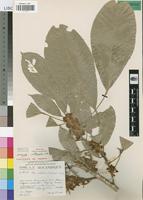
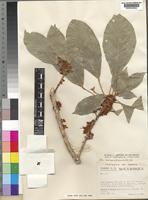
Isotype of Cola mossambicensis Wild [family STERCULIACEAE]
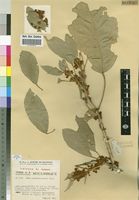
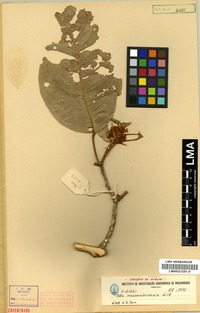
Holotype of Cola mossambicensis Wild [family STERCULIACEAE]
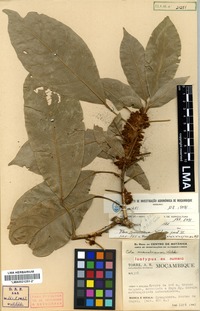
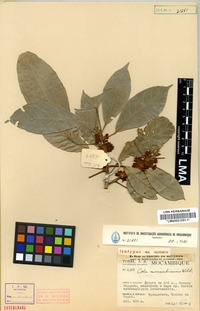
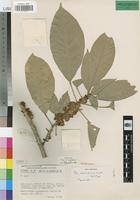
Isotype of Cola mossambicensis Wild [family STERCULIACEAE]
Previous
Next

Name

Identification
Isotype of Cola mossambicensis Wild [family STERCULIACEAE ] (stored under name); Verified by Not on sheet,
Related name
  • Cola mossambicensis

Flora

Entry for Cola mossambicensis Wild [family STERCULIACEAE]
Herbarium
Royal Botanic Gardens, Kew (K)
Collection
Flora of Tropical East Africa
Resource Type
Reference Sources
Entry From
Flora of Tropical East Africa, page 1, Author: MARTIN CHEEK AND LAURENCE DORR
Names
Cola mossambicensis Wild [family STERCULIACEAE], in Bol. Soc. Brot. Ser. 2, 33: 39 (1959); Wild in F.Z. 1: 560 (1961); Palgrave, Trees of Southern Africa: 599 (1977). Type: Mozambique, Manica e Sofala, Espungabera, Gogoi Mt, Torre 4308 (LISC, holo., K!, SRGH, iso.)
Information
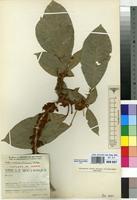
Evergreen tree, (3–)18–35 m tall; bole fluted and buttressed in larger specimens, bark ashy grey or pale brown; ultimate branchlets terete, 4–5 mm wide, with reddish brown scurf when young, soon or at length lost, revealing a white, longitudinally ridged, epidermis; bud-scales not seen, caducous. Leaf-blade oblanceolate or elliptic, (2–)14–21 cm long, (0.8–)7–11 cm wide, apex acuminate, base acute to rounded, 12–15 pairs of main veins, quaternary veins conspicuous on both surfaces, leathery, glabrous; petiole terete, 1–100 mm long, 1–2 mm wide, pulvini with caducous reddish brown scurf; stipules triangular, ± 3–4 mm long, 2–3 mm wide, grey pubescent, caducous, seen only in buds. Inflorescences axillary, amongst the leaves, with fascicles of ± 6–10 flowers; bracts numerous, concave, rounded-triangular, 2–3 mm long, 2 mm across, apex entire, outer surface densely brown pubescent; flower stalk 6–9 mm long, articulation absent or obscure in flower, basal in fruit, with dense orange-red hairs. Flowers white or cream, perianth divided for 6/7 into 5 lobes each 4–7 mm long, 2–2.5 mm across, outer surface as stalk, inner densely hairy in upper half and densely and minutely papillate throughout. Male flowers with androphore terete ± 3 mm long, densely stellate-pubescent; anthers uniseriate, 5–6, glabrous, in a disc 1–1.5 mm long, 1.5–2.5 mm diameter; ovary vestigial, concealed. Female flowers with androphore absent; anthers barely reduced, at base of ovary; ovary subglobose, ± 1.5 mm diameter, densely pale brown tomentose; style 1.5 mm long; stigmas 4, recurved, ± 1 mm long, 0.7 mm wide, papillose. Fruitlets 1–5, brown, downy, transverse ridges faint, two pairs, subglobose-obovoid ± 1.4 cm long, 1.3 cm wide, stipe ± 2 mm long, rostrum ± 1.5 mm diameter.
Range
DISTR. T ?4, 8
Altitude range
altitude unknown but probably less than 900 m
Distribution
TANZANIA Lindi District Rondo Plateau, Mtene, fr. March 1952, Semsei 733!
Distribution (external)
Malawi
Mozambique
Notes
LOCAL USES. Mkupete (Kimwera), timber, fide Semsei 733.   Cola mossambicensis is listed as VU B1+2C, i.e. vulnerable, (www.redlist.org), based on an assessment by S. Bandeira in 1988 (Bandeira, S. 1995. Data collection forms for tree species of Mozambique). Bandeira d that this species is severely threatened by the decline in quality and conversion of its habitat for agricultural purposes. However he cited the species as mainly occurring in central Mozambique, and only possibly occurring in Malawi. In fact, of the 17 specimens known, most are from Malawi, where it occurs in Mlanje, Dedze, Ncheu and Zomba Districts, seven of the specimens occurring in Zomba District. Six specimens are known from Mozambique, namely from Manica e Sofala, Zambezia and Zambezia-Niassa Provinces. Since the species is now known from more than ten sites (the 17 specimens are derived from 11 sites) and has an extent of occurrence that now exceeds the IUCN (2001), criterion for vulnerable status, it may be more appropriate to treat the species as near threatened (NT) unless conversion of its habitat can be shown to have been 30% or more in the last 100 years.   Cola mossambicensis is only likely to be confused with C. microcarpa, since they both have the young stems and petiole covered in a thick scurfy-felt like layer of red-brown hairs that is shed to reveal white stems, unusual features in East African members of the genus. However, they differ from each other in several floral and fruit features (see the key). In addition, C. mossambicensis is distinctive in that it is a tall tree with a fluted bole, and in that the white stems are conspicuously longitudinally grooved, with hair remnants showing darkly in the grooves. The leafy stems are particularly straight, stout and bear leaves at unusually regular intervals (1.5–2 cm) for a Cola. Moreover the petioles are very long, 10 cm being common. These features make the species determinable with some confidence even when sterile, which is not normally the case for simple-leaved Cola species. Specimens labelled C. microcarpa from T 4 (Kigoma District: Kasye Forest, buds 25 March 1994, Bidgood et al. 2962, ibid. fr. 2964; Mt Livandabe, y.fr.28 May 1997, Bidgood et al. 4152) may well represent C. mossambicensis since they have the distinctive characteristics referred to in the paragraph above. Their altitudinal range (850–1200 m) is also seen in the material of the species from Malawi. However flowering material is needed to confirm this identification. The limited fruiting material (only 3 mericarps are available) differs from C. mossambicensis in being more sparsely hairy than usual, and in lacking a rostrum and ridges, so it is also possible that this represents yet another new taxon for the area.

Related Materials

  • Terms and Conditions
  • Privacy Policy
  • Cookie Policy
  • Cookie Settings
  • Accessibility
  • Help
  • Contact Us
  • Facebook
  • Twitter
ITHAKA

JSTOR is part of ITHAKA, a not-for-profit organization helping the academic community use digital technologies to preserve the scholarly record and to advance research and teaching in sustainable ways.

©2000-2026 ITHAKA. All Rights Reserved. JSTOR®, the JSTOR logo, JPASS®, Aluka®, and ITHAKA® are registered trademarks of ITHAKA.

╳