JSTOR Global Plants Home
  • Home
  • Browse
  • About
  • Access
  • Account
    • Saved Items
    • Profile
  • Log in

Global Plants

Skip to Main Content
  • JSTOR Global Plants Home
  • Global Plants

    • Browse
    • About
    • Access
    • Account
      • Saved Items
      • Profile
Log in
  • Browse
  • About
  • Access
  • Account
    • Saved Items
    • Profile
Advanced Search

Compilation
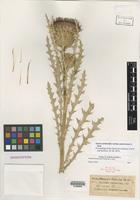
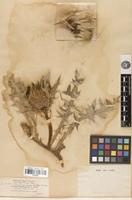
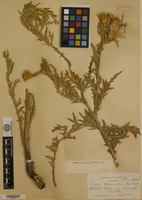
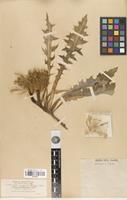
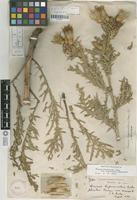
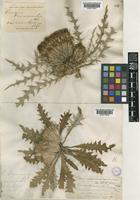
Cnicus drummondii

10 Images see all

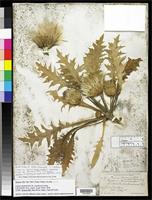
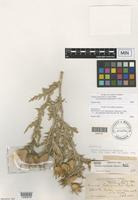
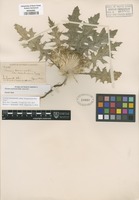
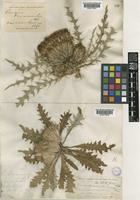
Isosyntype of Cnicus carlinoides Fisch. ex Schrank var. americanus A. Gray [family ASTERACEAE]
Type of Cnicus drummondii (Torr. & A. Gray) A. Gray var. vexans A.Gray [family ASTERACEAE]
Type? of Cnicus drummondii A. Gray var. bipinnatus Eastwood [family ASTERACEAE]
Type of Cnicus drummondii (Torr. & A. Gray) A. Gray var. vexans A.Gray [family ASTERACEAE]
Filed as Cnicus drummondii var. acaulescens Gray, A. 1874 [family ASTERACEAE]
Isotype of Cnicus drummondii Torry & A. Gray var. bipinnatus Eastw. [family ASTERACEAE]
Type? of Cirsium drummondii Torr. & A. Gray ssp. latisquamum Petr. [family ASTERACEAE]
Cirsium drummondii Torr. & A. Gray var. acaulescens (A. Gray) J.F. Macbr. [family COMPOSITAE]
Holotype of Cnicus drummondii (Torr. & A. Gray) A. Gray var. bipinnatus Eastw. [family ASTERACEAE]
Cirsium drummondii Torr. & A. Gray var. acaulescens (A. Gray) J.F. Macbr. [family COMPOSITAE]
Previous
Next

Name

Identification
Cnicus drummondii (Torr. & A. Gray) A. Gray [family ASTERACEAE ] (stored under name); Verified by Not on sheet,
Related name
  • Cnicus drummondii
  • Cirsium drummondii
  • Cirsium arizonicum
  • Cirsium acaule
Common name
  • Four Corners thistle, Flora of North America Vol. 19

Flora

Entry for Cirsium arizonicum (A. Gray) Petrak var. bipinnatum (Eastwood) D. J. Keil [family COMPOSITAE]
Herbarium
Flora of North America (FNA)
Collection
Flora of North America
Resource Type
Reference Sources
Entry From
Flora of North America, Vol 19,
Names
Cirsium arizonicum (A. Gray) Petrak var. bipinnatum (Eastwood) D. J. Keil [family COMPOSITAE], Sida, 21: 209. 2004
Cnicus drummondii Torrey & A. Gray var. bipinnatus Eastwood [family COMPOSITAE], Zoë, 4: 8. 1893
Cirsium bipinnatum (Eastwood) Rydberg [family COMPOSITAE]
Cirsium calcareum (M. E. Jones) Wooton & Standley [family COMPOSITAE]
Cirsium calcareum var. bipinnatum (Eastwood) S. L. Welsh [family COMPOSITAE]
Cirsium calcareum var. pulchellum (Greene ex Rydberg) S. L. Welsh [family COMPOSITAE]
Cirsium diffusum (Eastwood) Rydberg [family COMPOSITAE]
Cirsium pulchellum (Greene ex Rydberg) Wooton & Standley [family COMPOSITAE]
Cirsium pulchellum subsp. bipinnatum (Eastwood) Petrak [family COMPOSITAE]
Cirsium pulchellum subsp. diffusum (Eastwood) Petrak [family COMPOSITAE]
Cirsium pulchellum var. glabrescens Petrak [family COMPOSITAE]
Treatment Author(s)
David J. Keil
Information
Stems glabrous to tomentose, usually without septate trichomes. Leaf blades unlobed to deeply divided, faces glabrous to tomentose on one or both, usually without septate trichomes; main marginal spines slender to stout, 3–10 mm; cauline bases narrowed to truncate or clasping or decurrent as spiny wings to 30 mm. Involucres cylindric or ovoid to campanulate; spines of mid phyllaries 1–6 mm, slender to very stout. Corollas usually lavender to purple or reddish purple, 22–34 mm, tubes 7–12, throats 4–9 mm, lobes 8–18 mm; style tips 1.2–4.5 mm.
Phenology
mar-may (spring), jun-aug (summer), sep-oct (fall)
Altitude range
900–3100 m;
Distribution
USA Ariz.USA Colo.USA N.Mex.USA Utah.
Discussion
Variety bipinnatum grows in the Colorado Plateau of New Mexico, northeastern Arizona, southeastern Utah, and southwestern Colorado south to the Sacramento Mountains of southern New Mexico. It is a polymorphic assemblage of races and local populations with overlapping patterns of variation. Extremes are diverse and strikingly different, and various authors have attempted to segregate variants as species, subspecies, or varieties. Apparently independent segregation of character states of multiple variable characters has resulted in a complex array of local morphotypes. Leaves range from wholly glabrous to densely tomentose on one or both faces. The bases of cauline leaves vary from sessile and not at all decurrent to prominently decurrent with spiny wings to 3 cm. Leaf lobing and spininess are similarly variable. Heads may be solitary at the branch tips or densely clustered. I have been unable to detect patterns that can consistently separate the many forms in any meaningful way.

Related Materials

  • Terms and Conditions
  • Privacy Policy
  • Cookie Policy
  • Cookie Settings
  • Accessibility
  • Help
  • Contact Us
  • Facebook
  • Twitter
ITHAKA

JSTOR is part of ITHAKA, a not-for-profit organization helping the academic community use digital technologies to preserve the scholarly record and to advance research and teaching in sustainable ways.

©2000-2026 ITHAKA. All Rights Reserved. JSTOR®, the JSTOR logo, JPASS®, Aluka®, and ITHAKA® are registered trademarks of ITHAKA.

╳