

Compilation
Clitoria tanganicensis
1 Images see all
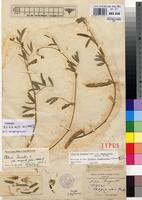
Name
Identification
Clitoria tanganicensis Micheli [family FABACEAE ] Verified by Not on sheet, Clitoria ternatea L. [family FABACEAE ] (stored under name); Verified by Fantz P.R., 1975
Related name
- Clitoria tanganicensis
- Clitoria ternatea
Flora
Entry for Clitoria ternatea L. [family LEGUMINOSAE]
Herbarium
Royal Botanic Gardens, Kew (K)
Collection
Flora Zambesiaca
Resource Type
Reference Sources
Entry From
FZ, Vol 3, Part 5, (2001) Author: B. Mackinder, R. Pasquet, R. Polhill and B. Verdcourt
Names
Clitoria ternatea L. [family LEGUMINOSAE], Sp. Pl.: 753 (1753). —J.G.Baker in F.T.A. 2: 177 (1871). —E.G. Baker, Legum. Trop. Africa: 428 (1929). —Wilczek in F.C.B. 6: 267, fig. 7 (1954). —Hepper in F.W.T.A., ed. 2. 1: 560 (1958). —Torre in C.F.A. 3: 279 (1966). —Verdcourt in F.T.E.A., Leguminosae, Pap.: 515, fig. 75 (1971). —Drummond in Kirkia 8: 217 (1972). —Gonçalves in Garcia de Orta, Sér. Bot. 5: 65 (1982). —Lock, Leg. Afr. Check-list: 390 (1989). TAB. 3.5.8, fig. A. Syntypes from Sri Lanka.
Clitoria tanganicensis Micheli [family LEGUMINOSAE], in T. Durand & De Wildeman in Bull. Soc. Roy. Bot. Belgique 36: 60 (1897). —E.G. Baker, Legum. Trop. Africa: 429 (1929) as “tanganyicensis”. Type from Dem. Rep. Congo (Katanga Prov.).
Information
Perennial herb, climbing trailing or suberect at the base; rootstock woody. Leaflets 2–3(4) pairs, membranous to chartaceous, 0.6–6.5 × 0.6–3.9 cm, ovate, elliptic, oblong or round, glabrescent above, pubescent beneath; petiole 1–3 cm long. Flowers resupinate, 1–2 per axil, on a peduncle 3–10 mm long; pedicels 6–9 mm long; bracteoles 4–17 × 2–17 mm, ovate or round. Calyx 7–18 mm long, finely pubescent; lobes oblong, lanceolate or triangular. Standard white, often margined with blue or completely blue, 2.5–5 × 1.5–3.5(4) cm, shortly clawed, finely pubescent outside. Pod 6–12.5 × 0.7–1.2 cm, linear-oblong, mucronate, compressed, glabrous or finely pubescent, 8–12-seeded. Seeds light to dark brown or black, 5–7 × 3–4 × 2 mm, with a small white rim aril and funicular remnant.
Habitat
Hot low altitudes, usually beside rivers and lake shores, riverine and coastal associations, in wooded and open grassland, and in disturbed places
Range
Cape Verde Islands and Senegal to Somalia and south to Angola and South Africa, Arabia through India and southeast Asia to China, Taiwan, Malaysia, Indonesia, Australia and many Pacific islands, North and South America and the West Indies
Altitude range
0–1000 m.
1000
0
Distribution
Mozambique M Mocímboa da Praia Distr., Ponta Vermelha, fl. & fr. 18.i.1960, Lemos & Balsinhas 4 (BM; K).Mozambique GI Inhambane, fl. & fr. xii.1936, Gomes e Sousa 1943 (K).Mozambique MS Sofala, fl. & fr. 24.ix.1961, Methuen 244 (K).Mozambique T Zambezi R. at Msusa, fl. & fr. 26.vii.1950, Chase 2815 (K; SRGH).Malawi S 10 km southwest of Mangochi near Nasenga Bridge, fl. & fr. 24.ii.1979, Brummitt & Patel 15477 (K).Malawi C Salima Distr., Chitala R. at bridge on Chitala–Salima road, fl. & fr. 13.ii.1959, Robson & Steele 1582 (BM; K).Zimbabwe E Chipinge Distr., Sabi Experimantal Station (Sabi Valley Experimental Station), fl. & fr. ii.1960, Soane 263 (K).Zambia S Gwembe Distr., Siavonga, fl. 15.x.1972, Kornas 2382 (K).Mozambique Z Mocuba, Posto Agrícola, fl. & fr. 16.v.1949, Barbosa & Carvalho 2645 (K).Zimbabwe C Marondera Distr., Grasslands Research Station (cultivated), fl. 19.iii.1961, Corby 968 (K; SRGH).Zambia C Luangwa (Feira), fr. 15.xii.1970, Fanshawe 11025 (K).Caprivi Strip Katima Mulilo, fl. 26.xi.1973, Pienaar & Vahrmeyer 230 (K; PRE).Malawi N Rumphi Distr., St Patrick’s Parish, fl. & fr. 9.ii.1969, Pawek 1702 (K).
Distribution (external)
Madagascar
Mascarene Islands
Notes
Clitoria ternatea var. angustifolia Hochst. ex Baker f., type from Ethiopia, has been recognised as a distinct variety by some authors, primarily distinguished from the typical form by narrower leaflets. However, in the material seen from the Flora Zambesiaca area, the ranges of leaflet shapes of this supposed variety and the typical form overlap to a considerable degree and thus such a distinction serves little purpose