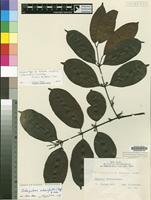
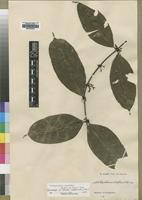
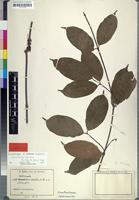
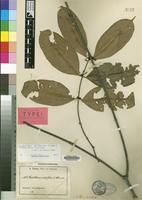
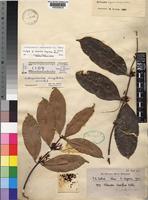
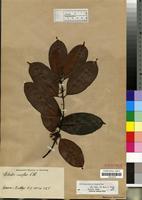
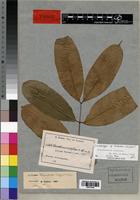
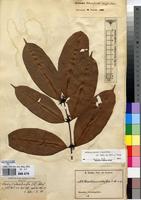
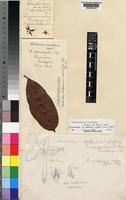
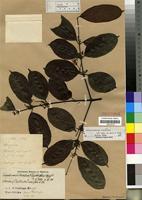
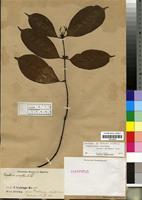
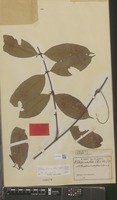
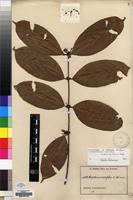
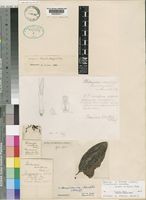
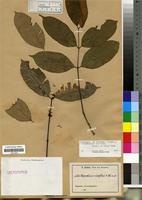
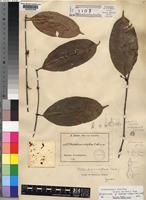
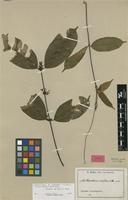
A climbing glabrous shrub with flagelliform tendrils from the branch-forks; young branches slender, reddish-brown or fuscous, with inconspicuous minute lenticels. Leaves oblong-elliptic, abruptly acuminate (acumen linear, obtuse, 3–6 lin. long), subcuneate or obtuse at the base, 4–5 in. long, 2–2 1/4 in. broad, thinly coriaceous, margins almost flat; midrib slightly sunk above, raised beneath; secondary nerves fine, 4–6 to an inch, with still finer, parallel tertiary ones between them, all slightly raised on both sides; veins obscure beneath; a distinct outer marginal nerve running close to the margin (apart from the inner, which consists of the arches connecting the lateral nerves); petiole 3 1/2–6 lin. long, rather stout. Cymes glabrous, 6- or more flowered, as long as the petioles or slightly longer; bracts minute; pedicels up to 1 1/2 lin. long. Calyx 1/2 lin. long, glabrous; sepals ovate, subacute or obtuse, ciliolate. Corolla white, glabrous without; tube slender, subcylindric, slightly widened just above the base, 3–4 lin. long; lobes linear, subacute, 3–5 1/2 lin. long. Stamens inserted close to the base; filaments very short; anthers cordate-oblong, acute. Ovary glabrous, globose, gradually passing into, or more or less distinct from, the cylindric style, about 1/4 lin. long; stigma clavate, slightly shorter than the style. Ovules in 2 series of 4 each. Second or outer marginal nerve sometimes indistinct or absent. Peduncle rarely minutely pubescent. Ovary sometimes with a few hairs in the upper part; ovules 16–20 in 4 rows in each carpel (not 8 in 2 rows as stated on p. 67). Fruit ovoid, about 3 in. long, truncate at the top; pericarp smooth, crustaceous (when dry). Seeds numerous, irregularly ovoid or ellipsoid, angular, 7–8 lin. long.